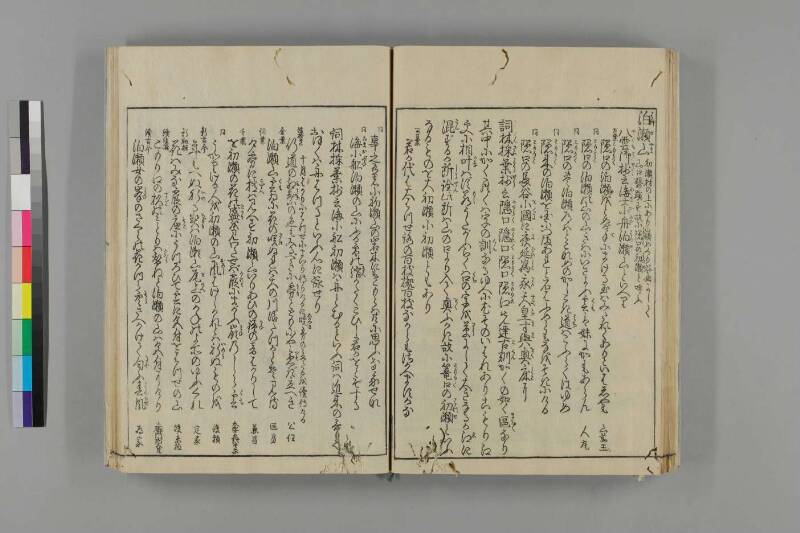
翻刻
【コマ195】
【右丁】
泊瀬山(はつせやま)《割書:初瀬村の上にあり嶺めくり谷幽にして|山口翳蹊す故に隠口(こもりく)の初瀬(はつせ)と呼ふ》
八雲御抄(やくもみせう)云 海士(あま)小舟(おふね)泊瀬山(はつせ )といへり
《割書:万葉》
隠口(こもりく)の泊瀬をとめが手(て)にまける玉はみたれてありといはしやも 山前王
《割書:同》
隠口(こもりく)の泊瀬の山の山きはにいさよふ雲(くも)は妹にかもあらん 人丸#1
《割書:同》
隠口(こもりく)の豊泊瀬道はとこなめのかしこき道(みち)はこふらくはゆめ
《割書:同》
隠來(こもりく)の泊瀬を国につまあれと石はふめともなをそきにける
《割書:同》
隠口(こもりく)の長谷 小國(をくに)に夜延為(よばひして)我(わか)天皇寸與(すべらきよ)奥床(おくとこ)に
詞林採葉抄(しりんさいようせう)云 隠口(かくらく)隠口(かくれく)隠口(こもりく)隠江(こもりゑ)先達 古訓(こくん)かくの如く區(まち〳〵)なり
其中にかくらくは字の訓(くん)なるゆへに尤そのいはれありこもり江
更に相 叶(かな)はず若(もし)うたがふらくは口(くち)の字を草(さう)にして大きなるか江(ゑ)に
混(こん)ずるか所詮(しよせん)此所は山の口より入て奥(おく)ふかき故に篭口(こもりく)の初瀬(はつせ)といふ
なるものを大初瀬小初瀬ともあり
《割書:万葉》
君か代は大はつせ路の百枝槻#2百枝なからもさかへますかな
【左丁】
《割書:同》
事し有は小初瀬山の岩木にもこもらは共に思ふな我せな
《割書:同》
海小舟(あまおぶね)泊瀬の山にふる雪の消(きへ)かたくこひし君かをとそする
詞林採葉抄云海小舩初瀬は舟とむるといふ詞は近來の哥也
おほくは舟はつるといふ心に詠せり
《割書:後拾遺 十月はかりにはつせにまいり侍りけるに暁(あかつき)霧の立たるを讀侍ける》
行道の紅葉(もみち)の色もみるべきに霧(きり)とともにや急(いそ)ぎ立へき 公任
《割書:金葉》
泊瀬山 雲(くも)ゐに花の咲(さき)ぬれは天の川浪たつかとそ見る 匡房
《割書:詞葉》
夕霧に梢(こずへ)は見へす初瀬山いりあひの鐘(かね)の音はかりして 兼昌
《割書:千載》
を初瀬の花の盛(さかり)を見わたせば霞(かすみ)にまがふ嶺(みね)のしら雲(くも) 大宰大弐重家
《割書:同》
うかりける人を初瀬の山颪( おろし)はけしかれとは祈(いのら)ぬものを 俊頼
《割書:新古今》
年もへぬ祈(いの)る契(ちぎり)は泊瀬山 尾上(をのへ)のかねのよ所のゆふくれ 定家
《割書:新勅撰》
花はみな霞の底(そこ)にうつろひて雲に色付をはつせの山 後京極
《割書:續後撰》
こもり江の杦(すぎ)のみとりは替(かわら)ねと泊瀬の山は色付にけり 土御門内大臣
《割書:續古今》
泊瀬女の峯(みね)のさくらの花かつら空(そら)さへかけて匂(にほ)ふ春風(はるかぜ) 為家
現代語訳
【コマ195】
【右丁】
**泊瀬山(はつせやま)**
〔割注:初瀬村の上にある山で、尾根が巡り谷は幽深で、山の入り口が木々に鬱蒼と覆われているため、「隠口(こもりく)の初瀬(はつせ)」と呼ばれる。〕
『八雲御抄』に「海士小舟(あまおぶね)泊瀬山(はつせやま)」と詠まれているとある。
〔万葉集より〕
隠口の泊瀬の乙女が手に巻ける玉は乱れてあると言わしやも 山前王
〔同〕
隠口の泊瀬の山の山際にたゆたう雲は妹(いも)にかもあらん 柿本人麻呂
〔同〕
隠口の豊泊瀬道はとこなめの畏(かしこ)き道は恋うらくは夢
〔同〕
隠来の泊瀬を国に妻あれど石は踏めどもなおぞ来にける
〔同〕
隠口の長谷の小国に夜這いして我が天皇(すべらき)よ奥床(おくとこ)に
『詞林採葉抄(しりんさいようしょう)』に言う:「隠口(かくらく)・隠口(かくれく)・隠口(こもりく)・隠江(こもりえ)」と先人たちの古い訓み(よみ)はこのようにさまざまである。その中で「かくらく」は文字の訓(くん)から来るものであるため、とりわけ由来があるといえる。「こもりえ(隠江)」については、どうにも意味が合わない。もしや疑わしいのは、「口」の字を草書(くずし字)で書いた時に、大きな「江(え)」の字と混同されることによるものであろうか。要するに、この地は山の入り口から入って奥深いところにあるため、「篭口(こもりく)の初瀬」と呼ぶのである。また「大初瀬(おおはつせ)・小初瀬(こはつせ)」という呼び方もある。
〔万葉集より〕
君が代は大初瀬路の百枝槻(ももえつき)百枝ながらも栄えますかな
---
【左丁】
〔同〕
事しあらば小初瀬山の岩木にも籠らば共に思うな我が背な
〔同〕
海人小舟(あまおぶね)泊瀬の山に降る雪の消えがたく恋し君が音(おと)ぞする
『詞林採葉抄』に言う:「海人小舟(あまおぶね)初瀬」とは、舟を留める(泊める)という意の詞は近年の歌のいい方である。多くの場合は「舟を放つ(はつる)」という意味に詠まれていた。
〔後拾遺集。十月ごろに初瀬に参詣した折、夜明け前に霧が立っているのを詠んだ歌。〕
行く道の紅葉の色も見るべきに霧とともにや急ぎ立つべき 藤原公任(ふじわらのきんとう)
〔金葉集より〕
泊瀬山 雲居に花の咲きぬれば天の川浪立つかとぞ見る 大江匡房(おおえのまさふさ)
〔詞葉(新撰朗詠集など)より〕
夕霧に梢(こずえ)は見えず初瀬山 入り合いの鐘の音ばかりして 藤原兼昌(ふじわらのかねまさ)
〔千載集より〕
をはつせの花の盛りを見渡せば霞にまがう嶺のしら雲 大宰大弐重家(だざいだいにしげいえ)
〔同〕
うかりける人を初瀬の山颪(やまおろし)激しかれとは祈らぬものを 源俊頼(みなもとのとしより)
〔新古今集より〕
年も経ぬ祈る契りは泊瀬山 尾上の鐘の夜(よ)そのゆふぐれ 藤原定家(ふじわらのさだいえ)
〔新勅撰集より〕
花はみな霞の底に移ろいて雲に色付く初瀬の山 後京極摂政(ごきょうごくせっしょう・藤原良経)
〔続後撰集より〕
籠り江の杉の緑は変わらねど泊瀬の山は色付きにけり 土御門内大臣(つちみかどのないだいじん)
〔続古今集より〕
泊瀬女(はつせめ)の峯の桜の花かつら空さへかけて匂う春風 藤原為家(ふじわらのためいえ)
英語訳
【Folio 195】
【Right page】
**Hatsuse-yama (Mount Hatsuse)**
[Interlinear note: This mountain lies above Hatsuse village. Its ridges wind about and its valleys are deep and secluded; the mouth of the mountain entrance is densely shaded by trees, and so it is called *Komori-ku no Hatsuse* ("Hatsuse of the hidden hollow/enclosed entrance").]
The *Yakumo Mishō* (an imperial poetic treatise) cites the phrase "Ama-obune Hatsuse-yama" (the diver's small boat / Mount Hatsuse) as a poetic usage.
[From the *Man'yōshū*:]
The jewels strung upon the hand of the maiden of Hatsuse of the hidden hollow — do you say they lie scattered? Prince Yamasaki no Ōkimi
[Same:]
At the mountain's edge of Hatsuse-yama of the hidden hollow, the drifting cloud — could it be my beloved? Kakinomoto no Hitomaro
[Same:]
The road through abundant Hatsuse of the hidden hollow, smooth as *tokoname* (a creeping vine) — the awe-inspiring road: longing for it is like a dream.
[Same:]
Though I have a wife in the land of Hatsuse of the hidden hollow, and stones press upon my feet, still I came.
[Same:]
Calling upon my beloved in the small province of Hase of the hidden hollow, our sovereign — in the innermost bedchamber…
The *Shirinsa'yōshō* (a commentary on poetic diction) states: The old readings of [the epithet written as 隠口] include *kakuraku*, *kakureku*, *komori-ku*, and *komori-e* — the ancient glosses of earlier scholars vary in this manner. Among these, *kakuraku* has the best etymological grounding as it represents a direct reading of the characters. *Komori-e* ("hidden inlet/harbor"), however, does not seem fitting at all. One suspects that this may be a case of the character 口 (*kuchi*, "mouth") written in cursive script being confused with the larger character 江 (*e*, "inlet"). In any case, this place is so named *komori-ku no Hatsuse* ("Hatsuse of the hidden-mouth valley") because one enters through the mountain's mouth and the interior is deep. There are also the designations *Ō-Hatsuse* (Great Hatsuse) and *Ko-Hatsuse* (Lesser Hatsuse).
[From the *Man'yōshū*:]
May your reign be like the zelkova tree of the Great Hatsuse road — long-lived with its hundred branches, flourishing through all those hundred branches!
---
【Left page】
[Same:]
Should something befall me, even if I were to hide among the trees and rocks of Ko-Hatsuse-yama — do not grieve for me, my beloved.
[Same:]
Like the snow that falls on Hatsuse-yama from the diver's small boat, slow to melt — I hear the sound of my beloved, whom I long for so deeply.
The *Shirinsa'yōshō* states: The phrase "diver's small boat / Hatsuse" (*ama-obune Hatsuse*), used as a *kakekotoba* (pivot word) on the meaning of "a boat stopping (*tomaru*)" is a usage found in more recent poetry. In earlier times, it was more commonly composed with the sense of "a boat setting loose/departing (*hatsuru*)."
[From the *Goshūishū*. Composed upon visiting Hatsuse around the tenth month, when mist was rising before dawn:]
The colors of the autumn leaves along my path were worth seeing — yet must I hasten off together with the mist? Fujiwara no Kintō
[From the *Kin'yōshū*:]
At Hatsuse-yama, the blossoms blooming up among the clouds — it looks as though waves are rising on the Milky Way. Ōe no Masafusa
[From the *Shi'yōshū* (or similar anthology):]
In the evening mist the treetops are hidden from sight at Hatsuse-yama — only the sound of the vesper bell is heard. Fujiwara no Kanemasa
[From the *Senzaishū*:]
Gazing out over the full bloom of cherry blossoms at Hatsuse — the white clouds upon the peaks blend indistinguishably with the haze. Dazai no Daini Shigeie
[Same:]
I never prayed that the mountain wind of Hatsuse would blow cruelly upon that cold-hearted one — yet here I am, it seems. Minamoto no Toshiyori
[From the *Shin-Kokinshū*:]
Years have passed — my vow and prayer at Hatsuse-yama: the distant evening bell from the summit, in the twilight of the night. Fujiwara no Teika (Sadaie)
[From the *Shin-Chokusenshū*:]
All the blossoms have faded into the depths of the haze — the mountain of Hatsuse tinged with color in the clouds. Gokyo-goku Sesshō (Fujiwara no Yoshitsune)
[From the *Zoku-Gosenshū*:]
The cedar's green in the hidden inlet does not change — yet Hatsuse-yama has taken on its autumn hues. The Minister of the Interior, Lord Tsuchimikado
[From the *Zoku-Kokinshū*:]
The flower-garland of cherry blossoms on the peak of Hatsuse-me — even the sky itself is draped in fragrance on the spring breeze. Fujiwara no Tameie