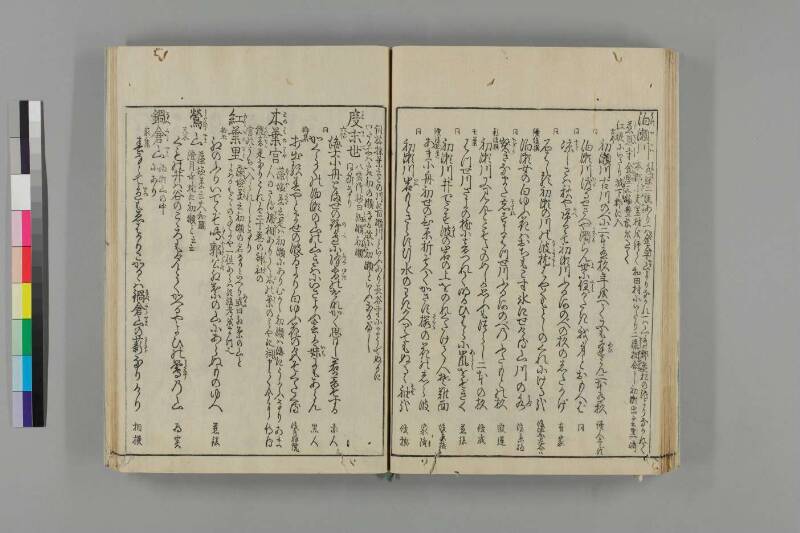
翻刻
【コマ197】
【右丁】
泊瀬川(はつせかは)《割書:水源(みなかみ)二流あり一は金(かね)ガ平山(ひらやま)よりなかれ一は山辺郡並松の池よりなかれて|本郡 小夫(をぶ)笠村(かさ )を経て和田村にいたり二流( りう)相合(あひがつ)し初瀬出雲黒﨑》
《割書:慈恩寺(じをんし)金屋(かなや)三輪豊前を過て|江堤にいたり城下郡(しきしも )に入》
《割書:古今》
初瀬川古川のべに二本有杦年をへて又も逢(あひ)みん二本有杦 讀人しらず
《割書:同》
泊瀬川 渡(わた)るせさへや濁(にごる)らん丗(よ)に住(すみ)がたき我身とおもへば 同
《割書:同》
涼(すゞ)しさは秋や帰(かへ)りて初瀬川ふる河のべの杦のしたかげ 有家
《割書:同》
石はしる初瀬の川の波枕(なみまくら)はやくもとしのくれにける哉 後徳大寺㔫大臣
《割書:續後撰》
泊瀬女の白ゆふ花はおちもこす氷にせける山川の水(みづ) 後京極
《割書:同》
《振り仮名:𭑕|ちぎり》きなまた忘(わすれ)すよはつせ川ふる河のべのふたもとの杦 寂蓮
《割書:新後撰》
初瀬川又見んとこそたのめしか思ふもつらし二本の杦 俊成
《割書:玉葉》
はつせ川さよの枕に音つれて明るひはらに嵐(あらし)をぞきく 慈鎮
《割書:同》
初瀬川井でこす波(なみ)の岩の上をのれくたけて人ぞ難面 後京極
《割書:續後拾遺》
あま小舟初せのひ原折そへてかさす桜(さくら)の花のしら波 家隆
《割書:同》
初瀬川 岩(いは)もとさらす行水のわきかへりてもぬるゝ袖(そで)哉 俊頼
【左丁】
《割書:詞林採葉云この川に百瀬川といふあり長谷寺にまうでぬるに|わたる所は最初の瀬なる故に初瀬といふなるべし》
度末世(とませ)《割書:八雲御抄曰 泊瀬(とませ)初瀬(はつせ)|同所なり》
《割書:六帖》
海士小舟とませの野辺(のべ)に降雪(ふるゆき)のけなかく思ほし君か音そする 赤人
《割書:同》
かくらくの泊瀬の山の山きはにいさよふ雲は妹(いも)にもあらん 黒人
《割書:御集》
打出る春やとませの波間より白ゆふ花の色そくたくる 後鳥羽院
木葉宮(このはのみや)《割書:藻塩草(もしほくさ)云是は初瀬にありむかし初瀬は海にうかふなりあま|人のさる瑞相(ずいさう)ありて木(こ)の葉(は)のみやに祠(やしろ)申て今に侍る》
《割書:観音(くはんをん)是なりこれは二十巻の神社(しんしや)の|宮のうちへ入られしとなり》
紅葉里(もみぢのさと)《割書:藻塩草(もしほくさ)云初瀬の名なりといへり或(あるか)曰紅葉の山と|よめるもこゝの事にや一往あらはす後考をまつ也》
《割書:拾玉》
紅のふりいでゝぞ鳴(なく)郭公(ほとゝぎす)紅葉の山にあらぬものゆへ 慈鎮
鶯山(うぐひすやま)《割書:藻塩草云大和國|澄月哥枕に初瀬と云云》
《割書:夫木》
くもの井は谷のこゝろも夕とてかへるやよひの鶯(うくひす)の山 為実
鍋倉山(なへくらやま)《割書:泊瀬山の中|にあり》
《割書:家集》
春ならて色(いろ)もゑはかりこかるゝは鍋倉山(なべくらやま)の薪(たきゞ)なりけり 相模
現代語訳
## 【コマ197】
### 【右丁】
**泊瀬川**(はつせがわ)
〔割書:水源には二流あり。一つは金ヶ平山より流れ、一つは山辺郡並松の池より流れて、本郡の小夫・笠村を経て和田村に至り、二流が合流し、初瀬・出雲・黒崎・慈恩寺・金屋・三輪・豊前を過て、江堤に至り、城下郡(しきしもこおり)に入る。〕
---
**古今集より**
初瀬川よ、古い川辺に二本の杉が立っている。長い年月を経て、またも逢うことができようか、あの二本の杉に。 読人しらず
**同(古今集)より**
泊瀬川を渡る瀬でさえも濁ることだろうか。この世に住みにくい我が身であることを思えば。 読人しらず
**同(古今集)より**
涼しさは秋がまた戻ってきたのであろうか。初瀬川よ、古い川辺の杉の木陰よ。 有家
**同(古今集)より**
岩を走る初瀬の川の波を枕として、早くも年の暮れになってしまったことよ。 後徳大寺左大臣
**続後撰集より**
泊瀬女の白木綿花は散りもせず、氷のように冷え固まった山川の水の中に浮かんでいる。 後京極
**同(続後撰集)より**
契りをきたまま、また忘れずにいよう。初瀬川よ、古い川辺にある二本の杉よ。 寂蓮
**新後撰集より**
初瀬川よ、またいつか逢えることを信じていたのに、思えば辛い、あの二本の杉よ。 俊成
**玉葉集より**
初瀬川よ、夜の枕元に川音が訪れて、夜明けの日原(ひはら)に嵐の音を聞くことよ。 慈鎮
**同(玉葉集)より**
初瀬川よ、堰を越えて流れる波が岩の上で砕け散るように、私もくじけて、人に会いにくいことよ。 後京極
**続後拾遺集より**
海士の小舟よ。初瀬の日原で折り添えて、翳すように広がる桜の花の白波よ。 家隆
**同(続後拾遺集)より**
初瀬川よ、岩の根元をさらして流れる水が沸き返るように、私の涙でも袖が濡れることよ。 俊頼
---
### 【左丁】
〔割書:「詞林採葉」に言う。この川には百瀬川というものがあり、長谷寺に参詣するのに渡る所が最初の瀬であるために「初瀬」というのであろう。〕
**度末世(とませ)**
〔割書:「八雲御抄」に曰く、「泊瀬(とませ)」と「初瀬(はつせ)」は同じ場所である。〕
**六帖より**
海士の小舟よ、度末世の野辺に降る雪のように、(あなたへの思いが)消えずに長く思われる君の声がする。 赤人
**同(六帖)より**
かくらくの泊瀬の山の、山の際にたゆたう雲は、きっと愛しい妹(いも)ではあるまいか。 黒人
**御集より**
打ち出る春よ、度末世の波間から白木綿花の色が輝き出ることよ。 後鳥羽院
---
**木葉宮(このはのみや)**
〔割書:「藻塩草」に言う。これは初瀬にあり、昔、初瀬は海に浮かんでいた。海人に何らかの瑞相(めでたい兆し)があって、木の葉の宮に祠を建て申して今に至っている。〕
〔割書:観音がこれにあたり、これは二十巻の神社の宮の中へ入られたとのことである。〕
---
**紅葉里(もみじのさと)**
〔割書:「藻塩草」に言う。初瀬の別名であるといわれる。あるいは、「紅葉の山」と詠まれているのもここのことであろうか。一応ここに記しておき、後の考証を待つ。〕
**拾玉集より**
紅色を振り出して鳴く郭公(ほととぎす)よ。紅葉の山でないものゆえ(に、鳴くのだろうか)。 慈鎮
---
**鶯山(うぐいすやま)**
〔割書:「藻塩草」に言う、大和国。「澄月歌枕」に初瀬とある。〕
**夫木集より**
雲の井(泉)は谷の心も夕暮れとして、帰ってゆく弥生の鶯の山よ。 為実
---
**鍋倉山(なべくらやま)**
〔割書:泊瀬山の中にある。〕
**家集より**
春でもないのに、あのように焦がれる色を見せるのは、鍋倉山の薪(たきぎ)であることよ。 相模
英語訳
## 【Frame 197】
### 【Right Page】
**The Hatsuse River** (泊瀬川)
[Annotation: The river has two sources. One flows from Kanegahirayama, and the other from Naramitsu Pond in Yamabe District. They flow through Obu and Kasa villages in this district, converge at Wada village, and pass through Hatsuse, Izumo, Kurosaki, Jionji, Kanaya, Miwa, and Buzen, reaching Edote and entering Shikishimo District.]
---
**From the Kokinshū:**
At Hatsuse River, on the ancient riverbank, two cedar trees stand. After all these years, can I meet them again—those two cedar trees? Anonymous
**From the same collection (Kokinshū):**
Even the ford I cross at Hatsuse River must grow turbid—for I think of myself as one who finds this world so hard to dwell in. Anonymous
**From the same (Kokinshū):**
Has autumn's coolness returned once more? O Hatsuse River—in the shade of the cedars along the ancient riverbank. Arlie (有家)
**From the same (Kokinshū):**
Resting on pillows of waves from Hatsuse River as it rushes over the rocks—and already the year has drawn to its close. Gotokudaiji no Sadaijin (後徳大寺左大臣)
**From the Zoku Gosen Shū:**
The white yū-flowers of the Hatsuse maidens—they do not fall, but float in the mountain stream's waters, frozen like ice. Gokyōgoku
**From the same (Zoku Gosen Shū):**
I pledged my vow and shall not forget—O Hatsuse River, those two cedar trees along the ancient bank. Jakuren
**From the Shin Gosen Shū:**
I had trusted that I would see the Hatsuse River once more—yet how painful it is now to think of those two cedar trees. Shunzei (俊成)
**From the Gyokuyō Shū:**
O Hatsuse River—your sound visits my pillow in the night, and at the break of day, in Hihara, I hear the storm winds blow. Jichin (慈鎮)
**From the same (Gyokuyō Shū):**
Like the waves of Hatsuse River that leap over the weir and shatter upon the rocks—so too do I break, finding it so hard to face others. Gokyōgoku
**From the Zoku Goshūi Shū:**
O little fishing boat—at Hatsuse's Hihara, bending cherry blossoms to shade us: white waves of cherry flowers. Ietaka
**From the same (Zoku Goshūi Shū):**
O Hatsuse River—washing bare the roots of the rocks, the rushing water swells and turns back upon itself, and so too do my sleeves grow wet with tears. Toshiyori (俊頼)
---
### 【Left Page】
[Note: The *Shirin Saiyō* states: "There is a river called Momose-gawa in this area. Since the place where one crosses when visiting Hase-dera temple is the very first ford, it is called 'Hatsuse' (first ford)."]
**Tomase** (度末世)
[Note: The *Yakumo Mishō* states: "Tomase" (泊瀬) and "Hatsuse" (初瀬) refer to the same place.]
**From the Kokinrokujō:**
O little fishing boat—like the snow falling upon the fields of Tomase, your voice reaches me, long-remembered and not forgotten. Akahito (赤人)
**From the same (Kokinrokujō):**
At kakuraku—on Tomase Mountain of Hatsuse, the clouds that linger at the mountain's edge must surely be my beloved. Kurohito (黒人)
**From the Imperial Collection (御集):**
Spring bursts forth—and from between the waves at Tomase, the color of the white yū-flowers blazes brilliantly. Emperor Gotoba (後鳥羽院)
---
**Konoha no Miya** (木葉宮, "Shrine of Tree Leaves")
[Note: The *Moshiogusa* states: "This is located at Hatsuse. In ancient times, Hatsuse floated upon the sea. A fisherman received a certain auspicious omen, and a shrine was built at the Shrine of Tree Leaves, which continues to this day."]
[Note: This corresponds to Kannon (the Bodhisattva of Compassion), and it is said that this deity was enshrined within the halls of the shrines recorded in the twenty-volume collection.]
---
**Momiji no Sato** (紅葉里, "Village of Autumn Leaves")
[Note: The *Moshiogusa* states: "It is said to be another name for Hatsuse. Perhaps what is composed as 'the mountain of autumn leaves' also refers to this place. This is noted provisionally here, awaiting further scholarly inquiry."]
**From the Jūgyoku Shū:**
Scattering crimson hues, the cuckoo calls—since this is not the mountain of autumn leaves, why does it sing so? Jichin
---
**Uguisu-yama** (鶯山, "Warbler Mountain")
[Note: The *Moshiogusa* states: "Yamato Province." The *Chōgetsu Utamakura* lists it as Hatsuse.]
**From the Fuboku Shū:**
Even the spring of clouds in the valley feels like evening—and the warbler's mountain of the third month, as the bird returns home. Tamezan (為実)
---
**Nabekurayama** (鍋倉山)
[Note: Located within Tomase Mountain.]
**From a personal poetry collection (家集):**
Though it is not spring, to burn with such color—it is none other than the firewood of Nabekurayama. Sagami (相模)