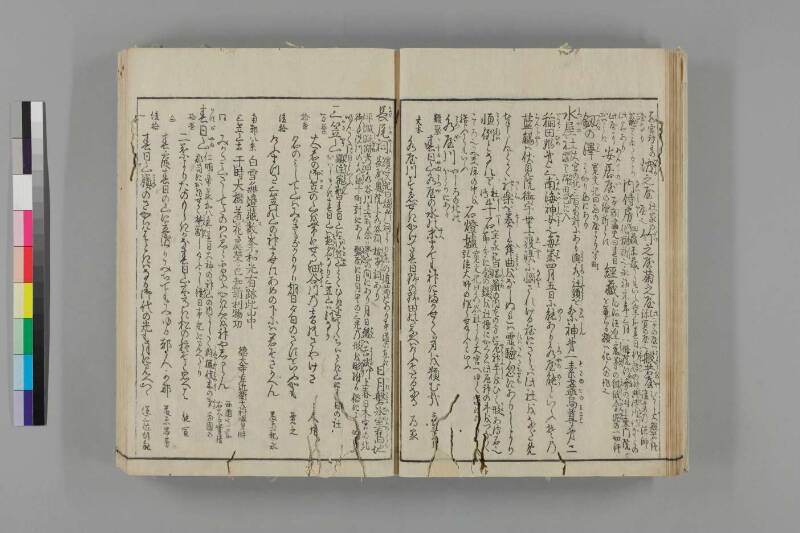
翻刻
【コマ22】
【右丁】
《割書:若宮神主の|屋なり》渡之屋(わたり )《割書:社家の|屋也》竹之屋(たけ )菊之屋《割書:此二ヶの屋は|祢冝の屋也》般若屋(はんにやのや)《割書:むかし大般若經|講書の法師》
《割書:籠(こも)り居たるより|此名あり》内侍房(ないしほう)《割書:細藏赤藏ともいふ皇后春日 行啓(きやうけい)の时 典侍(すけ)内侍(ないし)なとの|化粧所(けしやうしよ)也永祚元年三月一條院 行幸(みゆき)の时上東門院》
《割書:此屋に|おはしき》安居屋(あんごのや)《割書:本朝畵史曰春日|の繪所とす》經藏《割書:白河法皇 宸筆(しんひつ)の紺紙金泥(こんしきんでい)の一切經|を篭らる額(かく)は化人の作也》
《振り仮名:釼の澤|つるぎ さは》《割書:寛文記曰西の屋より半町|はかり西にあり》
水屋社(みつやの )《割書:大宮の北三百歩計にあり澗水(たにみつ)社頭(しやとう)を|遶(めぐ)り野田邑(のだむら)に入》祭神(さいしん)㐧一 素盞烏尊(そさのをのみこと)㐧二
稲田姫(いなだひめ)㐧三 南海神女(なんかいしんによ)也 毎歲(まいさい)四月五日に能(のう)あり水屋能(みつやののう)といふその
藍觴(らんじやう)#1は伏見院御宇世上 疫疾(ゑやみ)に惱(なやま)されける程にさらば此社をなだめ
奉らんとて神樂(かくら)を奏(そう)し舞曲(ふきよく)をなしぬれは霊驗(れいげん)忽(たちまち)にありしより
恒例(こうれい)となれり《割書:社|傳》牛石(うしいし)《割書:宝永記曰 瑞籬(みつかき)の内㔫の方に厄神(やくしん)牛(うし)をひく形(かたち)ある石也|節分に金(かね)の鎻(くさり)を社檀にかくるは此厄神の牛をつなく》
《割書:こゝろ也又夫婦の中を|結ぶともいふ》石燈壚《割書:寛文記曰水谷社より大宮へゆく道にあり|弘法大師の作らせ給ふといふ》
水屋川(みつや )《割書:やしろの北の|ほとりにあり》
《割書:類聚》春日山(かすがやま)水屋(みつや)の水の末(すへ)まても神にまかせて身を頼む哉 衣笠大臣
《割書:夫木》水屋川すゑせきかけて春日野の野田のさなへはけふそとるなる 為家
【左丁】
長尾祠(ながおのやしろ)《割書:寛文記曰 祓戸祠(はらひと )より東の道端にあり本道の東に|長尾奥院(ながををくの )上水谷祠 祓本祠(はらひもとの )あり》《振り仮名:日月磐氷室𦾔地|ひつきはんひむろのきうぢ》
《割書:平城趾跡考( しせき )曰水谷川上六町余東山の間にあり月日磐( はん)は《振り仮名:𠮷城川|よしきの 》上春日本宮の北|御手洗川(みたらし )の水源(みなもと)十町計にあり盤面(はんめん)に日月星の三光の形(かたち)を彫(ほり)附る俗に其地を|呼んて月日といふ》
三笠山( かさやま)《割書:顕注密勘(けんちうみつかん)曰春日山に御笠山(みかさやま)とてひき下りてちいさきやまに春日の社|おはします春日山は惣名(そうめう)なり三笠山は別(へち)なり》
《割書:万葉》大君の御笠(みかさ)の山を帯にせる細谷川(ほそたに )の音のさやけさ 人丸
《割書:拾遺》名のみして山はみかさもなかりけり朝日夕日のさすをいふかも 貫之
《割書:後拾》けふまつる三笠の山の神ませはあめの下には君そさかへん 藤原範永
《割書:南都八景|三笠山雪》白雪無邉藏 ̄ス_二數峯 ̄ヲ_一和光有_レ跡此山中
于_レ時大樹着 ̄ス_レ花處榮色知_レ新利物㓛 德大寺左近衛大將實時
《割書:同》 みかさ山さしてたのめはしら雪のふかき心を神やしるらん 《割書:西園寺前|右大臣實俊》
春日山(かすがやま)《割書:仁明帝𣴎和八年春日大神の神山の内にして狩猟伐木(しゆりやうはつもく)の事(こと)當國の|郡司におほせて禁制(きんせい)し給ふよし續日本紀(ぞく )に見へたり》
《割書:拾遺》二葉よりたのもしきかな春日山木高き松の種そと思へは 能宣
《割書:仝 》春霞春日の山に立渡りみちてもみゆる都人かな 藤原忠房
《割書:後拾》春日山 嶺(みね)のさかきはときはなる御代の光も月に見へつゝ 従三位行能
現代語訳
【右丁】
(三大社之屋は)**若宮神主の屋である**。
**渡之屋**(社家の屋である)
**竹之屋**・**菊之屋**(この二つの屋は祢宜の屋である)
**般若屋**(昔、大般若経の講書を行う法師が籠り居たことからこの名がある)
**内侍房**(細蔵・赤蔵ともいう。皇后が春日へ行啓の時、典侍・内侍などの化粧所である。永祚元年〔989〕三月、一条院が行幸の時、上東門院がこの屋においでになった)
**安居屋**(『本朝画史』によれば、春日の絵所とする)
**経蔵**(白河法皇宸筆の紺紙金泥の一切経を納める。額は化人の作である)
**剣の沢**(寛文記によれば、西の屋より半町ほど西にある)
---
**水屋社**(大宮の北三百歩ほどのところにある。渓流が社頭をめぐり、野田村へと流れ入る)
祭神:第一、素盞嗚尊(すさのをのみこと)、第二、稲田姫(いなだひめ)、第三、南海神女(なんかいのしんにょ)
毎年四月五日に能があり、「水屋能」という。その濫觴(はじまり)は、伏見院の御代に、世の中が疫病に悩まされていた折に、「ならばこの社をお慰め申し上げよう」とて神楽を奏し舞曲をなしたところ、霊験がたちまち現れたことから恒例となった。(社伝による)
**牛石**(宝永記によれば、瑞垣の内、北の方に厄神が牛を引く形をした石がある。節分に金の鎖を社壇にかけるのは、この厄神の牛をつなぐ意味である。また夫婦の仲を結ぶともいう)
**石灯籠**(寛文記によれば、水谷社より大宮へ行く道にある。弘法大師がお作りになったという)
**水屋川**(社の北のほとりにある)
(類聚より)
春日山 水屋の水の 末までも 神にまかせて 身を頼む哉 衣笠大臣
(夫木より)
水屋川 末せきかけて 春日野の 野田のさなへは けふぞ取るなる 為家
---
【左丁】
**長尾祠**(寛文記によれば、祓戸祠より東の道端にある。本道の東に長尾奥院・上水谷祠・祓本祠がある)
**日月磐・氷室旧地**
(『平城址跡考』によれば、水谷川上流六町余り、東山の間にある。月日磐は吉城川上流、春日本宮の北、御手洗川の水源から十町ほどのところにある。盤面に日・月・星の三光の形を彫り付けてある。俗にその地を「月日」と呼ぶ)
---
**三笠山**(『顕注密勘』によれば、春日山に御笠山というなだらかで小さな山があり、そこに春日の社がおわします。春日山は総称であり、三笠山は別の名称である)
(万葉集より)
大君の 御笠の山を 帯にせる 細谷川の 音のさやけさ 人丸
(拾遺集より)
名のみして 山はみかさも なかりけり 朝日夕日の さすをいふかも 貫之
(後拾遺集より)
けふまつる 三笠の山の 神ませば あめの下には 君ぞさかえん 藤原範永
(南都八景「三笠山雪」より、漢詩)
白雪辺りなく数峯を蔵し 和光の跡あり此の山中
時に大樹花着くる処に 栄色新たなりと知る 利物の功 徳大寺左近衛大将実時
(同より、和歌)
みかさ山 さしてたのめば 白雪の 深き心を 神やしるらん 西園寺前右大臣実俊
---
**春日山**(仁明帝承和八年〔841〕、春日大神の神山の内において狩猟・伐木のことを当国の郡司に命じて禁制なさったよし、『続日本紀』に見えている)
(拾遺集より)
二葉より たのもしきかな 春日山 木高き松の 種ぞと思えば 能宣
(同より)
春霞 春日の山に 立ち渡り みちても見ゆる 都人かな 藤原忠房
(後拾遺集より)
春日山 嶺のさかきは ときはなる 御代の光も 月に見えつつ 従三位行能
英語訳
**[Right Page]**
(The Three Great Shrines Hall is) **the hall of the Wakamiya Chief Priest.**
**Watari no Ya (Crossing Hall)** (The hall of the shrine families)
**Take no Ya (Bamboo Hall)** · **Kiku no Ya (Chrysanthemum Hall)** (These two halls are the residences of the *negi* [junior priests])
**Hannya no Ya (Prajñā Hall)** (In former times, monks who lectured on the *Mahāprajñāpāramitā Sūtra* would seclude themselves here, and thus the name arose)
**Naishi-bō (Ladies' Chamber)** (Also called *Hosokura* [Narrow Repository] or *Akakura* [Red Repository]. This served as the dressing room for the *suke* (senior ladies-in-waiting) and *naishi* (ladies-in-waiting) when the Empress made an imperial visit to Kasuga. In the 3rd month of Eiso 1 [989], when Emperor Ichijō made an imperial visit, the Jōtōmon'in [Empress Shōshi] stayed in this building.)
**Ango no Ya (Summer Retreat Hall)** (According to the *Honchō Gashi* [History of Japanese Painting], this served as the painting studio of Kasuga Shrine)
**Kyōzō (Sutra Repository)** (The complete scriptures (*issaikyō*) written in gold on dark blue paper in the imperial brushwork of the Retired Emperor Shirakawa are stored here. The placard above the entrance is the work of a transformed being [*kejin*].)
**Tsurugi no Sawa (Sword Ravine)** (According to the Kanmon Records: Located about half a *chō* [approximately 55 meters] to the west of the Nishi no Ya)
---
**Mizuya Shrine** (Located approximately 300 paces to the north of the Great Shrine. A mountain stream encircles the shrine precincts and flows into the village of Noda.)
Deities enshrined: First, Susanoo no Mikoto; Second, Inadahime; Third, Nankai no Shinjo (the Divine Woman of the Southern Sea)
Every year on the 5th day of the 4th month, a Noh performance is held, called the "Mizuya Nō." Its origin (*ranshō*) dates to the reign of Retired Emperor Fushimi, when the land was afflicted by an epidemic. Thinking to appease this shrine's deity, *kagura* sacred music was performed and dances were offered, whereupon divine efficacy immediately manifested, and it became an annual tradition. (According to shrine tradition)
**Ushiishi (Ox Stone)** (According to the Hōei Records: Inside the sacred fence, on the north side, there is a stone in the shape of a deity of misfortune (*yakushin*) leading an ox. The practice of hanging an iron chain on the shrine altar at *Setsubun* [the seasonal turning point] symbolizes tying up this misfortune deity's ox. It is also said to bind together the relationship between husband and wife.)
**Stone Lantern** (According to the Kanmon Records: This stands on the road from Mizuya Shrine to the Great Shrine. It is said to have been made by Kōbō Daishi [Kūkai].)
**Mizuya River** (Located along the northern bank of the shrine)
(From the *Ruijū* [anthology]):
> *Spring of Kasuga — even to where the waters of Mizuya flow — I entrust my life to the care of the gods* — Kinugasa no Ōtodo (Minister Kinugasa)
(From the *Fuboku* [anthology]):
> *The Mizuya River — damming its waters downstream — in the fields of Kasuga — the seedlings of Noda — are being gathered today* — Tameie
---
**[Left Page]**
**Nagao Shrine** (According to the Kanmon Records: Located on the east side of the road from the Haraido Shrine. To the east of the main road are the Nagao Inner Sanctuary, the Upper Mizuya Shrine, and the Haraihonto Shrine.)
**Hitotsuki-iwa (Sun-Moon Rock) and Himuro Old Site**
(According to the *Heijō Shiseki Kō* [Study of Heijō Palace Ruins]: Located about six *chō* above the Mizuya River, in the area of the eastern mountains. The Hitotsuki-iwa is located about ten *chō* above the Yoshiki River, north of the Kasuga Hon-miya (original shrine), near the source of the Mitarashi River. The images of the sun, moon, and stars — the three luminaries — are carved into the surface of the rock. The local people call this place "Hitotsuki" [Sun and Moon].)
---
**Mikasayama (Mount Mikasa)** (According to the *Kenchū Mikkan* [a Heian-period poetic commentary]: At Kasugayama there is a gently sloping, small mountain called Mikasayama, and the Kasuga Shrine is situated there. "Kasugayama" is the general name, while "Mikasayama" is the specific name.)
(From the *Man'yōshū*):
> *The great sovereign's — Mount Mikasa serving as a sash — the sound of the narrow valley stream — how clear and bright it is!* — Hitomaro [Kakinomoto no Hitomaro]
(From the *Shūishū*):
> *Only the name exists — the mountain has no "mikasa" [august parasol] — or does it refer to where the morning and evening sun shines?* — Tsurayuki [Ki no Tsurayuki]
(From the *Goshūishū*):
> *Since the god of Mount Mikasa — whom we worship today is present — under the heavens — may you prosper and flourish!* — Fujiwara no Noriyoshi
(From the "Eight Views of the Southern Capital — Snow on Mount Mikasa," a Chinese poem):
> *Boundless white snow conceals the many peaks — traces of *wakō* [the softening of divine light] remain within this mountain*
> *When the great tree [the Shogun] puts forth blossoms — its glorious color tells us anew of the merit of benefiting beings* — Tokudaiji, Commander of the Left Imperial Guard, Sanetoki
(From the same, a waka poem):
> *Trusting in Mount Mikasa — as my sure support — does the god know — the deep sincerity — of the white snow that falls?* — Saionji, Former Minister of the Right, Sanetoshi
---
**Kasugayama (Mount Kasuga)** (In Jōwa 8 [841] of Emperor Nimmyō's reign, it is recorded in the *Shoku Nihongi* [Chronicles of Japan Continued] that hunting and logging within the sacred mountain of the Kasuga Great Deity were prohibited by imperial command issued to the provincial district officials.)
(From the *Shūishū*):
> *How promising! — even from its two tender leaves — Mount Kasuga — for I know it to be the seed — of a lofty pine* — Yoshinobu [Minamoto no Yoshinobu]
(From the same):
> *Spring haze — drifting and settling — over Mount Kasuga — filled to overflowing — with the sight of people from the capital* — Fujiwara no Tadafusa
(From the *Goshūishū*):
> *The sakaki tree — on the ridge of Mount Kasuga — is evergreen — the light of an eternal reign — shines too in the moon* — Junior Third Rank Yukinō