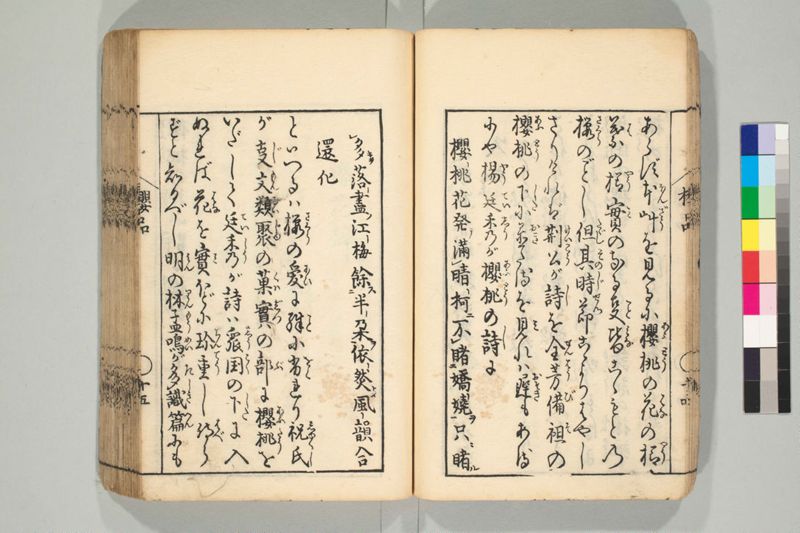
翻刻
【右丁】
あらず本艸(ほんざう)を見るに桜桃(あふとう)の花(はな)の様(やう)
葉(は)の様(やう)実(み)のなる事(こと)皆(みな)こゝもとの
桜(さくら)のごとし但(たゞし)其(その)時節(じせつ)こゝよりはやし
さりければ荊公(けいこう)が詩(し)を全芳(せんはう)備祖(びそ)の
桜桃(あふとう)の下(した)に置(おき)たるを見(み)れは遅(おそき)もある
にや楊廷秀(やうていしう)が桜桃(あふとう)の詩(し)に
桜-桃花発 ̄テ満_レ晴-柯 ̄ニ不_レ睹_二嬌-嬈 ̄ヲ_一只 ̄ニ睹 ̄ル
【左丁】
《返り点:レ》多 ̄キヲ落-尽 ̄ノ江-梅余 ̄ス_二半-朶 ̄ヲ_一依-然 ̄トス風-韻合
還化
といつるは桜(さくら)の愛(あひ)に殊(こと)に劣(をと)れり祝氏(しゆくし)
が事文(じもん)類聚(るいじゆ)の菓実(くはじつ)の部(ぶ)に桜桃(あふたう)を
いだして廷秀(ていしう)が詩は衆国(しうこく)の下(した)に入
ぬれば花(はな)を実(み)ほどに珍重(ちんてう)し侍(はべ)ら
ずと知るべし明(みん)の林孟鳴(りんもうめい)が多識篇(たしきへん)にも
現代語訳
【右丁】
そうではない。本草書を見ると、桜桃の花の様子、葉の様子、実のなることは、皆この土地の桜のようである。ただし、その時節はこちらよりも早い。そうであるから、荊公(王安石)の詩を『全芳備祖』の桜桃の項目の下に置いてあるのを見ると、遅く咲くものもあるのだろうか。楊廷秀の桜桃の詩に
桜桃の花が咲いて晴れた枝に満ちているが、その美しい姿を見ることはなく、ただ多くが
【左丁】
散り尽きているのを見るのみ。江梅は半分ほど残って、依然として風情があり調和している。
と詠んでいるのは、桜への愛においては特に劣っている。祝氏の『事文類聚』の果実の部に桜桃を挙げて、廷秀の詩を衆国の項目の下に入れているので、花を実ほどには珍重していないと知るべきである。明の林孟鳴の『多識篇』にも
英語訳
【Right page】
That is not so. Looking at herbals, the appearance of cherry-peach flowers, the appearance of leaves, and the bearing of fruit are all like the cherry blossoms of this place. However, their season is earlier than here. Therefore, when we see Jinggong's (Wang Anshi's) poem placed under the cherry-peach section in "Quanfang Beizu," perhaps there are some that bloom late. In Yang Tingxiu's poem on cherry-peach:
Cherry-peach flowers bloom and fill the sunny branches, but one does not see their charming beauty, only sees the many
【Left page】
that have fallen completely. The river plum retains half its blossoms, still harmonious in wind and charm.
This shows a particular inferiority in love for cherry blossoms. Master Zhu's "Shiwen Leiju" lists cherry-peach in the fruit section and places Tingxiu's poem under the various countries section, so we should understand that flowers are not treasured as much as fruit. Ming dynasty Lin Mengming's "Duoshi Pian" also