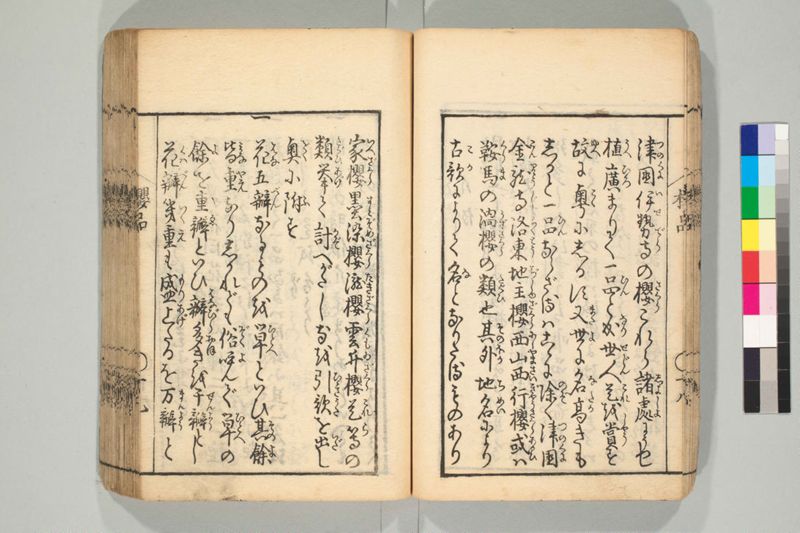
翻刻
【右丁】
津国(つのくに)伊勢寺(いせでら)の桜(さくら)これら諸処(しよしよ)にうつし
植(うへ)広(ひろ)まりて一 品(ひん)と成(なり)世人(せじん)是(これ)を賞(しやう)す
故(ゆへ)に粤(こゝ)にしるす又(また)世(よ)に名高(なたか)きも
しかと一 品(ひん)ならざるはこゝに除(のぞ)く津国(つのくに)
金竜寺(こんりうじ)洛東(らくとう)地主桜(ぢしゆざくら)西山(にしやま)西行桜(さいぎやうさくら)或(あるひ)は
鞍馬(くらま)の渦桜(うずさくら)の類(たぐひ)也 其(その)外(ほか)地名(ちめい)により
古歌(こか)によりて名(な)となりたるものあり
【左丁】
家桜(いへざくら)墨染桜(すみぞめざくら)滝桜(たきざくら)雲井桜(くもゐざくら)是等(これら)の
類(たぐひ)挙(あげ)て計(かぞ)へがたしなを引歌(ひきうた)を出(いだ)し
奥(をく)に附(ふ)す
一 花(はな)五 弁(べん)なるものを単(ひとへ)といひ其余(そのよ)
皆(みな)重(やえ)なりしかれども俗(ぞく)呼(よ)んで単(ひとへ)の
余(よ)を重弁(やゑ)といひ弁(はなびら)多(おほ)きを千弁(せんよう)とし
花弁(くはべん)幾重(いくえ)も盛上(もりあげ)たるを万弁(まんよう)と
現代語訳
【右丁】
摂津国伊勢寺の桜。これらは諸所に移し
植えられて広まり、一つの品種となって世人がこれを賞賛する
ゆえに、ここに記す。また世に名高くても
確かに一品種でないものはここでは除く。摂津国
金竜寺、洛東地主桜、西山西行桜、あるいは
鞍馬の渦桜の類である。その外、地名により
古歌によって名前となったものがある。
【左丁】
家桜、墨染桜、滝桜、雲井桜、これらの
類は挙げて数えがたい。なお引用歌を出し、
奥に付す。
一 花が五弁のものを単弁といい、その余は
皆重弁である。しかれども俗に呼んで単弁の
余を八重といい、花弁の多いものを千弁とし、
花弁が幾重にも盛り上がったものを万弁と
英語訳
【Right page】
The cherry of Isedera in Tsu Province. These have been transplanted
and spread to various places, becoming a single variety that people
admire, hence we record them here. Also, even if famous in the world,
those that are not clearly a single variety are excluded here: Tsu Province's
Konryuji, Rakutō Jishu-zakura, Nishiyama Saigyō-zakura, or
Kurama's Uzu-zakura and the like. Besides these, there are those
named after place names and ancient poems.
【Left page】
Ie-zakura, Sumizome-zakura, Taki-zakura, Kumoi-zakura—these
types are too numerous to count. Furthermore, we present quoted poems
and attach them at the end.
1 Flowers with five petals are called single (hitoe), and the rest
are all double. However, in common parlance, those beyond single
are called yaezaki (double), those with many petals are called senben (thousand petals), and
those with flower petals piled up in many layers are called manben (ten thousand petals)