翻刻
【右丁】
【図の説明】
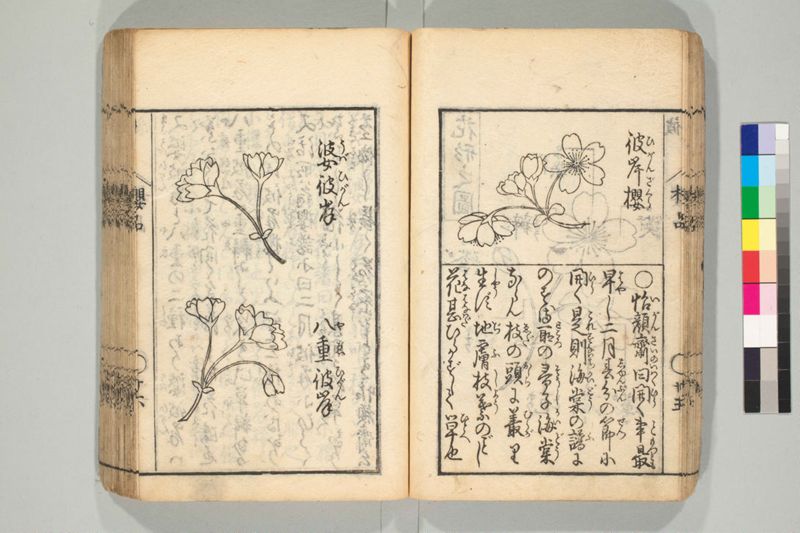
彼岸桜(ひがんざくら)
○怡顔斎(いがんさいの)曰(いはく)開(ひら)く事(こと)最(もつとも)
早(はや)し二月 春分(しゆんぶん)の節(せつ)に
開(ひら)く是(これ)則(すなはち)海棠(かいどう)の譜(ふ)に
のする所(ところ)の帚子(そうし)海棠(かいどう)
ならん枝(ゑだ)の頭(かしら)に叢(むらが)り
生(しやう)ず地膚(ぢふ)枝葉(しよう)のごとし
花(はな)甚(はなはだ)ひらかずして単(ひとへ)也
【左丁】
【図の説明】
婆彼岸(うばひがん)
八重彼岸(やゑひがん)
現代語訳
【右丁】
【図の説明】
彼岸桜(ひがんざくら)
○怡顔斎(松岡玄達)が言うには、開花することが最も早く、二月の春分の節に開く。これはすなわち海棠の図譜に記載されている帚子海棠であろう。枝の先端に群がって生じる。地膚子の枝葉のようである。花は非常に平たく開かずして一重である。
【左丁】
【図の説明】
婆彼岸(うばひがん)
八重彼岸(やえひがん)
英語訳
【Right page】
【Diagram explanation】
Higan cherry (Higan-zakura)
○Master Igansan (Matsuoka Gentatsu) says: This blooms earliest of all, opening during the vernal equinox period in the second month. This is likely the Sōshi-kaidō (broom-shaped begonia) recorded in begonia catalogs. The flowers cluster and grow at the tips of branches, resembling the branches and leaves of the kochia plant. The flowers do not open very flat and are single-petaled.
【Left page】
【Diagram explanation】
Uba-higan (Old woman Higan cherry)
Yae-higan (Double-petaled Higan cherry)