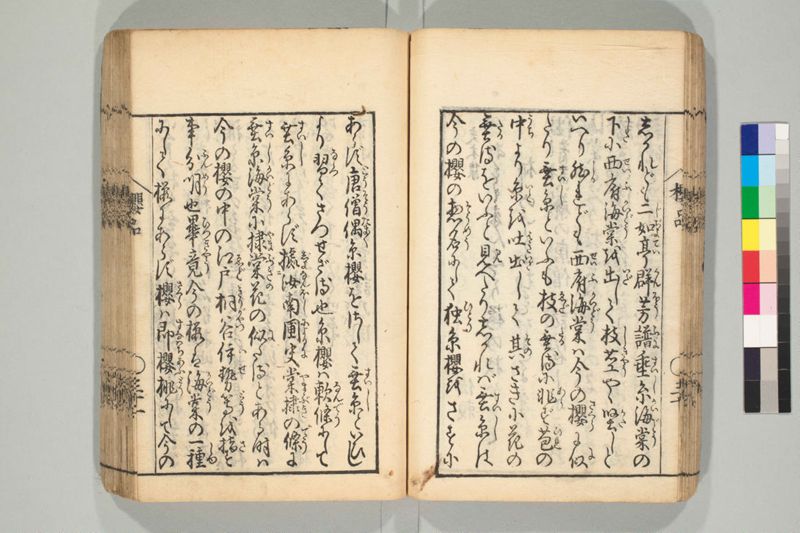
翻刻
【右丁】
しかれども二如亭群芳譜(じぢよていくんほうふに)垂糸海棠(すいしかいどう)の
下(した)に西府海棠(せいふかいどう)を出(いだ)して枝茎(しきやう)やゝ堅(かた)しと
いへり然(しか)れども西府海棠(せいふかいどう)は今の桜(さくら)に似(に)
たり垂糸(すいし)といふも枝(ゑだ)の垂(たる)るに非(あら)ず苞(ひれ)の
中(うち)より糸(いと)を吐出(はきいだ)して其(その)さきに花の
垂(たる)るをいふと見(み)へたりしかれば垂糸(すいし)は
今の桜の惣名(そうめう)にして独(ひとり)糸桜をさすに
【左丁】
あらず唐僧(とうそう)偶(たま〳〵)糸桜をさして垂糸(すいし)といひし
より習(ならつ)てさつせざる也糸桜は軟条(なんでう)にして
垂糸(すいし)にあらず《振り仮名:拠_二汝南圃史_一|じよなんほしによるに》棠捸(やまぶき)の条(でう)に
垂糸海棠(すいしかいどう)に捸棠(やまぶきの)花の似(に)たるとある時は
今の桜の中の江戸(ゑど)桐谷(きりがやつ)伊勢(いせ)等(とう)を指(さ)す
事 分明(ふんめう)也 畢竟(ひつきやう)今の桜は海棠(かいどう)の一 種(しゆ)
にして桜にあらず桜(さくら)は即(すなはち)桜桃(あふとう)にして今の
現代語訳
【右丁】
しかしながら、二如亭群芳譜では垂糸海棠の項目の下に西府海棠を載せて、「枝茎がやや堅い」と述べている。しかしながら西府海棠は今の桜に似ている。垂糸というのも、枝が垂れ下がることではなく、苞の中から糸を吐き出して、その先に花が垂れ下がることを言うと思われる。したがって垂糸は今の桜の総称であって、糸桜だけを指すのでは
【左丁】
ない。中国僧がたまたま糸桜を指して垂糸と言ったことから、習慣的にそう呼ぶようになっただけである。糸桜は軟条(柔らかい枝)であって垂糸ではない。『汝南圃史』によれば、棠捸(やまぶき)の項目に「垂糸海棠は捸棠(やまぶき)の花に似ている」とあるときは、今の桜の中の江戸桜、桐谷桜、伊勢桜等を指すことが明らかである。結局のところ、今の桜は海棠の一種であって桜ではない。桜とは即ち桜桃のことであって、今の
英語訳
【Right page】
However, in the Nijotei Gunpōfu (Nijotei's Catalog of Various Flowers), under the entry for suishi-kaidō (drooping thread begonia), it lists seifu-kaidō (Western Prefecture begonia) and states that "the branches and stems are somewhat hard." Nevertheless, seifu-kaidō resembles today's cherry blossoms. The term "drooping thread" does not refer to drooping branches, but appears to describe the emission of thread-like structures from within the bracts, with flowers hanging at their tips. Therefore, "drooping thread" is a general term for today's cherry blossoms and does not refer exclusively to ito-zakura (thread cherry)
【Left page】
alone. It is simply that a Chinese monk happened to point to ito-zakura and call it "drooping thread," and this became customary usage. Ito-zakura has soft branches (nanjō) and is not truly "drooping thread." According to the Jonan Hoshi (Jonan Garden History), in the section on tōshū (yamabuki), it states that "drooping thread begonia resembles the flowers of shū-tō (yamabuki)," which clearly refers to varieties among today's cherry blossoms such as Edo-zakura, Kirigaya-zakura, and Ise-zakura. Ultimately, today's cherry blossoms are a type of begonia and not true cherry. True cherry refers to ōtō (cherry fruit trees), and today's