翻刻
【右丁】
【上段・図】
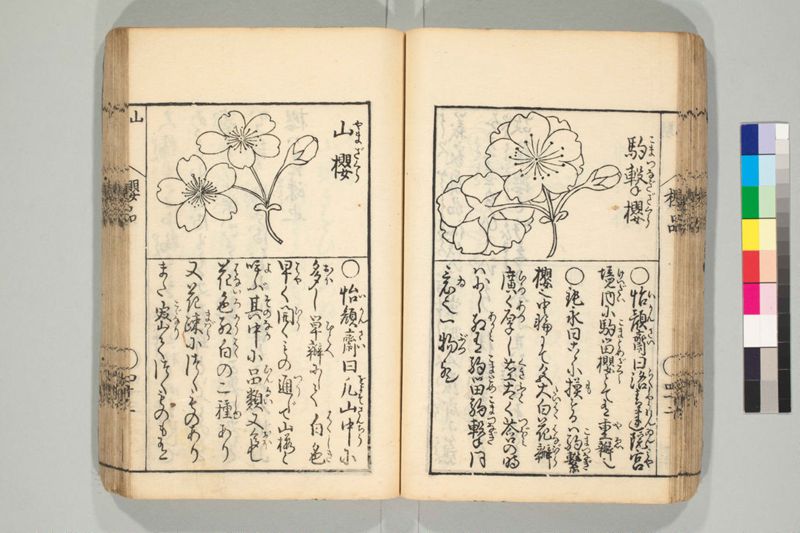
駒撃桜(こまつなぎざくら)
【下段】
○怡顔斎(いかんさい)曰 洛(らく)青蓮院宮(しやうれんゐんみや)
境内(けいだい)に駒留桜(こまとめざくら)とて有 重弁(やゑ)也
○鈍永曰こゝに摸(も)するは駒繋(こまつなぎ)
桜也中輪にて色 太白(たいはく)花弁(はなびら)
広(ひろ)く厚(あつ)し茎(くき)太(ふと)く莟(つぼみ)の時
は少し紅(あかみ)有 駒留(こまとめ)駒撃(こまつなぎ)同
意(ゐ)也一 物(ぶつ)歟
【左丁】
【上段・図】
山桜(やまざくら)
【下段】
○怡顔斎(いかんさい)曰 凡(をよそ)山中(さんちう)に
多(おほ)し単弁(ひとへ)にして白色(はくしき)
早(はや)く開(ひら)くもの通(つう)じて山桜と
呼(よ)ぶ其(その)中(なか)に品類(ひんるい)又 多(おほ)し
花色(はないろ)紅白(かうはく)の二 種(しゆ)あり
又花 疎(まばら)につくものあり
また密(こゞなり)てつくものも有
現代語訳
【右丁】
【上段・図】
駒撃桜(こまつなぎざくら)
【下段】
○怡顔斎が言うには「京(洛中)の青蓮院宮の境内に、駒留桜(こまとめざくら)と称されるものがある。八重咲きである。」
○鈍永が言うには「ここに模写したのは駒繋桜(こまつなぎざくら)である。中輪で、色は太白(純白に近い白)、花弁は広く厚い。茎は太く、蕾のときはわずかに赤みを帯びる。駒留・駒撃(こまつなぎ)は同じ意味であり、同一のものであろうか。」
【左丁】
【上段・図】
山桜(やまざくら)
【下段】
○怡顔斎が言うには「おおよそ山中に多く見られる。一重咲きで白色のもので、早く開くものを総じて山桜と呼ぶ。その中にも品種は多く、花の色には紅と白の二種がある。また、花が疎らにつくものもあり、また密にかたまってつくものもある。」
英語訳
【Right page】
【Upper section・illustration】
Komatusnagi-zakura (Horse-tethering Cherry)
【Lower section】
○Iganai said: "Within the precincts of Shōren'in-no-miya in the capital (Kyoto), there is a variety known as Komatome-zakura (Horse-stopping Cherry). It is a double-petaled (yaezaki) variety."
○Donei said: "What is depicted here is the Komatusnagi-zakura (Horse-tethering Cherry). It is a medium-sized bloom, the color being taihaku (a near-pure white), with broad and thick petals. The stem is stout, and when in bud, it bears a slight reddish tinge. 'Komatome' (horse-stopping) and 'Komatusnagi' (horse-tethering) share the same meaning, and the two may indeed be one and the same variety."
【Left page】
【Upper section・illustration】
Yama-zakura (Wild Mountain Cherry)
【Lower section】
○Iganai said: "This variety is found in great abundance throughout the mountains. Those that bloom early, with single petals and white coloring, are collectively referred to as Yama-zakura. Even within this category, there are many sub-varieties: the flowers come in two colors, red and white. Moreover, some trees bear their blossoms sparsely, while others bear them in dense clusters."