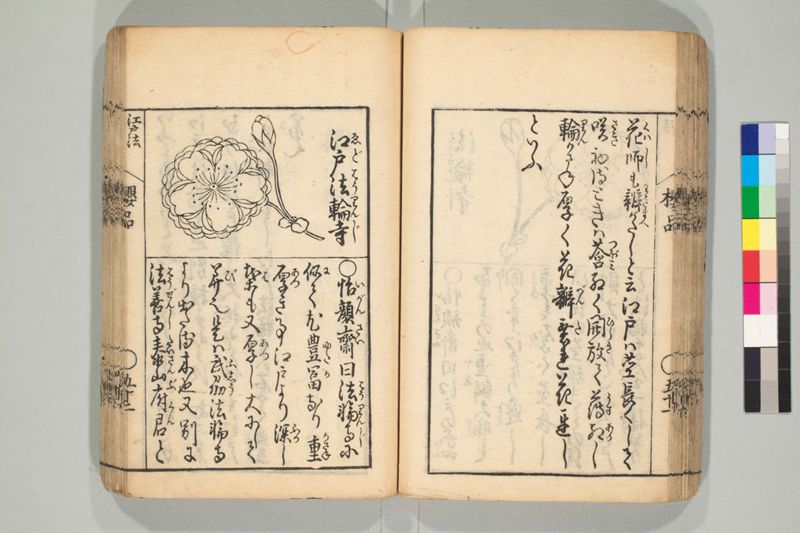
翻刻
【右丁】
花師(くはし)も弁(わきまへ)がたしと云江戸は茎長くして
咲(さき)初るときは莟(つぼみ)紅く開放(ひらき)て薄紅(うすあか)し
輪(りん)かさね厚(あつ)く花 弁(べん)垂(た)れ花遲し
といふ
【左丁】
【上段・図】
江戸法輪寺(ゑどはうりんじ)
【下段】
○怡顔斎(いがんさい)曰 法輪寺(はうりんじ)に
似(に)て尤 豊冨(ゆたか)なり重(かさね)
厚(あつ)き事江戸より深(ふか)し
葉(は)も又 厚(あつ)し大にして
美(び)也是は武州(ふしう)法輪寺
より出たる木也又別に
法善寺(はうぜんし)泰山府君(たいさんぶくん)と
現代語訳
【右丁】
花師(くわし)でも見分けがたいという。江戸(桜)は茎が長く、咲き始めのときは蕾が紅く、開ききると薄紅色になる。花輪の重なりは厚く、花弁は垂れ下がり、開花は遅いという。
【左丁】
【上段・図】
江戸法輪寺(えどほうりんじ)
【下段】
○怡顔斎いわく、法輪寺に似ており、とりわけ花が豊かで充実している。花びらの重なりの厚さは江戸(桜)より深い。葉もまた厚く、大きく、美しい。これは武州(武蔵国)の法輪寺より出た木である。また別に「法善寺」「泰山府君」と
英語訳
【Right folio】
It is said that even expert horticulturalists (kwashi) find it difficult to distinguish between them. The Edo cherry has long stems; when it first begins to bloom, the buds are crimson, and when fully open, they become a pale reddish pink. The layering of the blooms is thick, the petals hang downward, and flowering is late, so it is said.
【Left folio】
【Upper section – Illustration】
Edo-Hōrinji (江戸法輪寺)
【Lower section】
○Ikansai states: It closely resembles the Hōrinji, and is particularly abundant and full in its flowering. The thickness of the petal layering is deeper than that of the Edo cherry. The leaves too are thick, large, and beautiful. This is a tree that originated from Hōrinji temple in Bushū (Musashi Province). Additionally, it is separately known as "Hōzenji" and "Taisanfukun"—