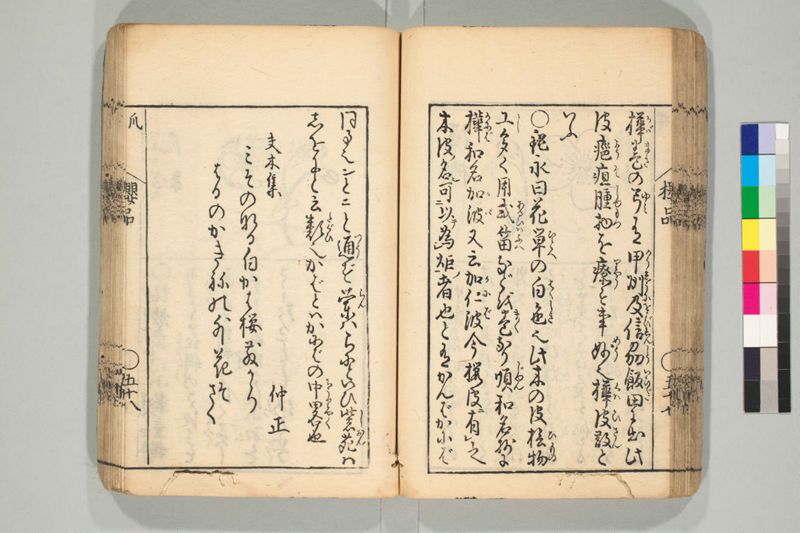
翻刻
【右丁】
樺巻(かばまき)の弓(ゆみ)有 甲州(かうしうに)及(をよび)信州(しんしう)飯田(いひだ)に出此
皮 ■(よう)【癰か𤶛か】疽(そ)腫物(しゆもつ)を療(りやう)す事 妙(めう)也 樺皮散(くはひさん)と
いふ
○鈍永曰花 単(ひとへ)の白色(はくしき)也此木の皮 桧物(ひもの)
工(し)多く用 或(あるひは)笛(ふへ)などを巻(まく)なり順(じゆん)和名抄に
樺(かにば)和名 加波(かば)又云 加仁波(かにば)今桜皮 ̄ニ有_レ之
木皮 ̄ノ名《送り仮名:也》可_二似 ̄テ為_レ炬 ̄ノ_一者也と有かんばかにば
【左丁】
同事也ンとニと通(つう)ず蘭(らん)はらにといひ紫苑(しおん)は
しをにと云 類(たぐひ)也かばとはかにばの中略(ちうりやく)也
夫木集 仲正
みそのなる白かは桜散かゝり
春のかきねの外花そさく
現代語訳
【右丁】
樺巻きの弓もある。甲州(現在の山梨県)および信州(現在の長野県)飯田にて産出される。この(樺の)皮は、癰疽(よう・そ)や腫れ物を治療するのに効験がある。「樺皮散(かわひさん)」というものがある。
○鈍永いわく――花は一重の白色である。この木の皮は、桧物師(曲物師)が多く用いるほか、笛などを巻くのにも使われる。順(源順)の『和名類聚抄(わみょうるいじゅしょう)』には、「樺(かにば)、和名は加波(かば)、また加仁波(かにば)とも云う。今、桜皮にこれがある。木皮の名であり、炬(たいまつ)となしうべき者也」とある。「かんば」と「かにば」は
【左丁】
同じことである。「ン」と「ニ」は通じ(音が転じ)る。例えば、「蘭(らん)」は「らに」ともいい、「紫苑(しおん)」は「しをに」という類のことである。「かば」とは「かにば」を中略したものである。
夫木集 仲正
みそのなる白かは桜散かかり
春のかきねの外(そと)花ぞ咲く
英語訳
【Right folio】
There are also bows wrapped with birch bark. This bark is produced in Kōshū (present-day Yamanashi Prefecture) and Iida in Shinshū (present-day Nagano Prefecture). The bark is wonderfully effective in treating carbuncles (yō-so) and swellings. There is a medicinal preparation called "Kawahi-san" (Birch Bark Powder).
○Don'ei writes: The flower is single-petaled and white. The bark of this tree is widely used by craftsmen who make bentwood articles (himonoshi), and is also used to wrap flutes and similar instruments. In Minamoto no Shitago's Wamyō Ruijushō (Japanese-Chinese Dictionary of Names), it states: "Kaniba (樺): Japanese reading is 'kawa' or 'kaba'; also written 'kaniba.' It is found today in cherry bark. It is a name for tree bark, referring to that which can be made into torches (taimatsu)." The words "kamba" and "kaniba"
【Left folio】
refer to the same thing. The sounds "n" (ン) and "ni" (ニ) are interchangeable. For example, "ran" (蘭, orchid) is also called "rani," and "shion" (紫苑, aster) is called "shiwoni" — it is that kind of phenomenon. Thus, "kaba" is an abbreviated form of "kaniba."
Fubokushū Nakamasa
In the garden, the white birch-cherry blossoms scatter and fall,
While beyond the spring fence, the flowers are yet in bloom.