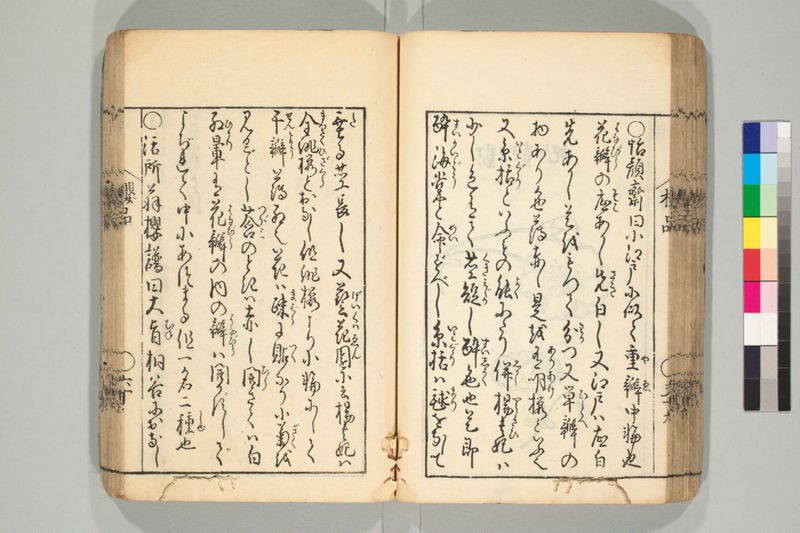
翻刻
【右丁】
○怡顔斎曰小江戸に似て重弁(やゑ)中輪也
花弁(はなびら)の底(そこ)あかし先(さき)白し又江戸は底白
先あかし是をもつて分(わか)つ又 単弁(ひとへ)の
物あり色薄赤し是を有明(ありあけ)桜といふ也
又 糸括(いとぐゝり)といふもの能(よく)にたり併(しかし)楊貴妃(やうきひ)は
少し色有て茎(くき)短(みじか)し酔色(すいしよく)也是即
酔海棠(すいかいどう)と命(めい)ずべし糸括(いとぐゝり)は毬(まり)をなして
【左丁】
垂(た)る茎長し又 芸花園(げいくはゑん)に云楊貴妃は
全(まつたく)緋桜(ひざくら)とおなし但緋桜より小輪にして
千弁(せんよう)薄紅也花は疎(まばら)に貼(つく)なり小 菊(ぎく)を
見るごとし莟(つぼみ)のときは赤し開(ひら)きては白
紅暈(ひかり)有 花弁(はなびら)の内の弁(はなびら)は開かずして
よぢれて中にあつまる但一名二 種(しゆ)也
○活所翁桜譜曰大 旨(むね)桐谷におなし
現代語訳
【右丁】
○怡顔斎いわく――小江戸(こえど)に似て八重咲き、中輪である。花びらの底(付け根部分)は赤く、先は白い。また、江戸桜は付け根が白く先が赤いので、それをもって両者を区別する。また、一重咲きのものもあり、色はうす赤い。これを有明桜という。また、糸括(いとくくり)というものによく似ている。しかし楊貴妃は少し色みがあり、茎が短く、酔ったような色合い(酔色)である。これはまさに酔海棠(すいかいどう)と呼ぶべきものである。糸括は毬(まり)のようになって
【左丁】
垂れ下がり、茎が長い。また、『芸花園(げいかえん)』にいわく――楊貴妃は全く緋桜と同じである。ただし緋桜より小輪で、千重咲き(多弁)のうす紅色である。花はまばらについており、小菊を見るようである。つぼみのときは赤いが、開くと白みを帯びた紅色で光沢(暈)がある。花びらの内側の弁は開かずによじれて中心に集まる。ただし、一名にして二種がある。
○活所翁桜譜にいわく――大意は桐谷と同じである。
英語訳
【Right folio】
○Igan-sai writes: It resembles Ko-Edo (Little Edo) but is double-petaled and medium-flowered. The base of the petals is red while the tips are white. In contrast, Edo cherry has a white base with red tips, and this distinction serves to differentiate the two varieties. There is also a single-petaled form, which is light red in color; this is called Ariake-zakura (Dawn Cherry). It also closely resembles the variety called Ito-kukuri (Thread-binding). However, Yōkihi has a slight tinge of color, its stem is short, and its color is that of intoxication (sui-shoku). This should indeed be called Sui-kaidō (Drunken Crabapple). Ito-kukuri forms a ball-like cluster and
【Left folio】
hangs downward, with a long stem. Furthermore, the Geikaten (Geika-en) states: Yōkihi is entirely the same as Hi-zakura (Scarlet Cherry). However, it is smaller-flowered than Hi-zakura, with a thousand-petaled, light crimson form. The blossoms are sparsely attached, giving the appearance of small chrysanthemums. The buds are red, but upon opening, they become a white-tinged crimson with a luminous glow (halo effect). The inner petals do not open but remain twisted, gathering at the center. However, this is one name covering two distinct varieties.
○The Sakura-fu by Kasshō-ō states: The general description is the same as that of Kiritani.