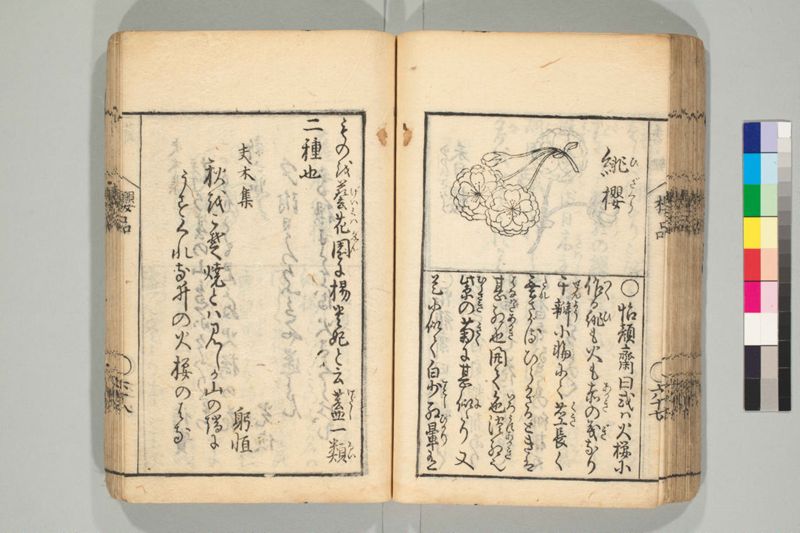
翻刻
【右丁】
【上段・図】
緋桜(ひざくら)
【下段】
○怡顔斎曰或は火桜に
作(つく)る緋(ひ)も火も赤(あかき)の義(ぎ)なり
千弁(せんよう)小輪にて茎(くき)長く
垂(たれ)さがるひらかざるときは
甚(はなはだ)紅(あかき)也開て色(いろ)淡紅(うすあかき)也
紫(むらさき)の菊(きく)に甚 似(に)たり又
是に似て白 少(すこし)紅暈(ひかり)有
【左丁】
ものを芸花園(げいくはゑん)に楊貴妃と云 蓋(けだし)一 類(るい)
二種也
夫木集 躬恒
秋をこそ焼とは見しか山の端に
うすくれなゐの火桜のはる
現代語訳
【右丁】
【上段・図】
緋桜(ひざくら)〔図〕
【下段】
○怡顔斎いわく あるいは「火桜」とも書く。「緋」も「火」も赤いという意味である。千重咲き(せんようざき)の小輪にして、茎が長く垂れ下がる。開く前はたいへん紅い。開くと色は淡紅(うすあかい)になる。紫の菊にたいへんよく似ている。また、これに似ていて、白に少し紅の暈(ぼかし)がある
【左丁】
ものを、芸花園(げいかえん)では「楊貴妃(ようきひ)」と呼ぶ。思うに、〔緋桜と楊貴妃は〕同じ類の二種である。
夫木集 躬恒(みつね)
秋をこそ焼くとは見しか 山の端に
薄紅の火桜の春
英語訳
【Right folio】
【Upper section · Illustration】
Hi-zakura (Scarlet Cherry) [illustration]
【Lower section】
○Igan-sai states: This variety is sometimes written as "Hi-zakura" using the character for "fire" (火) rather than "scarlet" (緋). Both "hi" characters — "scarlet" (緋) and "fire" (火) — carry the meaning of redness. It is a multi-petaled (senyo), small-flowered variety, with long stems that hang drooping downward. Before the blossoms open, they are deeply crimson. Once open, the color becomes a pale red. The flowers greatly resemble purple chrysanthemums. There is also a variety similar to this one, but white with a faint blush of pinkish red,
【Left folio】
which is called "Yōkihi" (Yang Guifei) at the Geikaan nursery garden. These two are likely of the same lineage, but constitute two distinct varieties.
Fuboku-shū Mitsune
It was autumn I thought they burned —
yet at the mountain's edge,
the pale crimson fire-cherry blooms in spring.