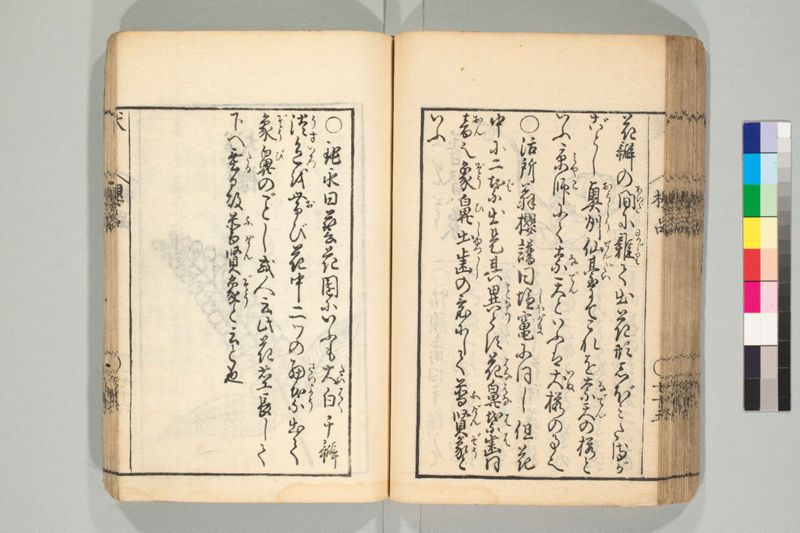
翻刻
【右丁】
花弁の間(あいだ)に雑(まじり)て出花形しぼみたるが
ごとし奥州(おうしう)仙台(せんだい)にてこれを奈天(なでん)の桜と
いふ京師(みやこ)にて奈天(なでん)といふは犬(いぬ)桜の事也
○活所翁桜譜曰 《振り仮名:塩𥧄|しほがま》に同し但花
中に二 葉(ば)出是其 異(ことなり)とす花(はな)鼻(はな)葉(は)歯(は)同
音(おん)也 象鼻(ぞうひ)出歯(しゆつし)の意にして普賢象(ふげんぞう)と
いふ
【左丁】
○鈍永曰芸花園にいふも大白(たいはく)千弁
淡色(うすいろ)を帯(お)び花中二つの細葉(さいよう)出て
象鼻(ぞうび)のごとし或人云此花茎長して
下へ垂(たる)る故 普賢象(ふげんぞう)と云と也
現代語訳
【右丁】
(普賢象の続き)花弁の間に混じって出てくる(二葉が)、花がしぼんだようにも見える。奥州仙台ではこれを「奈天(なでん)の桜」と呼ぶ。ただし、京都で「奈天(なでん)」というのは犬桜のことを指す。
○活所翁の『桜譜』にいわく、塩竈桜と同じである。ただし、花の中に二枚の葉が出るところがその違いである。「花(はな)」・「鼻(はな)」・「葉(は)」・「歯(は)」は同じ音である。すなわち象の鼻(ぞうひ)・出歯(しゅつし)の意から、「普賢象(ふげんぞう)」と呼ぶのである。
【左丁】
○鈍永いわく、芸花園(うんかえん)に記されているものも(普賢象と)同じく、大白(たいはく)で千弁、淡い色を帯び、花の中から二枚の細い葉が出て象の鼻のようである。ある人の説によれば、この花は茎が長く下へ垂れるので「普賢象(ふげんぞう)」と呼ぶとのことである。
英語訳
【Right folio】
(Continued from the previous entry on *Fugen-zō*)
These (two leaf-like structures) emerge mixed among the petals, giving the flower the appearance of being withered or closed. In Ōshū (Mutsu Province), Sendai, this variety is called *Naden-no-sakura*. However, in the capital (Kyoto), the name *naden* refers to the wild cherry (*inu-zakura*).
○The *Ōjō* [*Katsusho-okina*]'s *Sakurafu* states: It is the same as the *Shiogama* cherry. The distinguishing feature, however, is that two leaves emerge from within the flower. The words *hana* (flower/nose), *ha* (leaf/tooth) all share the same sounds. The name *Fugen-zō* derives from the meaning of *zōhi* (elephant's trunk) and *shussshi* (protruding teeth), referring to the elephant's prominent features.
【Left folio】
○Donei states: What is described in *Ungaen* is likewise a large white (*taihaku*) variety of a thousand petals, with a pale hue, and two slender leaves emerging from within the flower, resembling an elephant's trunk. According to one account, this flower is called *Fugen-zō* because its stems are long and hang downward.