翻刻
【右丁】
なす諸々(しよ〳〵)山中に多し
夫木集 俊頼
山陰に痩さらほへる犬さくら
をひはなたれて
ひく人もなし
【左丁】
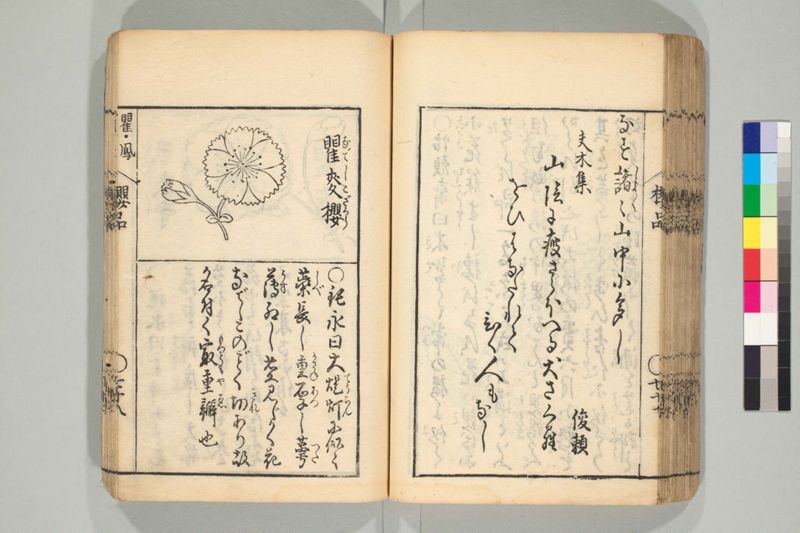
【上段・図】
瞿麦桜(なでしこざくら)
【下段】
○鈍永曰大 煶灯(てうちん)に似て
蘃(しべ)長し重(かさね)厚(あつ)し蕚(つた)
薄(うす)紅し茎みじかく花
なでしこのごとく切(きれ)あり故
名付く最(もつとも)重弁(やゑ)也
現代語訳
【右丁】
(酒の肴と)なす。あちこちの山中に多く見られる。
夫木集 俊頼
山陰に痩せさらぼえる犬桜
生い放たれて
引く人もなし
【左丁】
【上段・図】
瞿麦桜(なでしこざくら)
【下段】
○鈍永いわく、大きな提灯(ちょうちん)に似ていて、しべが長く、花びらの重なりが厚く、萼(がく)は薄く紅色を帯びる。茎は短く、花はなでしこのように切れ込みがある。それゆえこの名が付いた。きわめて八重咲きの品種である。
英語訳
【Right folio】
(…used as an accompaniment to sake.) It is found in abundance throughout various mountain areas.
*Fubokushū* Toshiyori
In the mountain shade, a gaunt and withered *inu-zakura*,
left to grow wild and untended—
with no one to tend to it.
【Left folio】
【Upper section · Illustration】
*Nadeshiko-zakura* (Pink Cherry / *Dianthus* Cherry)
【Lower section】
○Don'ei states: It resembles a large lantern (*chōchin*), with long stamens/pistils, thick layered petals, and a calyx tinged with a pale crimson. The stem is short, and the petals have the fringed, cut edges characteristic of *nadeshiko* (wild pink / *Dianthus*). It is for this reason that the variety bears its name. It is an especially full double-flowered (*yaezaki*) variety.