翻刻
【右丁】
【上段・図】
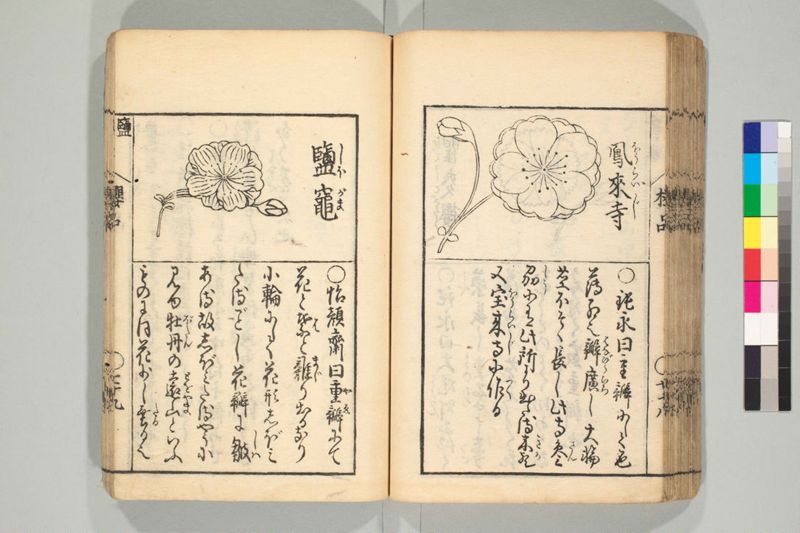
鳳来寺(ほうらいじ)
【下段】
○鈍永曰重弁にして色
薄紅也 弁(はなびら)広(ひろ)し大輪
茎ほそく長く此寺 参(さん)
州(しう)に有此所より出たる木(き)歟(か)
又 宝来寺(ほうらいじ)に作(つく)る
【左丁】
【上段・図】
《振り仮名:塩𥧄|しほがま》
【下段】
○怡顔斎曰 重弁(やゑ)にて
花と葉(は)と雑(まじ)り出るなり
小輪にして花形しぼみ
たるごとし花弁に皺(しは)
ある故しぼみたるやうに
見ゆ牡丹(ぼたん)の遠山(とをやま)といふ
ものに同花少し垂(たる)る也
現代語訳
【右丁】
【上段・図】
鳳来寺(ほうらいじ)
【下段】
○鈍永いわく、八重咲きで色は薄い紅色である。花びらは広く、大輪である。茎は細く長い。この寺は参州(三河国)にあり、その地より出た木(の品種)であろうか。また「宝来寺(ほうらいじ)」とも表記する。
【左丁】
【上段・図】
塩竈(しおがま)
【下段】
○怡顔斎いわく、八重咲きで、花と葉とが混じり合って出るものである。小輪で、花の形がしぼんだようである。花弁に皺(しわ)があるため、しぼんだように見える。牡丹(ぼたん)の「遠山(とおやま)」というものと同じで、花が少し垂れる。
英語訳
【Right folio】
【Upper section · Illustration】
*Hōraiji* (Hōraiji Cherry)
【Lower section】
○Don'ei states: It is a double-flowered (*yaezaki*) variety with a pale crimson color. The petals are broad and the flowers are large-bloomed. The stem is slender and long. This temple is located in Sanshū (Mikawa Province), and the variety may have originated from trees found there. It is also written as *Hōraiji* (宝来寺) using alternative characters.
【Left folio】
【Upper section · Illustration】
*Shiogama* (Salt Cauldron Cherry)
【Lower section】
○Igan-sai (the author) states: It is a double-flowered (*yaezaki*) variety in which flowers and leaves emerge together intermingled. It is small-bloomed, and the shape of the flowers appears as though they are withered. Because the petals are wrinkled (*shiwa*), they appear shriveled. It is similar to the peony (*botan*) variety known as *Tōyama*, and the flowers droop slightly.