翻刻
【右丁】
【上段・図】
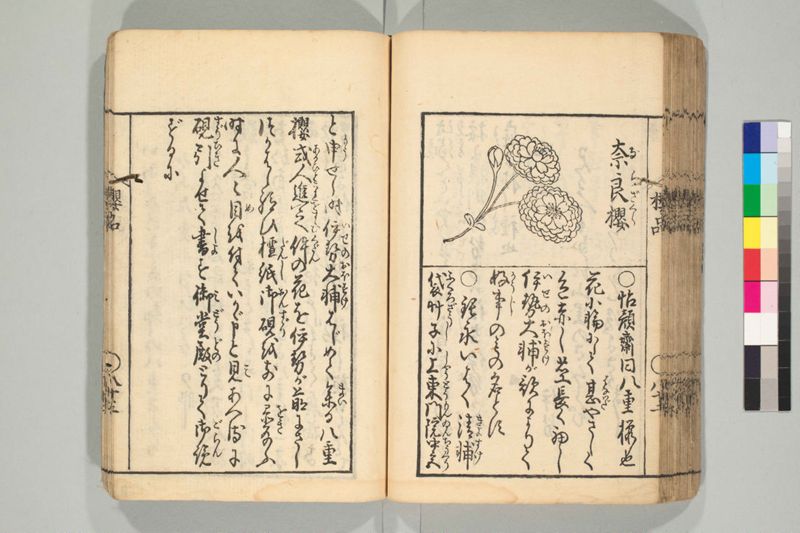
奈良桜(ならざくら)
【下段】
○怡顔斎曰八重桜也
花小輪にして甚(はなはだ)やさしく
色赤し茎長く細し
伊勢大輔(いせのおほすけ)が歌によりて
好事(かうじ)のもの名とす
○鈍永いはく清輔(きよすけ)
袋艸子(ふくろざうし)に上東門院(しやうとうもんゐん)中宮(ちうくう)
【左丁】
と申(もう)せし時 伊勢大輔(いせのおほすけ)はじめて参(まい)る八重
桜 或(ある)人(ひと)《振り仮名:進_レ之|これをすゝむ》件(くだん)の花を伊勢が前にさし
つかはし給ひ檀紙(だんし)御硯(おんすゞり)を前に置(をき)給ふ
時に人々目(め)を付ていかゞ申と見(み)あへるに
硯(すゞり)引(ひき)よせて書(しよ)す御堂殿(みどうどの)とりて御覧(ごらん)
ずるに
現代語訳
【右丁】
【上段・図】
奈良桜(ならざくら)
【下段】
○怡顔斎いわく、八重桜である。花は小輪で、はなはだ優美であり、色は赤い。茎(花柄)は長く細い。伊勢大輔の歌によって、風流を好む者がこの名(奈良桜)をつけた。
○鈍永(どんえい)いわく、清輔の『袋草子』に、上東門院が中宮で
【左丁】
いらっしゃった頃、伊勢大輔がはじめて参内した時、ある人がその(奈良からの)八重桜を伊勢大輔の前にさし向けてお遣わしになり、檀紙と御硯を前にお置きになった。その時、人々は目を向けて、「さて、どのように詠まれるか」と見守っていたところ、(伊勢大輔は)硯を引き寄せて(歌を)書きつけた。御堂殿がそれを取って御覧になると、
英語訳
【Right folio】
【Upper section – Illustration】
Nara-zakura (Nara cherry)
【Lower section】
○Igan-sai states: This is a double-flowered cherry (*yae-zakura*). The flowers are small-petaled and exceedingly delicate, with a red hue. The stems (flower stalks) are long and slender. Lovers of refinement gave it this name (Nara-zakura) in reference to the poem by Ise no Ōsuke.
○Don'ei states: According to Kiyosuke's *Fukuro Zōshi*, at the time when the Jōtōmon'in was serving as the Imperial Consort (*chūgū*),
【Left folio】
when Ise no Ōsuke made her first appearance at court, someone sent the aforementioned double-flowered cherries (from Nara) and placed them before Ise no Ōsuke, along with *danshi* (fine ceremonial paper) and an inkstone set before her. At that moment, all those present turned their eyes toward her, watching intently to see how she would compose a poem. She drew the inkstone toward herself and began to write. When Lord Midō (Fujiwara no Michinaga) took up the paper and read it,