翻刻
【右丁】
【上段・図】
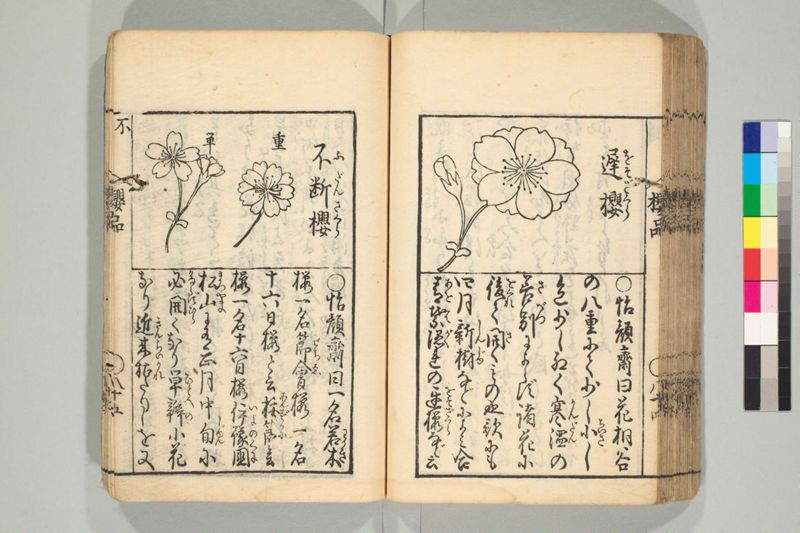
遅桜(をそざくら)
【下段】
○怡顔斎曰花桐谷
の八重にて少し小(ちいさ)し
色少し紅く寒温(かんだん)の
差別(さべつ)によらず諸花に
後(をくれ)て開(さ)くもの也歌にも
四月 新樹(しんじゆ)などによみ合
青葉隠(あをはがく)れの遅桜(をそざくら)など云
【左丁】
【上段・図】
不断桜(ふだんさくら)
重
単
【下段】
○怡顔斎曰一名 若木(わかき)
桜一名 節会(せちゑ)桜一名
十六日桜と云 按(あんずるに)節会
桜一名十六日桜 伊予国(いよのくに)
松山(まつやま)に有正月中 旬(じゆん)に
必(かならず)開(ひら)くなり単弁(ひとへの)小花
なり近来(きんらい)枯(かれ)たりしを又
現代語訳
【右丁】
【上段・図】
遅桜(おそざくら)
【下段】
○怡顔斎いわく:花は桐谷の八重桜に似て、やや小ぶりである。色はやや紅みを帯び、寒暖の差に関わらず、他のどの花よりも遅れて開くものである。和歌においても、「四月」や「新樹」などと詠み合わせ、「青葉隠れの遅桜」などと表現される。
---
【左丁】
【上段・図】
不断桜(ふだんざくら)
重(八重)
単(一重)
【下段】
○怡顔斎いわく:一名「若木桜」、一名「節会桜」、一名「十六日桜」ともいう。考えるに、節会桜・一名十六日桜は、伊予国松山にあり、正月の中旬に必ず開花するものである。一重の小さな花である。近年は枯れてしまったが、また(新たに植えられ)……
英語訳
【Right folio】
【Upper section — Illustration】
*Osozakura* (Late-blooming Cherry)
【Lower section】
○ Itangensai states: The flowers resemble those of the double-flowered *Kiridanizakura*, but are somewhat smaller. The color is slightly tinged with red, and regardless of differences in temperature, this variety always blooms later than all other cherries. In poetry, it is often paired with words such as "the fourth month" or "new foliage," and is referred to with phrases such as "the late cherry hidden among green leaves" (*aoba-gakure no osozakura*).
---
【Left folio】
【Upper section — Illustration】
*Fudan-zakura* (Ever-blooming Cherry)
Double-flowered (重)
Single-flowered (単)
【Lower section】
○ Itangensai states: This variety is also known by the name *Wakakizakura* ("Young Tree Cherry"), and alternatively as *Sechiē-zakura* ("Festival Cherry") or *Jūrokunichibazakura* ("Sixteenth-Day Cherry"). Upon investigation, the *Sechiē-zakura*, also called *Jūrokunichibazakura*, is found in Matsuyama in Iyo Province, where it invariably blooms in the middle ten days of the first month (mid-January). It bears small, single-petaled flowers. In recent years it had withered, but once again…