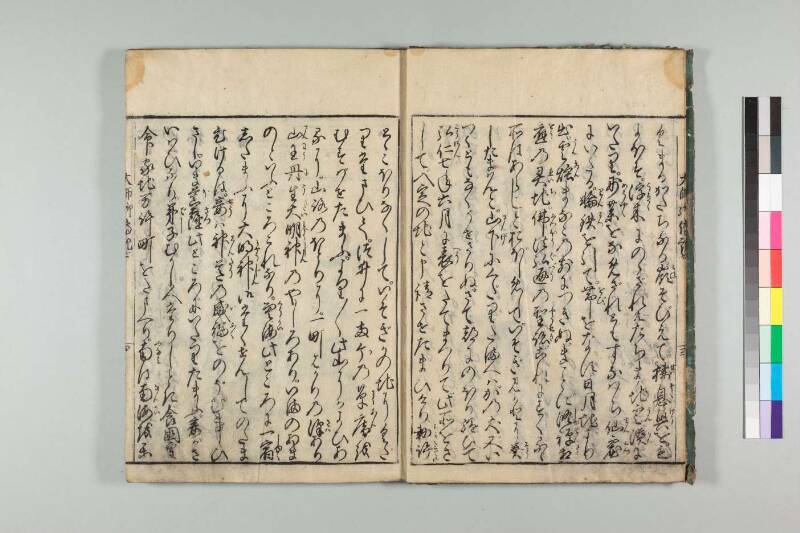
翻刻
【帝へ表をさゝげ給ふ事】
くまるかたちなり。嶺(みね)そびえて棲息(せいそく)興(けう)を。も
よほす。浮木(うきゝ)にのらざれ共たちまち雲(うん)漢(かん)に
いたり。妙薬(めうやく)をなめざれともすなはち仙窟(せんくつ)
にいたる。輪鉄(りんてつ)を引て。帯(おび)をなす。日月地より
出。雲煙(うんえん)まなこの前につきぬ。まことに修禅(しゆぜん)相(さう)
応(をう)の霊地。仏法(ぶつほう)弘通(ぐづう)の聖跡(しやうせき)。これにすくるゝ
所はあらじとおぼしめして。いそぎみかどに奏(そう)
したまはんと。山下(さんげ)にくだりたまへは。かの犬。又い
つくともなくうせさりぬ。さて都にのぼり給ひて
弘仁(こうにん)七年六月に表(へう)をたてまつりて。此所をさ
して。入定の地と申請させたまひけり。勅許(ちよくきよ)
【丹生明神御託宣の事】
とゝこほりなくして。いそぎかの地にくだ
りたまひて。つゐに一両 ケ(か)の草庵(さうあん)を
むすばせたまふ。より〳〵此山にかよひあ
るに。山路のほとりに。一町はかりの沢(さは)あり
山王(さんわう)丹生(にう)大明神(だいみやうじん)のやしろあり。いまのあま
のといふところこれなり。空海(くうかい)此ところに一 宿(しゆく)
したまふに大明神(みやうじん)御たくせんしてのたま
ひけるは。妾(せう)は神道(しんたう)の威福(いふく)をのぞむ事ひ
さし。いま菩薩(ぼさつ)此ところにいたりたまふ。妾がさ
いはいなり。弟子(でし)むかし人たりしとき。食国皇
命家地万件町をたまへり。南(みなみ)は南海(なんかい)をか
現代語訳
【帝へ表を捧げ給う事】
(虎が)渦を巻くような形の山が連なっている。峰々が高くそびえ、(そこに)住み留まることへの興趣を催させる。浮木(うつろ舟)に乗らずとも、たちまち天の川(雲漢)へと至るかのようであり、妙薬をなめずとも、すなわち仙人の住む洞窟に至るかのようである。輪のような山の稜線が帯をなすように巡り、日と月は地より出て、雲や霞が目の前に尽きることなく漂う。まことに禅を修めるにふさわしい霊地であり、仏法を広める聖なる跡地として、これを超えるところはあるまいとお思いになり、急いで帝に奏上しようと、山を下りられると、あの犬はまたどこへともなく姿を消してしまった。さて都に上られて、弘仁七年六月に表(上奏文)を奉り、この場所を指して、入定の地として申し請けられた。勅許は
【丹生明神御託宣の事】
滞りなく下り、急いでかの地へ下られて、ついに一、二の草庵を結ばせられた。折に触れてこの山に通われるうちに、山路のほとりに一町ほどの沢があり、山王・丹生大明神の社があった。今の「あまの」と呼ばれる所がこれである。空海がこの所に一夜宿られると、大明神が御託宣して仰せられるには:「妾(わらわ)は神道の威福を望んで久しい。今、菩薩がこの所においでになった。妾にとって幸いなことである。弟子(わが眷属)がかつて人であったとき、食国(おすくに)皇命の家地万件町を賜った。南は南海を——」
英語訳
**[On the Matter of Presenting a Memorial to the Emperor]**
——the mountains ranged in coiling, spiraling shapes. The peaks soar high, inspiring the desire to dwell and reside therein. Without boarding a drifting boat, one feels as though one has immediately reached the River of Heaven (the Milky Way); without tasting a miraculous elixir, one feels as though one has arrived at the cavern of the immortals. The mountain ridges encircle the land like a belt; the sun and moon rise from the earth, and clouds and mists drift endlessly before one's eyes. Truly, this is a sacred ground most suited to the practice of Zen meditation, a holy site for the propagation of Buddhism — Kūkai thought to himself that there could be no place surpassing this. He hastened to descend the mountain, intending to make his report to the Emperor with all speed. At that moment, the dogs vanished without a trace, disappearing to who knows where. He then proceeded up to the capital, and in the sixth month of Kōnin 7 (816 CE), he presented a formal memorial to the throne, designating this place as the site for his entering samādhi (入定), and petitioned for imperial permission. The imperial sanction
**[On the Matter of the Divine Oracle of the Niū Myōjin]**
was granted without delay, and he promptly descended to that place, where he at last had one or two thatched hermitages built. As he came and went on the mountain from time to time, he found along the mountain path a marsh of about one *chō* in extent, with a shrine dedicated to the Sannō and Niū Daimyōjin. This is the place now called "Amano." When Kūkai lodged there for a night, the Great Deity bestowed a divine oracle, declaring: "I have long desired the glory and blessings of the Way of the Gods. Now that the Bodhisattva has come to this place, it is a great fortune for me. When my disciple (attendant deity) was once a mortal, he was granted ten-thousand *chō* of household land by imperial decree over this realm. To the south, the South Sea——"