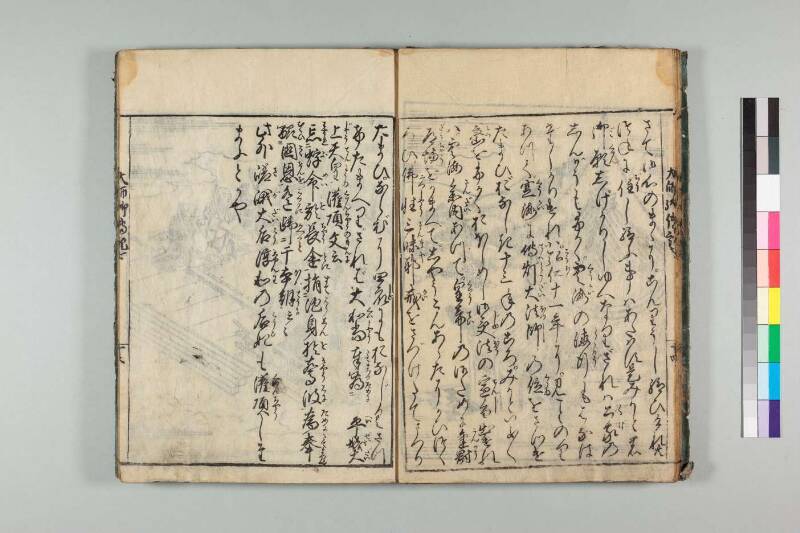
翻刻
【帝御受法の事(目録ではこの前に「秘鍵開題の事并死人蘇生の事
」がある)】
さて御心のまゝに。こんりうし給ひけれ共
つねに住(ぢう)し給ふ事はあたはす是みかとの
御(ご)願(くはん)しげかりしゆへなり。されは公家(くげ)の
しんがうもふかく。空海(くうかい)の徳行(とくかう)もはなは
だしかりけれは。弘仁(こうにん)十一年に。みことのり
あつて空海に伝灯(でんとう)大(だい)法師(ほつし)の位(くらゐ)をさつけ
たまひ。おなしき十三年のころ。みかどいよ〳〵
密(みつ)をふかくおほしめし御受法(じゆほう)の宣旨(せんじ)を出けれ
ば。空海参内(さんだい)あつて。皇帝(くはうてい)の御ために金剛(こんがう)
道場(だうぢやう)をかまへて。しやうごんあらたにかひつく
ろひ。仏性(ふつしやう)三昧耶(さんまや)戒(かい)をさづけたてまつり
たまひ。ならびに四衆(しゆ)にもおなじくさづ
けたまへり。されば大 和尚(くはしやう)奉(たてまつる)為(ために)_二 平城(へいぜい)大(だい)
上(じやう)天皇(てんわうの)灌頂(くはんちやう)文(のもんに)云
忘(わすれ)_二蜉命(ぶめい)於(を)長途(ちやうとに)_一捐(すて)_二泡身(はうしん)於(を)驚波(きやうはに)_一為(ために)_レ奉(たてまつらん)
_レ報(むくひ)_二国恩(こくをんを)_一遥帰(はるかにかへること)_二于 本朝(ほんてうに)_一云々
此外 嵯峨(さが)大后(だいこう)淳和(しゆんわ)の后妃(こうひ)も灌頂(くはんちやう)した
まふとかや
現代語訳
【帝御受法の事】
さて、思いのままに建立なさったけれども、常に(高野山に)お住まいになることはおできにならなかった。これは帝のご要望が多かったからである。それゆえ、公家の信仰も深く、空海の徳行もはなはだ盛んであったので、弘仁十一年(820年)に勅命があって、空海に伝灯大法師の位を授けられた。同じく弘仁十三年(822年)ごろ、帝はいよいよ密教を深くお慕いになり、御受法の宣旨を出されたので、空海は参内して、皇帝のために金剛道場を設え、荘厳を新たに整え、仏性三昧耶戒を授け申し上げ、あわせて四衆にも同じく授けられた。
そこで大和尚が平城太上天皇のために奉る灌頂文に言う、
「蜉命(はかない命)を長途(長い旅路)において忘れ、泡身(泡のようなはかない身)を驚波(荒波)において捨て、国恩に報いんがために、はるかに本朝(日本)に帰ること云々」
この他、嵯峨大后、淳和の后妃も灌頂なさったとのことである。
英語訳
【On the Emperor's Receiving the Dharma】
Now, although Kūkai had accomplished the construction of the temple as he wished, he was unable to reside there permanently. This was because the imperial court's requests of him were frequent. Thus, as the faith of the nobility ran deep and Kūkai's virtuous conduct was most eminent, in the eleventh year of Kōnin (820), an imperial decree was issued granting Kūkai the rank of Dentō Daihosshi (Great Dharma Master of the Transmission of the Lamp). Around the thirteenth year of the same era (822), the Emperor's desire to deepen his practice of esoteric Buddhism grew ever stronger, and he issued an imperial proclamation for the ceremony of receiving the Dharma. Kūkai proceeded to the imperial palace and, for the Emperor's sake, established a Kongō (Diamond) Ritual Platform, renewed and adorned it with solemn decorations, and conferred the Busshō Sanmaya-kai (Bodhicitta Precepts of the Samaya). He also conferred the same precepts upon the Shishū (the four orders of Buddhist practitioners).
The text of the kanjo (abhiṣeka initiation) offered by the Great Monk (Kūkai) for the Retired Emperor Heizei reads:
"Forgetting one's ephemeral life upon a long journey, casting away one's bubble-like body amidst crashing waves — all in order to repay the grace of one's country, returning from afar to the homeland..." and so on.
Beyond this, it is said that the Empress Dowager of Emperor Saga and the consorts of Emperor Junna also received the kanjo initiation.