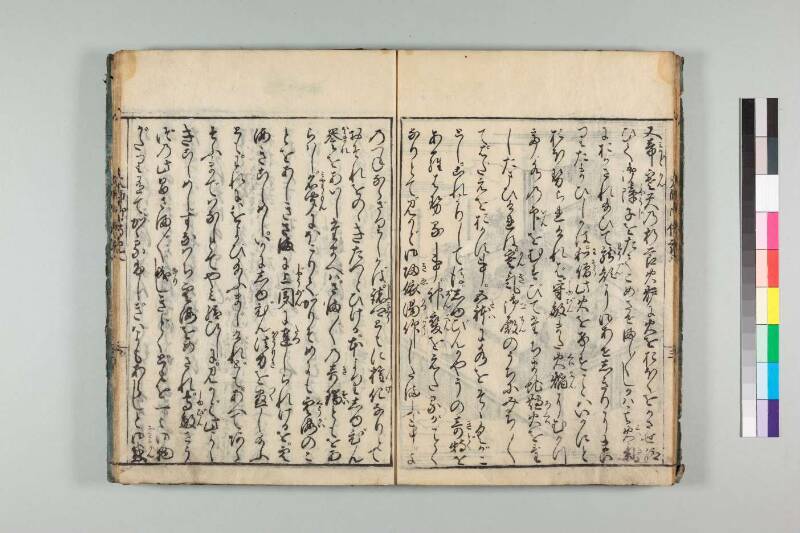
翻刻
又 帝(みかど)寒(かん)天の折節火炉に火をおほくおかせ給
ひて御 障子(しやうじ)をたてこめさせまし〳〵しかは其 火気(くはき)
におかされ給ひて竜顔(れうがん)に御あせしきりにまい
りたまひしかば。和僧(わそう)此火をけすことはいかにと
おほせられければ。守敏(しゆびん)また火焔(くはえん)にむかつ
て。水の印(いん)をむすびてたちまち炉火(ろくは)をけ
したまひければ。寒気(かんき)御殿(ごてん)のうちにみち〳〵
て。はだえをおかす事。五 体(たい)に水をそゝくがこ
とし。これよりして後。しゆびんかやうの奇特(きどく)を
あらはせる事。神変(しんべん)をえたるがことく
なりとて。みかど御 帰依(きゑ)渇仰(かつがう)したまふ事。よ
のつねならざりしかば。諸卿(しよきやう)ともに権化(ごんけ)なりとて
おそれおのゝきたつとひける。本よりしゆびん
誉(ほまれ)をあいしたまへは。さま〴〵の奇瑞(きすい)ともをあ
らはし。名聞(みやうもん)にほこりて。かりそめにも空海(くうかい)のこ
とをあしきさまに上聞(じやうぶん)に達(たつ)しられけるを。空
海きこしめし。いかにしゆびん法力(ほうりき)を尽(つく)し給ふ
とも。われにはおよび給ふまじけれども。あへてあら
そふまではなしとてやみ給ひしに。みかど此よし
きこしめし。すなはち空海をめされ。守敏(しゆびん)さう
づの此間さま〴〵成(なり)しきどくどもを一々御物
がたり有て。かゝるふしぎはよもあらしと。御感(ぎよかん)
現代語訳
また、帝は寒い季節のある折、火炉に火をたくさん置かせなさり、御障子を立て込めさせていらっしゃったところ、その火気に当てられなさって、龍顔(帝のお顔)に御汗がしきりに流れていらっしゃったので、「僧よ、この火を消すことはできるか」と仰せになったところ、守敏はまた火炎に向かって水の印を結び、たちまち炉の火を消してしまわれたので、寒気が御殿の中に満ち満ちて、肌を刺す様子は、五体に水を注ぐようであった。これ以来、守敏がこのような奇跡を現したことは、神通力を得たかのようだとして、帝が御帰依・渇仰なさること、世の常ならぬほどであったので、諸卿もともに(守敏は仏菩薩の)権化であると言って、恐れ畏み、尊んだのであった。もとより守敏は名誉を愛しておられたので、さまざまな奇瑞を現し、名声を誇って、かりそめにも空海のことを悪いように上聞(天皇のお耳)に達せられていたのを、空海はお聞きになり、「いかに守敏が法力を尽くされようとも、私には及びなさるまいけれども、あえて争うまでのことはない」と言ってやめておられたところ、帝はこのことをお聞きになり、すぐに空海をお召しになって、守敏僧都がこの間(その期間に)なしたさまざまな奇跡の数々を一々御物語になって、「このような不思議なことは、よもやあるまい」と御感心
英語訳
Furthermore, on one occasion during the cold season, the Emperor had a great quantity of fire placed in the brazier and had the paper screens drawn tightly shut. Overcome by the heat, the Emperor began to perspire profusely upon his august face. He therefore said, "Monk, can you extinguish this fire?" Shūbin turned once again toward the flames, this time forming the mudra of water, and instantly extinguished the fire in the brazier. Cold air then filled the palace to its very depths, and the chill that pierced the skin was as though water were being poured over one's entire body. From this time forward, Shūbin's display of such miracles came to be regarded as though he had obtained divine supernatural powers, and the Emperor's devotion and reverence for him became extraordinary, unlike anything common to this world. The assembled nobles together declared him to be an incarnation of a Buddha or bodhisattva, trembling in awe and revering him deeply. Since Shūbin had always been fond of renown, he displayed various wondrous signs and, proud of his fame, had even gone so far as to speak ill of Kūkai to the Emperor's ears. Upon hearing of this, Kūkai said, "However much Shūbin may exhaust his dharma powers, he cannot match me—yet there is no need for me to openly contend with him," and let the matter rest. When the Emperor heard of this, he immediately summoned Kūkai and recounted to him one by one the various miracles Shūbin the Sōzu had performed in the interval, expressing his admiration, saying, "Surely such wonders could not exist anywhere else in the world"—