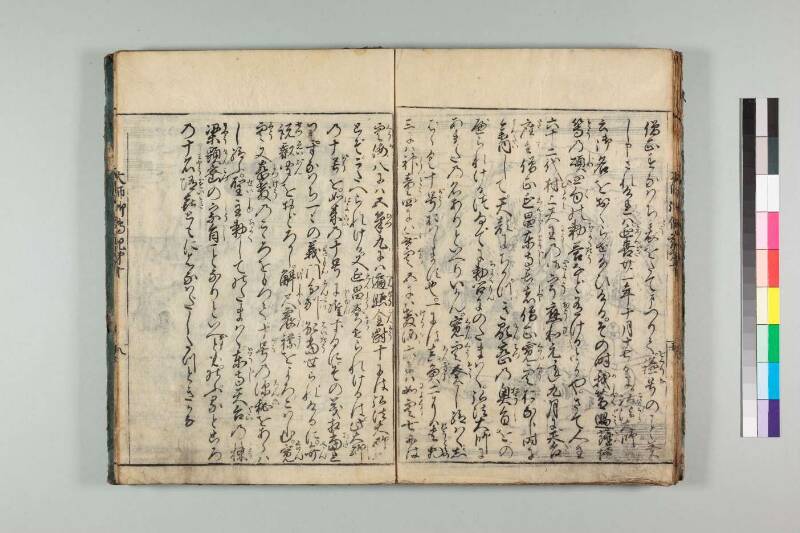
翻刻
【大師号の事】
僧正すなはち表(へう)をたてまつりて。謚号(をくりな)のこと奏
し申されけれは。延喜(えんぎ)廿一年十月十七日に。弘法(こうぼう)大師と
云法名をおくらせ給ひける。その時 我(か)昔(しやく)遇(ぐう)薩埵(さつた)
等(とう)の頌(しゆ)四 句(く)の勅答(ちよくたう)など有けるとかや。さて人王
六十二代 村上(むらかみ)天皇(わう)の御宇(ぎよう)応和(おうわ)元年九月に天台(だい)
座主(ざす)僧正 延昌(えんしやう)東寺(とうじ)長者(じや)僧正 寛空(くはんくう)おなじ時に
参内(さんだい)して。天 顔(がん)にちかづき験密(けんみつ)の奥旨(おうし)を。の
べられける。つゐでに勅問(ちよくもん)にのたまはく。弘法大師に
あまたの名ありといへりいかん。寛空(くはんくう)奏(そう)し給はく。し
ばらく十 号(がう)おはします也。一には真魚(しんぎよ)二には貴物(たうともの)
三には神童(しんとう)四には無空(むくう)五には教海(けうかい)六には如空(によくう)七には
【大師十号ある事】
空海(くうかい)八には五 筆(ひつ)九には遍照(へんせう)金剛(こんがう)十には弘法大師也
とぞ。こたへられける。又 延昌(えんしやう)奏(そう)せられけるは。此大 師(し)
の十号(がう)を。如来(によらい)の十号に准(じゆん)ずるに。その義相 当(あた)れ
り。すなはち一々の義門(ぎもん)分別(ぶんべつ)配当(はいたう)せられけるに。弁(べん)
説(せつ)叡聞(えいぶん)をおどろかし。解尺(げしやく)震襟(しんきん)をよろこはしむ。寛(くはん)
空(くう)又 密教(みつけう)のこゝろをもつて。十 号(がう)の深秘(しんひ)をあらは
し給ふ。聖主(せいしゆ)勅(ちよく)してのたまはく。東寺(とうじ)天台(だい)の棟(とう)
梁(りやう)験密(けんみつ)の宗旨(しうし)となりといへども。のぶるところ
の十 名(みやう)随喜(ずいき)ともにはなはだしたつときかな
現代語訳
【大師号の事(大師号について)】
僧正(観賢)はすぐさま表を奉って、謚号(おくり名)のことを奏上申し上げたところ、延喜二十一年(921年)十月十七日に、「弘法大師」という法名が贈られた。その時、「我昔遇薩埵等」の頌(偈)四句の勅答などがあったということである。さて、人王六十二代・村上天皇の御代、応和元年(961年)九月に、天台座主・僧正延昌と、東寺長者・僧正寛空が、同じ時に参内して、天顔(帝のご尊顔)に近づき、顕密の奥旨を述べられた。その折に、勅問があって仰せになるには、「弘法大師にはあまたの名があると言うが、いかに。」と。寛空が奏上なさるには、「しばらく(まず)、十の号がおはします。一には真魚(しんぎょ)、二には貴物(たうともの)、三には神童(しんどう)、四には無空(むくう)、五には教海(きょうかい)、六には如空(にょくう)、七には
【大師に十号ある事(大師に十の号がある事)】
空海(くうかい)、八には五筆(ごひつ)、九には遍照金剛(へんじょうこんごう)、十には弘法大師なり。」とお答えになった。また、延昌が奏上されるには、「この大師の十号を、如来の十号に准(なぞら)えてみれば、その義(意義)はよく相当(一致)する。」とおっしゃって、すなわち一つ一つの義門(意味の門)を分別し配当されたところ、その弁説は叡聞(帝のお耳)を驚かせ、解釈は帝の御心を喜ばせた。寛空はさらに密教の心をもって、十号の深秘(深い秘義)を明らかになさった。聖主(帝)は勅して仰せになるには、「東寺・天台の棟梁として顕密の宗旨となるとはいえ、述べるところの十の名(みな)、随喜ともに、はなはだ尊いことよ。」と。
英語訳
【On the Bestowal of the Title "Daishi"】
The Ecclesiastical Administrator (Kangen) immediately presented a memorial and submitted a formal request regarding the bestowal of a posthumous honorific title. Accordingly, on the seventeenth day of the tenth month of Engi 21 (921 CE), the Buddhist name "Kōbō Daishi" (Propagator of the Dharma, Great Master) was bestowed. At that time, it is said that there was an imperial rescript in the form of a four-verse gāthā beginning with the words "Ga shaku gū sattā" ("In former times I encountered the Bodhisattva..."). Now, in the reign of the sixty-second sovereign, Emperor Murakami, in the ninth month of the first year of Ōwa (961 CE), the Tendai Zasu (Head Abbot of the Tendai school), Ecclesiastical Administrator Enshō, and the Tō-ji Chōja (Head of Tō-ji Temple), Ecclesiastical Administrator Kankū, attended court together, approached the imperial presence, and expounded upon the inner teachings of the exoteric and esoteric doctrines. On that occasion, an imperial inquiry was made: "It is said that Kōbō Daishi had many names — how so?" Kankū replied in audience: "To enumerate briefly, he has ten appellations. The first is Shingyo (True Fish); the second is Tōtomono (Precious Being); the third is Shindō (Child Prodigy); the fourth is Mukū (Without Emptiness); the fifth is Kyōkai (Ocean of Teachings); the sixth is Nyokū (Like Emptiness); the seventh is
【On the Daishi Having Ten Appellations】
Kūkai (Sky and Sea); the eighth is Gohitsu (Five Brushes); the ninth is Henjō Kongō (Universally Illuminating Vajra); and the tenth is Kōbō Daishi (Propagator of the Dharma, Great Master)." Thus he answered. Furthermore, Enshō submitted: "If one were to compare these ten appellations of the Great Master with the ten epithets of the Tathāgata (Buddha), their meanings correspond most fittingly." He then proceeded to distinguish and assign the significance of each appellation one by one, and his eloquent exposition astonished the imperial ears, while his interpretations delighted the Emperor's heart. Kankū further revealed the profound and secret meanings of the ten appellations through the perspective of Esoteric Buddhism. The sacred sovereign then issued an imperial edict, saying: "Although you stand as the pillars of Tō-ji and Tendai and serve as the masters of the exoteric and esoteric teachings, the ten names you have expounded are, to our shared rejoicing, most exceedingly venerable."