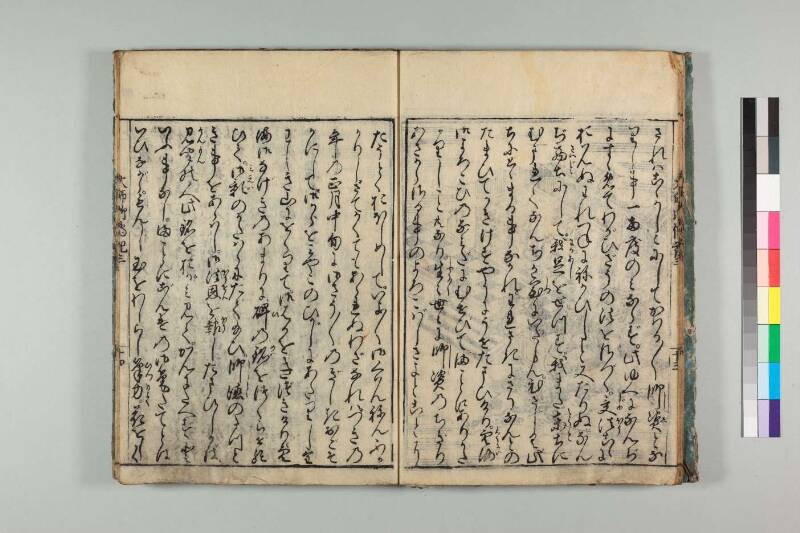
翻刻
されはこゝかしこにしてかはる〳〵師資(しし)と
なりし事一両度んおみならず。此ゆへになんぢ
にすゝめてわがひざうの法をさづく。受法(じゆほう)こゝに
おはんぬわれつねにねかひしこと又たりぬ。なん
ぢ西土(さいど)にして。我(わが)足(あし)をせつす。我また東土(とうど)も
むまれてなんぢか室(しつ)にいたらん。ひさしく此
ちにとゞまる事なかれ。われさきにさりなんとの
たまひてかきけすやうにうせたまひけり。空海(くうかい)
御よろこひのなみだにむせびて。まことにありかた
かりしこと供なり。生々(しやう〳〵)世々に師資(しし)のちぎり
あさからさる事のよろこばしさよとことに
【恵果和尚の碑銘を書給ふ事】
たうとくおほしめして。いよ〳〵御くはんねんふか
かりし。さてかくてもあられぬわざなれは。つきの
年の正月中旬に御さう〳〵のぎしきおごそ
かにして。御からをみやこのひがしにあたりしけ
わしき山にをくりて。御はかをきづきけり。空
海御なげきのあまりに。碑(ひ)の銘(めい)をつくらせ給
ひて。御影(みえい)のかたはらにたて給ひ。師徳(しとく)のたつと
き事をあらはし。御 法恩(ほうをん)を報(ほう)したまひしかば。
見聞(けんもん)の人此銘をおがみて。かんにたへずと
いふ事なし。まことにごんけの恩筆たてとは
いひながら。もんじ玉をわしらし筆力(ひつりよく)花をしく
現代語訳
「それゆえ、あちらこちらにおいて、交互に師と弟子となり合ったことは、一度や二度にとどまらない。このゆえに、汝に勧めて、我が秘蔵の法を授けたのである。受法はここに終わった。我がつねに願ってきたことも、また成就した。汝は西土(中国)において我の足跡を継いだ。我もまた東土(日本)に生まれて、汝の室に参ろう。久しくこの地に留まることなかれ。」
そのように仰せになって、かき消すようにお姿が消えてしまわれた。空海は喜びの涙にむせびながら、誠に有難いことばかりであると思われた。「生々世々に師と弟子との契りが浅からぬことの、なんと喜ばしいことよ」と、ことさらに尊く思し召して、いよいよ御観念が深まっていかれた。
とはいえ、このまままた(喪に伏したまま)ではいられないことゆえ、翌年の正月中旬に、御葬送の儀式を厳かに執り行い、御柩を都の東に当たる険しい山へと送って、御墓を築いた。空海は嘆きのあまりに、碑の銘文をお作りになり、御影のかたわらに建て、師の徳の尊いことを顕わし、御法恩に報いられたので、見聞きした人々はこの銘を拝して、感銘に堪えないと言わない者はなかった。誠に権化(仏菩薩の化身)の恩ある筆蹟であるとは言いながら、文字は玉を連ねたようで、筆力は花を敷き詰めたようであり——
英語訳
"It is for this reason that, here and there across many places, we have taken turns becoming master and disciple to one another — not merely once or twice. Therefore I urged you on, and transmitted to you the teachings of my most secret Dharma. The transmission of the Dharma is now complete here. That which I have always prayed for has also been fulfilled. You have received my footsteps here in the Western Land [China]. I, too, shall be born in the Eastern Land [Japan] and come to your dwelling. Do not linger long in this place."
With those words, the master's form vanished as if dissolving into thin air. Kūkai, choked with tears of joy and gratitude, felt that all of this was truly beyond words of thankfulness. "How joyful it is," he thought, "that the bond of master and disciple across life after life should be so deep." He held these feelings with the utmost reverence, and his contemplative devotion grew ever deeper.
Yet things could not remain as they were, and so in the middle of the first month of the following year, a solemn funeral rite was conducted with great ceremony. The master's remains were conveyed to the rugged mountains to the east of the capital, and a grave was built there. Overwhelmed with grief, Kūkai composed an epitaph inscription for the memorial stele, which was erected beside the master's portrait. In it, he gave expression to the noble virtue of his teacher and repaid his debt of gratitude for the transmission of the Dharma. There was not a single person who saw or heard of this inscription who was not moved to the depths of their heart. It was said to be a work of the brush graced by one who was himself a manifestation of a Buddha or Bodhisattva — the characters strung together like precious jewels, the power of the brushwork as if scattering flowers across the page —