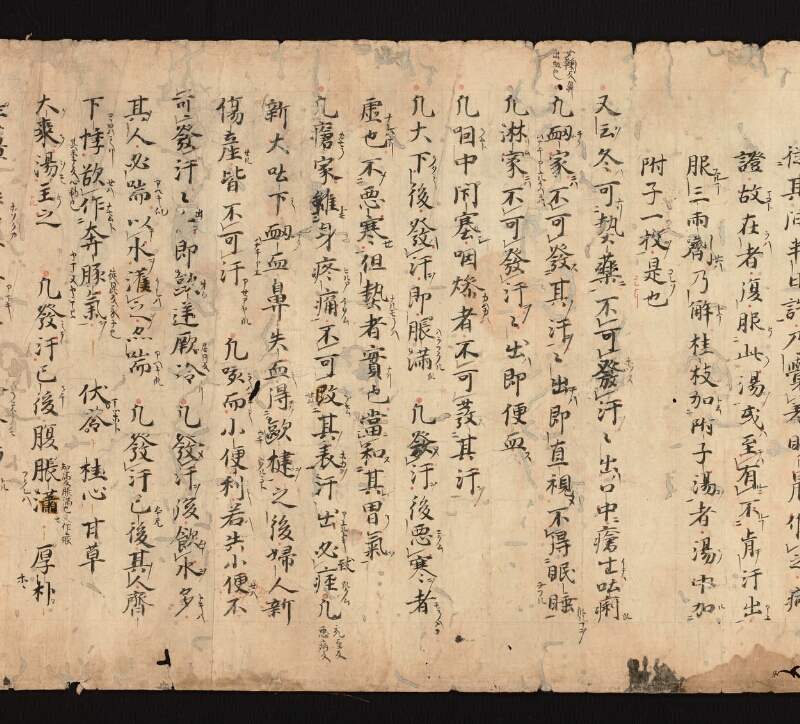
翻刻
証 故(マコト)在 ̄ラハ者復服 ̄リ_二此 ̄ノ湯 ̄ヲ_一或 ̄ハ至 ̄テハ_レ有 ̄ルニ_レ不 ̄ルヿ_二肯 ̄テ汗 出(ミエ)_一
服 ̄スルヿ三₋両₋剤 ̄セハ乃 解(トケ)桂₋枝 加(ト云)_二附₋子₋湯 ̄ヲ_一者湯 ̄ノ中加 ̄ル_二
附子一枚 ̄ヲ_一《振り仮名:是也|コレソ|コレナリ》
又云 ̄ク冬 ̄ハ可 ̄ナリ_二熱₋薬 ̄ニ_一不_レ可_レ発(ホツス)_レ汗 ̄ヲ々出 ̄ハ口中 ̄ニ瘡 出(イテヽ)吐₋痢 ̄ス
【欄外上部・衂】
「女鞠反鼻
出血也」
凡《振り仮名:衂₋|チク|ハナチミユルイヘニハ》家 ̄ニハ不_レ可_レ発 ̄ス_二其 ̄ノ汗 ̄ヲ_一々出 ̄テハ即直₋視 ̄メ不_レ得_二《振り仮名:眠₋睡||ネフル》 ̄スルヿヲ_一
凡淋 ̄リム₋家 ̄ニハ不_レ可_レ発_レ汗 ̄ヲ々出 ̄ハ即便血 ̄ス
凡 咽(ノムト)中閉₋塞 ̄シ咽 燥(カハカ)者(ハ)不_レ可_レ発 ̄ス_二其汗 ̄ヲ_一
凡大 下(クタシ)後発 ̄ハ_レ汗 ̄ヲ即 《振り仮名:脹₋満|ハラフクル》 ̄ス 凡発 ̄メ_レ汗 ̄ヲ後 悪(ニクム)_レ寒 ̄ヲ者(モノハ)
虚 ̄ナレハ也(ナリ)不 ̄メ_二悪₋寒 ̄セ_一但熱 ̄ナル者(モノハ)実 也(ナリ)《振り仮名:当| ニ| シ》_レ和 ̄ス_二其 ̄レ胃 ̄ノ気 ̄ヲ_一
凡 瘡(カサノ)家雖 ̄トモ_二身 疼(ヒルミ)₋痛(イタム)_一不_レ可_レ攻(セム)_二其 ̄ノ表(ホカヲ)_一汗 出(ミユルトキ)必_レ[致]𤷁(スクム) 凡
【欄外下部】《割書:充至反|悪病反》
新大呿下 ̄シ《振り仮名:衂₋|チク|ハナチミエ》血鼻失血 ̄シ得 ̄テノ_二《振り仮名:歐₋揵||ウチ ウタルヽコト》 ̄ヲ_一之後婦₋人新
傷₋産 ̄セル皆不_レ可_レ汗(アセミヤス) 凡 咳而(シハフキシ)小₋便₋利 ̄シ若 ̄ハ失小便 ̄セハ不
_レ可_レ発_レ汗々出即 歐(オウ)₋逆 厥(居月反)冷 ̄ナリ 凡発 ̄メ_レ汗 ̄ヲ後飲 ̄ムヿ_レ水 ̄ヲ多 ̄トキハ
其 ̄ノ人必 喘(アヘキス)以 ̄テ_レ水 ̄ヲ灌 ̄イレハ_レ之 ̄ヲ亦 喘(アヘキス) 凡発_レ汗已[本无]₋後其 ̄ノ人齊
下₋《振り仮名:悸|コヽロハシリ|其季反心動也》欲 ̄セハ_レ作(ナサムト)_二《振り仮名:奔₋豚(徒昆反豕子也)₋気||ヤマヌヤマイ》#1 ̄ヲ_一 伏苓(マツホト) 桂心 甘草
大 ̄ク₋棗 ̄ノ湯 ̄ヲモ《振り仮名:主| リ| トル》之 凡発 ̄シテ已₋後(ノチ)腹《振り仮名:脹(知髙反脹満也又作痕)満||フクレハ》 ̄セ 厚₋《振り仮名:朴||ホヽ》₋
生姜 半夏(ホソクア) 甘草(アマキ) 人参(カノニケクサ)#2湯《振り仮名:主| トル| リ》之
現代語訳
## 【桂枝加附子湯の続き・発汗の禁忌】
(前頁より続き)……証(しるし)がまことにある者は、再びこの湯を服する。あるいは、どうしても汗が出ないことがあっても、三両剤(さんりょうざい)を服すれば、すなわち(病が)解ける。「桂枝加附子湯(けいしかぶしとう)」と言うものは、(桂枝)湯の中に附子(ぶし)一枚を加えたものである。これがそれである。
---
また云う:冬は熱薬(ねつやく・温める薬)がよく、発汗させるべきではない。汗が出れば、口中に瘡(かさ)が出て、吐き下し(吐瀉・としゃ)をする。
> 【欄外注】「衂(ちく)」:女鞠反(じょきくはん)。鼻より血が出ることをいう。
およそ衂(はなちみ)——(すなわち、鼻血を出す)病のある——家(人)には、その汗を発させてはならない。汗が出れば、すなわち直視(ちょくし・目がまっすぐ固定して動かない状態)となり、眠ること(眠睡)ができなくなる。
およそ淋(りん)——(すなわち、排尿困難の)病のある——家(人)には、汗を発させてはならない。汗が出れば、すなわち便血(べんけつ)する。
およそ咽中(のどの中)が閉塞し、咽(のど)が燥(かわ)いている者は、その汗を発させてはならない。
およそ大いに下(くだし)た後に発汗させれば、すなわち脹満(はらがふくれること)する。
およそ発汗した後に寒を悪(にく)む(悪寒する)者は、(正気が)虚(きょ)しているからである。悪寒せずただ熱(ねつ)のある者は実(じつ)である。(その場合は)その胃の気(いのき)を和(やわら)げるべきである。
およそ瘡(かさ)——(すなわち、皮膚に傷や瘡のある)——家(人)は、身体が疼痛(ひるみいたむ)していても、その表(おもて・体表)を攻めてはならない。汗が出れば必ず𤷁(すくみ・痙攣・引きつり)を招く。
> 【欄外注】𤷁(充至反、悪病反)
およそ新たに大いに下し、衂血(ちくけつ・鼻出血)し、失血し、打ち打たれること(歐揵・外傷)を受けた後、あるいは婦人が新たに傷産(しょうさん・難産・産後の傷)をした者は、皆、汗をかかせてはならない(発汗させてはならない)。
およそ咳をして小便利(りん・頻尿・排尿)があり、あるいは小便を失禁する(失小便)ならば、発汗させてはならない。汗が出れば、すなわち嘔逆(おうぎゃく・嘔吐して気が逆上する)し、厥冷(けっれい・手足が冷え切る)となる。
およそ発汗した後に水を飲むことが多いときは、その人は必ず喘(あえ)ぐ。水をもってこれに灌(そそ)げば、また喘ぐ。
およそ発汗し已(おわ)った後、その人の臍下(へその下)が悸(こころはしり・動悸のようにどきどきする)して、奔豚気(ほんとんき・突き上げるような気の病)を作(な)さんとする(起こそうとする)ならば、
> **茯苓(まつほど)・桂心・甘草・大棗の湯**がこれを主(つかさど)る。
およそ発汗し已(おわ)った後、腹が脹満(ふくれ)すれば、
> **厚朴(こうぼく)・生姜・半夏(ほそくあ)・甘草(あまき草)・人参(かのにけぐさ)の湯**がこれを主(つかさど)る。
英語訳
## [Continuation of Keishi-ka-Bushi-tō; Contraindications for Inducing Perspiration]
*(Continued from the previous page)* …If the signs (*shirushi*, symptoms/indications) are genuinely present, administer this decoction again. Even if there are cases in which the patient is simply unwilling to sweat, after taking two or three preparations (*sān liǎng jì*), the condition will resolve. What is called "Keishi-ka-Bushi-tō" (Cinnamon Twig Decoction Plus Aconite) is [the base] Cinnamon Twig Decoction (*tō*) with one piece of aconite (*bushi*, *Aconitum*) added. This is it.
---
It further says: In winter, warming medicines (*netsuyaku*) are appropriate; one must not induce perspiration. If sweat is produced, sores (*kasa*) will emerge within the mouth, and the patient will vomit and have diarrhea.
> **Marginal note:** *Chiku* (衂): read [with the fanqie] *nǚjú* 女鞠 反 — meaning blood issuing from the nose.
As a general rule, in households where there is *chiku* (nosebleed, epistaxis) — [i.e., persons prone to nosebleeds] — one must not induce perspiration. If sweat is produced, the patient will immediately develop a fixed forward gaze (*chokushi*, staring eyes that cannot move), and will be unable to sleep.
As a general rule, in households where there is *rin* (淋, urinary difficulty, strangury) — [i.e., persons with urinary disorders] — one must not induce perspiration. If sweat is produced, the patient will immediately have blood in the stool (*benketsu*).
As a general rule, in persons whose throat is obstructed and whose throat is dry, one must not induce perspiration in them.
As a general rule, if perspiration is induced after a major purgation, the patient will immediately develop abdominal distension and fullness (*chōman*, bloating).
As a general rule, after perspiration has been induced, a person who has an aversion to cold (*okurimono wa kyōsuru*) is so because [their vital energy] is deficient (*kyō*). A person who has no aversion to cold but only fever is in a state of excess (*jitsu*). [In the latter case,] one should harmonize (*yawaragu*) the qi of that person's stomach.
As a general rule, in persons with sores (*kasa*) — [i.e., those with skin wounds or ulcers] — even if the body aches and is in pain, one must not attack (*semu*) the exterior (*omote*, surface of the body). If sweat is produced, it will certainly bring about rigidity/tetanic spasm (*sukumi*, convulsion or stiffening).
> **Marginal note:** 𤷁 — *chōngzhì fǎn* (充至反), *è bìng fǎn* (悪病反) [phonetic glosses].
As a general rule, those who have recently undergone major purgation, suffered nosebleed (*chikaketsu*, epistaxis with blood loss), lost blood, or received blows and injuries (*ōken*), and women who have recently suffered injury in childbirth (*shōsan*) — all of these must not be made to sweat.
As a general rule, if a person has a cough with free urination (*shōbenri*), or is incontinent of urine (*shitsu shōben*), one must not induce perspiration. If sweat is produced, the patient will immediately suffer from vomiting and counterflow (*ōgyaku*) and become cold in the extremities (*ketsurei*, jué-lěng, reversal cold of the limbs).
As a general rule, when after perspiration has been induced the patient drinks much water, that person will certainly pant (*aegu*, dyspnea, wheezing). If water is poured over that person, they will also pant.
As a general rule, after perspiration has been induced and completed, if the area below the patient's navel palpitates (*kokorobashiri*, "the heart runs" — a fluttering/throbbing sensation), and the patient is about to experience *Honton-ki* (奔豚気, "Running Piglet Qi," a paroxysmal condition of surging energy), then:
> **The decoction of Poria (*matsuhodo*, *Poria cocos*), Cinnamon Heart, Licorice, and Jujubes** governs (*tsukasadoru*) this.
As a general rule, after perspiration has been induced and completed, if the abdomen becomes distended and full (*chōman*, bloating), then:
> **The decoction of Magnolia Bark (*kōboku*, *Magnolia officinalis*), Fresh Ginger, Pinellia (*hosokuā*, *Pinellia ternata*), Licorice, and Ginseng (*Panax ginseng*)** governs this.