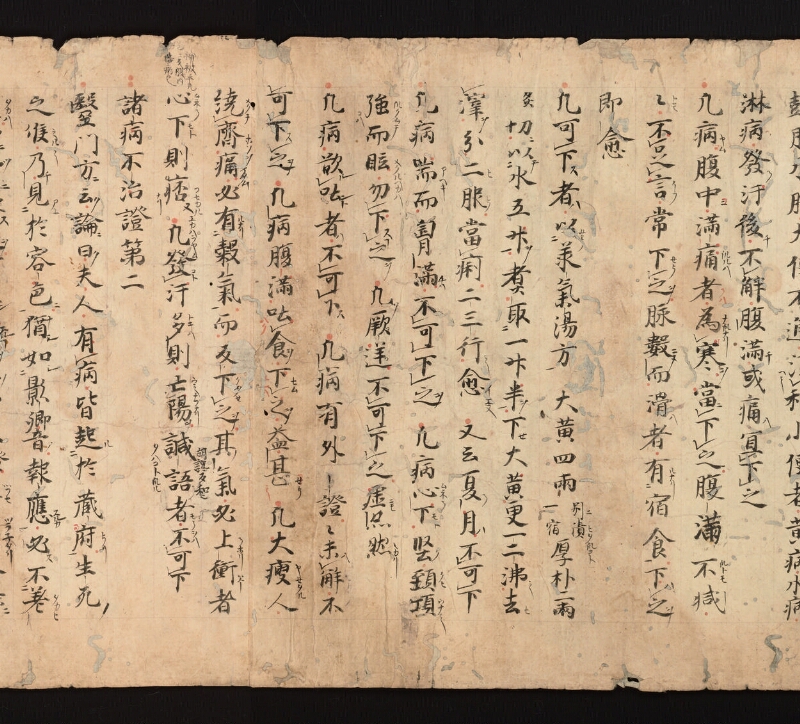
翻刻
淋病発 ̄ノ汗後 ̄チ不_レ解腹満 ̄チ或痛 ̄ハ宜_レ 下_レ之
凡 病(ヤム)腹中 ̄ニ満₋痛 ̄スルハ者 為(ナスナリ)_レ寒 ̄ヲ当 ̄ニ_レ 下_レ之腹₋満不 ̄ストモ減
減 ̄トモ不_レ足_レ言(イフ)常下 ̄セリ_レ之 ̄ヲ脈数 ̄ニメ而滑 ̄ハ者有 ̄ルナリ_二宿食_一 下 ̄ハ_レ之 ̄ヲ
則愈
凡可_レ 下 ̄ス者 ̄ハ以 ̄セリ_二承気湯方_一 大黄四両《割書:別 ̄ニ漬(ヒタスコト)|一 宿》厚朴二両
[灸]切 ̄ニ以 ̄テ_二水五升 ̄ヲ_一煮取_二 一升半 ̄ヲ_一 下 ̄せ大黄更一二沸 ̄シ去 ̄サ
_レ滓 ̄ヲ分二 ̄ヒ服 ̄リ当_レ痢二₋三₋行 ̄シ愈(イエヌ) 又云夏 ̄ノ月 ̄ハ不_レ可_レ 下
凡病 喘(アヘキ)而胸満 ̄テハ不_レ可_レ 下_レ之 ̄ヲ 凡病 心下(ムネノモト)堅 ̄ク頸項(クヒウナシ)
《振り仮名:強|スクムチ|コハ》而 眩(メクルヘカハ)勿_レ 下 ̄スヿ_レ之 ̄ヲ 凡 ̄ソ厥₋逆不_レ可_レ 下_レ之虚 ̄ニモ亦 然(シカリ)
凡病欲 ̄ル_レ吐 ̄ント者 ̄ハ不_レ可_レ 下 ̄ス 凡病有外々証々未 ̄ハ_レ解不
_レ可_レ 下_レ之 ̄ヲ 凡病腹₋満《振り仮名:吐||ハク》_レ食 ̄ヲ下 ̄サム_レ之 ̄ヲ益《振り仮名:甚|セリ| シ》 凡大 痩(ヤセタル)人
繞(メクテ)_レ臍(ホソヲ)痛(イタム)必有 ̄ルナリ_二穀₋気_一而反 下(クタセ)_レ之 ̄ヲ其 ̄ノ気必 上(ノホリ)衝(ツケ)者
【欄外上部・痞】
補被平凡
ニ反腹内
結病也
心下(ムネノモト)則《振り仮名:痞|フサカル又| ナリ》 ̄エカハラヤムコト凡発 ̄コト_レ汗多 ̄トキハ則 《振り仮名:亡_レ陽|ウシナフナリ》 ̄ヲ《振り仮名:諴₋語|胡説ハ反和也|タハコトスル》者(モノヲハ)不_レ可_レ 下
諸₋病不₋治証第二
医門方 ̄ニ云 ̄ク論 ̄ニ曰 ̄ク夫人有_レ病皆起 ̄ル_二於蔵₋府 ̄ヨリ_一生₋死 ̄ノ
之 候(シルシ)乃 ̄チ見(ミユ)_二於容₋色 ̄ニ_一猶(ナホ)如 ̄シ_二影₋響 ̄ノ報₋応 ̄スルカ_一必 ̄ス不_二差(タカヒ)
違(タカハ)_一《振り仮名:当| ニ| シ》_二審 ̄ニ察 ̄ス_一レ之 ̄ヲ万 ̄ニ無 ̄シ_レ失 ̄スルヿ_レ 一 ̄ヲ其 ̄ノ中形₋証 具(ツフサ)列(ツラネタリ)_二後₋条_一
現代語訳
## 【下法の大則・続き】
淋病(りんびょう)・発汗後に(症状が)解けず腹が満ちて、或いは痛む(者は)、これを下すのがよい。
およそ病んで腹中に満痛(まんつう・満ちて痛む)する者は、寒(かん・冷え)をなすものであり、当然これを下すべきである。腹満がたとえ減らなくとも、減ったとしても言うに足らぬほどであれば、常にこれを下せ。脈が数(さく・速い)にして滑(かつ・なめらか)な者は宿食(しゅくしょく)があるのであり、これを下せばすなわち癒える。
およそ下すべき者には、承気湯(じょうきとう)の方(処方)をもってする。
> **承気湯(じょうきとう)処方:**
> 大黄(だいおう)四両【別漬け・一宿(ひとよ・一晩)】、厚朴(こうぼく)二両、炙(あぶ)って切る。水五升をもって煮て一升半を取る。大黄を下(くだ)し、さらに一・二沸(わか)しして、滓(かす)を去り、二つに分けて服す。当に痢(り・下痢・排便)二・三行(こう・回)して癒えるべし。
また云う:夏の月は下してはならない。
およそ病で喘(あえぎ・息切れ)して胸が満ちている者は、これを下してはならない。
およそ病で心下(むねのもと・みぞおち)が堅く(かたく)、頸項(くびうなじ)が強(こわ・こわばり・すくむ)って、眩(めくるべか・めまいがする)者は、これを下してはならない。
およそ厥逆(けつぎゃく・四肢の冷えと気の逆上)の者は下してはならない。虚(きょ・虚弱)もまた同様である。
およそ病んで吐こうとする者は、下してはならない。
およそ病んで外証(がいしょう・表の証候)が未だ解けていない者は、これを下してはならない。
およそ病んで腹満して食を吐く(者に)これを下せば、益々甚だしくなる。
およそ大いに痩せた人で、臍(ほそ)の周りが痛む者は、必ず穀気(こくき・食物の滞り)があるのであり、それをかえって下せば、その気は必ず上に衝(つ)き上がる。
> **【欄外書き込み・上部:「痞」の注記】**
> 「補・被・平。凡そ反(かえ)って腹内に結びて病む也。心下(むねのもと)則ち痞(ふさがる)えかはらやむこと(痞え・塞がること)」
およそ発汗が多いときは、すなわち陽(よう・陽気)を亡(うしな)う。譫語(たわこと・たわごと・うわごと)をする者は、下してはならない。
---
## 諸病不治証 第二(諸々の病の治らぬ証候・第二)
『医門方(いもんほう)』に云う。論に曰く——
それ人に病あれば、みな蔵府(ぞうふ・五臓六腑)より起こり、生死の候(しるし・兆候)は、すなわち容色(ようしょく・顔かたち・顔色)に見(みゆ)る。なお影響(えいきょう・影と響きの喩え)が報応(ほうおう・応答すること)するが如く、必ず(一つも)差違(たがい・違い・誤り)なし。当にこれを審(つまびら)かに察すべし。万に一つも失することなし。その中の形証(けいしょう・外に現れた症状・徴候)は、後条(こうじょう・後の条文)に具(つぶさ)に列(つら)ねたり。
英語訳
## [General Principles of Purgation, Continued]
In cases of *rinbyō* (淋病, urinary difficulty/strangury), and after sweating when [the condition] is not resolved, the abdomen is full, or there is pain — it is appropriate to purge.
As a general rule, in those who are ill and have fullness and pain (*mantsū*) in the abdomen, this constitutes a cold (*kan*) condition; one should appropriately purge them. Even if the abdominal fullness does not decrease, or decreases only insignificantly, one should always purge them. Those whose pulse is rapid (*saku*) and slippery (*katsu*) have retained food (*shukushoku*); purge them, and they will recover.
As a general rule, for those in whom purgation is indicated, one uses the formula of *Jōki-tō* (承気湯, Order-the-Qi Decoction).
> **Formula for *Jōki-tō*:**
> *Daiō* (大黄, Rheum/rhubarb root) 4 *ryō* [soaked separately overnight]; *Kōboku* (厚朴, Magnolia bark) 2 *ryō*, roasted and sliced. Decoct in 5 *shō* of water, reducing to 1.5 *shō*. Add the *daiō*, bring to one or two more boils, remove the dregs, divide into two doses, and take. One should expect two or three bowel movements (*ri*), after which recovery follows.
It further says: In the summer months, one must not purge.
As a general rule, when a patient is wheezing (*aegi*, dyspnoea) and the chest is full, one must not purge them.
As a general rule, when a patient's epigastric region (*mune no moto*, below the heart) is hard, the neck and nape (*kubiunaji*) are stiff and rigid, and there is dizziness, one must not purge them.
As a general rule, those with *ketsugyaku* (厥逆, reversal-cold of the extremities with counterflow qi) must not be purged. Those who are deficient (*kyo*, vacuous) are likewise [contraindicated for purgation].
As a general rule, those who are ill and about to vomit must not be purged.
As a general rule, those who are ill and in whom the exterior manifestations (*gaishō*, exterior pattern/syndrome) have not yet resolved must not be purged.
As a general rule, those who are ill with abdominal fullness and are vomiting food — if one purges them, [the condition] will become even more severe.
As a general rule, in greatly emaciated people who have pain encircling the navel (*hoso*, umbilicus), there is certainly retained grain-qi (*kokuki*, food accumulation); if one purges them instead [of using the appropriate treatment], their qi will inevitably surge upward.
> **[Marginal annotation at top, note on *hi* (痞, epigastric glomus):]**
> "*Ho*, *hi*, *hei* [補被平]. As a general rule, when [qi] is instead bound up inside the abdomen and causes illness — the region below the heart (*mune no moto*) becomes *hi* (痞, blocked/congested; a sensation of obstruction and resistance in the epigastrium)."
As a general rule, when sweating is excessive, one loses one's *yō* (陽, yang qi). Those who speak deliriously (*tawakoto*, incoherent raving; delirium) must not be purged.
---
## Section Two: Signs of Incurable Diseases (*Shobyō Fuchi Shō*, 諸病不治証)
The *Imon-hō* (医門方, *Medical Gateway Formulary*) states, and the discourse (*ron*) says:
When a person has a disease, it always arises from the viscera and bowels (*zōfu*, the five viscera and six bowels). The signs (*shirushi*, indicators) of life and death are revealed in the countenance and complexion (*yōshoku*, facial appearance and skin colour). Just as a shadow invariably follows a form and a sound invariably follows its source — the response is certain and without any deviation or error. One must examine [these signs] carefully. In ten thousand cases, not a single one will be missed. The specific external signs and symptoms (*keishō*) [pertaining to these conditions] are listed in full in the sections that follow.