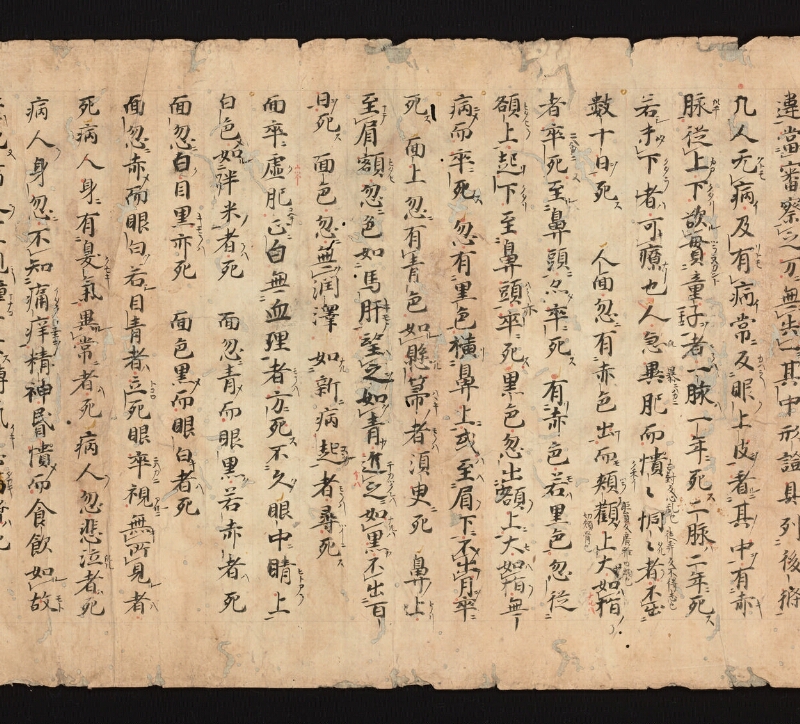
翻刻
凡人无 ̄クトモ_レ病 ̄イ及有 ̄リトモ_レ病 ̄イ常 ̄ニ反 ̄カヘシ_二眼 ̄ノ上₋皮 ̄ヲ_一看 ̄ルニ_二其 ̄ノ中 ̄ヲ_一有_二赤 ̄キ
脈(スチ)_一従_レ 上下(カミクタリ)欲 ̄ル_レ貫(ツラヌカント)_二童₋《振り仮名:子||マナコ》 ̄ヲ_一者(モノハ)一₋脈 ̄ハ一₋年 ̄ニ死 ̄ス二₋脈 ̄ハ二₋年 ̄ニ死 ̄ス
若 ̄シ未 ̄タ_レ 下(クタラ)者 ̄ハ可 ̄キ_レ療 也(ナリ)人 急(ス)異(ニハカニ)[暴]肥而《振り仮名:憒₋々|古対反心乱也|クワイ》《振り仮名:恫₋々|徒弄反不得志也》 ̄タル者 ̄ノ不_レ出_二
数₋十₋日 ̄ヲ_一死 ̄ス 人₋面忽 ̄ニ有_二赤₋色出 ̄ツ_一而 ̄モ頬(ツラ)₋《振り仮名:顴|距員反広雅曰䪼也|切頬骨也》 ̄ノ上大 ̄サ《振り仮名:如| ハ|ナルハ》_レ指 ̄ノ
者 卒(ニハカニ)死 ̄ス至 ̄ル_二鼻頭 ̄ニ_一亦 ̄タ卒 ̄ニ死 ̄ス 有 ̄リ_二赤色 若(モハ)黒色_一忽従_二
額(ヒタヒノ)₋上_一起 ̄リ下(クタリ)至_二鼻 頭(ハシ)_一[亦]卒 ̄ニ死 ̄ス黒₋色忽出_二額 ̄ノ上 ̄ニ_一大 ̄サ如 ̄ハ_レ指 ̄ノ無
病 ̄ニメ而卒 ̄ニ死 ̄ス 忽有_二黒₋色_一横 ̄リ_二鼻上 ̄ニ_一或 ̄ハ至 ̄ハ_二眉 ̄ノ下 ̄ニ_一不 ̄メ_レ出 ̄テ_レ月 ̄ヲ卒 ̄ニ
死 ̄ス 面₋上忽 ̄ニ有_レ青色如 ̄ル_レ懸 ̄ス箒(ハヽキ) ̄ノ者(モノハ)須₋更 ̄ニ死 鼻 ̄ノ上 ̄ヨリ
至 ̄マテ_レ眉₋額(ヒタヒ)忽 ̄ニ色如_二馬 肝(キモノ)_一望 ̄ハ_レ之 ̄ヲ如 ̄ク_レ青 ̄カ《振り仮名:近|チカツクレハ|ケハ》_レ之 ̄ニ如 ̄ナルハ_レ黒 ̄カ不_レ出_二百₋
日 ̄ヲ_一死 ̄ス 面₋色忽 ̄ニ無 ̄ク_レ潤₋沢 如 ̄ナル_二新 ̄ニ病起 ̄コルカ_一者(モノハ)尋 ̄ツイニ死 ̄ス
面卒 ̄ニ虚(ウツケ) ̄ク肥(コヘテ)正 ̄ニ白無_二血理_一者(モノハ)方 ̄ニ死 ̄ス不_二久 ̄ク眼₋中 ̄ニ晴(ヒトミノ)上_一
白色 ̄メ如 ̄ル_二《振り仮名:半||ワリ》米 ̄ノ_一者 ̄ノハ死 面忽 ̄ニ青 ̄メ而眼黒 ̄ク若赤亦者 ̄ハ死
面忽 ̄ニ白 ̄ノ目黒 ̄キモノハ亦死 面色黒 ̄メ而眼白 ̄キ者 ̄ハ死
面忽 ̄ニ赤 ̄メ而眼白 ̄ク若 ̄シ目青者 ̄ハ立 ̄トコロ死眼卒(ニハカニ)視(ミルニ)無 ̄キ_レ所_レ見 ̄ル者 ̄ハ
死病人身 ̄ニ有_二臭気(クサク)_一異 ̄ル_レ常 ̄ニ者 ̄ハ死 病人 ̄ノ忽悲₋泣 ̄スル者 ̄ハ死
病人 ̄ノ身忽 ̄ニ不_レ知_二痛(イタク)痒(カユキヲ)_一精₋神昏憒 ̄メ而食₋飲如 ̄ル_レ故(モト)
者 ̄ハ死 ̄ヌ病人 ̄ノ《振り仮名:直₋視||ソラメシテ》 ̄シ瞳子(マナコ)不_レ転 気息(イキ)㾸(タカキ)【高ヵ】者 ̄ハ死
現代語訳
## 諸病不治証 第二(続き)
およそ人は病がなくとも、また病があったとしても、常に(患者の)眼の上瞼(うわまぶた)を裏返して、その中を見るとよい。赤い脈筋(すじ)があって、上から下へ瞳(まなこ)を貫こうとしている者は、一筋あれば一年のうちに死に、二筋あれば二年のうちに死ぬ。もし(赤い脈筋が)まだ下まで達していない者は、治療することができる。
人が急に(にわかに)異常に肥え、而して憒々(くわい・くわい、心が乱れること)・恫々(どう・どう、志を得られず不安なこと)としている者は、数十日を出ずして死ぬ。
人の顔に忽ち赤色が現れ出て、頬の顴(かんこつ・頬骨)の上に指の太さほどの(赤色)がある者は、にわかに死ぬ。(赤色が)鼻の頭に至る者もまたにわかに死ぬ。
赤色あるいは黒色があって、忽ち額(ひたい)の上から起こり、下って鼻の頭に至る者もまたにわかに死ぬ。
黒色が忽ち額の上に現れ、指の太さほどの大きさで、病がないのにわかに死ぬ。
忽ち黒色があって、鼻の上に横たわり、あるいは眉の下に至って、(その色が)一月(ひとつき)を出ずしてにわかに死ぬ。
顔の上に忽ち青色があって、箒(ほうき)を懸けたように(垂れ下がって見える)者は、すぐに死ぬ。
鼻の上から眉・額(ひたい)にかけて、忽ち色が馬の肝(きも)のようになり、遠くから見れば青いようで、近づいて見れば黒いようである者は、百日を出ずして死ぬ。
顔色が忽ち潤沢(うるおい・つや)を失い、新たに病が起きたようである者は、ついに(程なく)死ぬ。
顔が急に空洞(うつろ)に肥えて(膨れて)、正(まさ)に白く血の理(すじ・気色)がない者は、まさに死ぬ。程なくして眼の中の瞳(ひとみ)の上に、白色が半米(こめひとつぶの半分)ほどの大きさで現れた者は死ぬ。
顔が忽ち青くなり、眼が黒く、あるいは赤い者は死ぬ。
顔が忽ち白くなり、目が黒い者もまた死ぬ。
顔色が黒くなり、眼が白い者は死ぬ。
顔が忽ち赤くなり、眼が白く、あるいは目が青い者は、その場で死ぬ。
眼が急に(にわかに)見るべきものが見えなくなった(視力を失った)者は死ぬ。
病人の身体に異常な臭気(くさみ)があって、常と異なる者は死ぬ。
病人が忽ち悲しんで泣く者は死ぬ。
病人の身体が忽ちに痛みも痒みも感じなくなり、精神が昏憒(こんかい・ぼんやりとして乱れ)して(いるに)、飲食はもとのとおりである者は死ぬ。
病人が直視(そらめ・目を正面に固定して)して、瞳(まなこ)が動かず、気息(いき)が高い(たかく・あえぐように荒い)者は死ぬ。
英語訳
## Section Two: Signs of Incurable Diseases (*Shobyō Fuchi Shō*), Continued
As a general rule, whether a person is ill or not, one should always fold back the upper eyelid and examine the interior. If there are red vessels (*suji*, streaks/veins) running downward from above, as if about to pierce through the pupil (*manako*), then: one such vessel means death within one year; two such vessels means death within two years. If [the vessels] have not yet reached down [to the pupil], the condition can be treated.
When a person suddenly and abnormally puts on weight and is in a state of *kwai-kwai* (憒々, mental confusion and agitation) and *dō-dō* (恫々, despondency and inability to fulfill one's will), such a person will die within a matter of tens of days.
When a red colour suddenly appears on a person's face, and on the *kankotsú* (顴, cheekbone) it is as large as a finger — such a person will die suddenly. If [the redness] reaches as far as the tip of the nose (*hanataki*), they will likewise die suddenly.
When there is a red or black colour that suddenly arises from the forehead (*hitai*) and descends to the tip of the nose — such a person will also die suddenly.
When a black colour suddenly appears on the forehead, as large as a finger, even without apparent illness — [the person] will die suddenly.
When there is a sudden black colour lying across the nose — or reaching as far as below the eyebrows — [the person] will die suddenly within the month.
When there is a sudden green-blue (*ao*) colour on the face, like a broom hanging down, such a person will die very soon.
When the colour of the region from the nose to the eyebrows and forehead suddenly becomes like horse's liver (*uma no kimo*) — appearing bluish-green when viewed from afar, but appearing black when approached closely — such a person will die within one hundred days.
When a person's facial colour suddenly loses its lustre and moisture, like someone in the early onset of a new illness, such a person will ultimately die [before long].
When the face suddenly swells up vacuously (*utsukeku*) and becomes pallid and white with no trace of healthy blood colour (*chi no suji*) — such a person is on the verge of death. Before long, when a white colour the size of half a grain of rice appears on the upper [area] of the pupil (*hitomi*) in the eye — such a person will die.
When the face suddenly turns blue-green and the eyes become dark, or red — [such a person] will die.
When the face suddenly turns white and the eyes become dark — [such a person] will also die.
When the facial colour becomes black and the eyes turn white — [such a person] will die.
When the face suddenly turns red and the eyes turn white, or the eyes turn blue-green — [such a person] will die on the spot.
When a person's eyes suddenly have nothing they can see [i.e., they suddenly lose their sight] — [such a person] will die.
When a sick person's body emits an unusual foul odour (*kusaki*), different from the ordinary — [such a person] will die.
When a sick person suddenly weeps with grief — [such a person] will die.
When a sick person's body suddenly loses all sensation of pain and itching, their spirit and mind (*seishin*) become dull and confused (*konkai*), yet their eating and drinking remain as normal — [such a person] will die.
When a sick person stares fixedly (*sorame*, with the eyes rigidly directed forward, immobile), their pupils (*manako*) do not move, and their breathing (*ikisoku*) is elevated and laboured — [such a person] will die.