翻刻
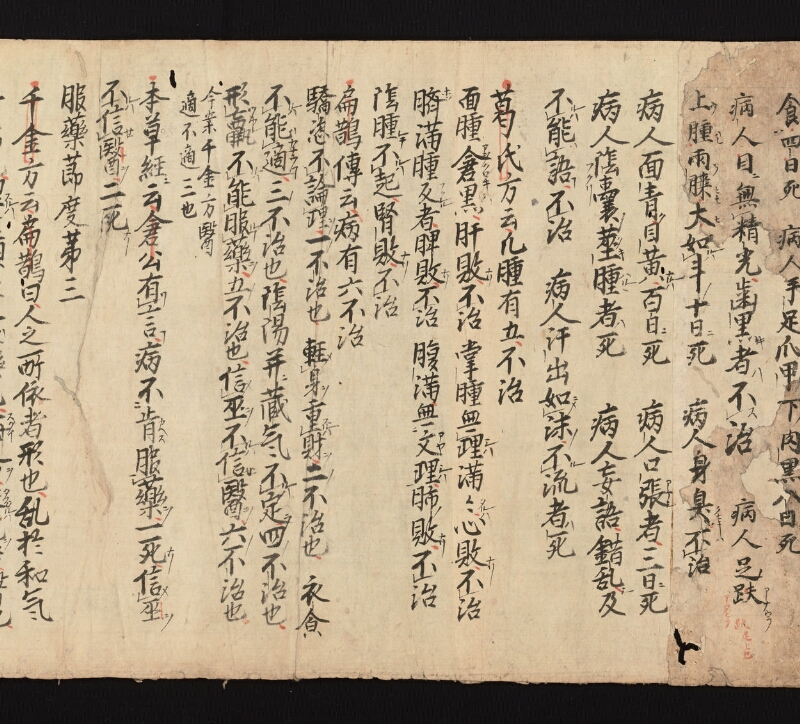
食_一 四₋日死 病人手足爪甲下 ̄ノ肉黒 ̄キハ八₋日死
病人目 ̄ニ無_レ精₋光歯黒 ̄キ者 ̄ハ不 ̄ス_レ治 病人足 ̄ノ《振り仮名:趺|アナウラ|アナヒラ》【欄外下部 趺 足上也】
上 ̄ヲ腫(ハレ)両 ̄ノ膝(ヒサ)大 ̄サ如 ̄ルハ_レ斗 ̄ノ十日 ̄ニ死 病人身 臭(クサキハ)不_レ治
病人面青 ̄ク目黄 ̄ナルハ百₋日 ̄ニ死 病人口 張(アケシ)者三日 ̄ニ死
病人《振り仮名:陰嚢||フクリ》 ̄ノ茎(クキ)腫(ハルヽ)者 ̄ハ死 病人妄₋語錯乱 ̄シ及
不 ̄ルハ_レ能 ̄ハ_レ語 ̄ヿ不_レ治 病人汗出如 ̄ニメ_レ沫 ̄ノ不 ̄ル_レ流者 ̄ハ死
葛氏方云凡腫有五不治
面腫 倉黒(アヲクロキハ)肝敗 ̄ナリ不_レ治 掌腫無_レ理(シハ)満々 ̄タルハ心敗 ̄ナリ不_レ治
臍(ホソ)満腫 反(フクレル)者、脾敗 ̄ナリ不_レ治 腹満無_二文理(アヤシハ)_一肺 ̄ノ敗 ̄ナリ不_レ治
陰腫 ̄レテ不 ̄ルハ_レ起腎敗 ̄ナリ不_レ治
扁鶺伝云病有六不治
驕₋恣不 ̄ハ_レ論_レ理 ̄ヲ一 ̄ノ不₋治也 軽 ̄メ_レ身 ̄ヲ重 ̄スルハ_レ財 ̄ヲ二 ̄ノ不₋治也 衣₋食
不 ̄ルハ_レ能 ̄ハ_レ適(カナウヿ)三 ̄ノ不₋治也 陰₋陽并 ̄ニ蔵気不 ̄ルハ_レ定 ̄ラ四 ̄ノ不₋治也
形 羸(ツカレ)不 ̄ルハ_レ能_レ服 ̄ルヿ_レ薬 ̄ヲ五 ̄ノ不₋治也 信 ̄メ_レ巫 ̄ヲ不 ̄ルハ_レ信 ̄せ_レ医 ̄ヲ六 ̄ノ不₋治也
《割書:今案千金方医|適不適三也》
本草経 ̄ニ云倉公有 ̄リ_レ言 ̄ヿ病不_二肯(カヘス)服_一レ薬 ̄ヲ一死 ̄ナリ信 ̄メ_レ巫 ̄ヲ
不 ̄ルハ_レ信 ̄せ_レ医 ̄ヲ二死 ̄ナリ
服薬節度第三
千金方云扁鶺曰人之所依者形也 乱於和気
者病也 理 ̄スルハ_二於煩毒者 ̄ハ薬也 済(スクイ)_レ命 ̄ヲ扶(タスクルハ)_レ厄 ̄ヲ者医也
現代語訳
## 【諸病不治証 第二・続き】
(前ページより続き)——食(飲み食い)せず、四日で死ぬ。
病人の手足の爪甲(つめ)の下の肉が黒い者は、八日で死ぬ。
病人の目に精光(せいこう・生き生きとした輝き)がなく、歯が黒い者は治らない。
病人の足の趺(あなうら・足の甲)の上が腫れ、両膝の大きさが斗(と・升を量る器)のようである者は、十日で死ぬ。
病人の身体が臭い(くさい)者は治らない。
病人の顔が青く、目が黄色い者は、百日で死ぬ。
病人の口が張り開いている者は、三日で死ぬ。
病人の陰嚢(ふくり)の茎(くき・陰茎)が腫れる者は死ぬ。
病人が妄語(もうご)・錯乱し、また言葉を発することができない者は治らない。
病人の汗が泡のように出て流れない者は死ぬ。
---
### 葛氏方(かつしほう)に云う——およそ腫(はれ)に五つの治らないものがある。
顔が腫れて蒼黒(あおぐろ)い者は、肝(かん)の敗(はい・衰え果てること)であり、治らない。
掌(てのひら)が腫れて理(しわ)がなく、ぱんぱんに満ちている者は、心(しん)の敗であり、治らない。
臍(ほそ・へそ)が満ちて腫れ、反(ふく)れる者は、脾(ひ)の敗であり、治らない。
腹が満ちて文理(あや・紋様・模様・しわ)がない者は、肺(はい)の敗であり、治らない。
陰(いん・陰部)が腫れて起(た)たない者は、腎(じん)の敗であり、治らない。
---
### 扁鵲伝(へんじゃくでん)に云う——病に六つの治らないものがある。
驕恣(きょうし)にして(驕り高ぶり、わがままで)道理を論じない者は、一つ目の不治である。
身(からだ)を軽んじて、財(たから)を重んじる者は、二つ目の不治である。
衣食(いしょく)が適(かな)うことができない者は、三つ目の不治である。
陰陽(いんよう)並びに蔵気(ぞうき)が定まらない者は、四つ目の不治である。
形(からだ)が羸(つか)れ(痩せ衰えて)、薬を服することができない者は、五つ目の不治である。
巫(ふ・かんなぎ・祈祷師)を信じて、医(い)を信じない者は、六つ目の不治である。
【割注:今、案ずるに、『千金方』では「医の適・不適」を三つ目としている。】
---
### 本草経(ほんぞうきょう)に云う——
倉公(そうこう)に言葉がある。病に肯(がえ)んじて薬を服さない者は、一つ目の死(死に至る理由)である。巫(かんなぎ)を信じて医を信じない者は、二つ目の死である。
---
## 服薬節度 第三
### 千金方に云う——
扁鵲(へんじゃく)曰く、「人の依(よ)るところのものは形(からだ)である。和気(わき・調和のとれた気)を乱すのは病である。煩毒(はんどく・病の苦しみ・毒邪)を理(ことわ)るのは薬である。命を済(すく)い、厄(やく)を扶(たす)けるのは医(いしゃ)である。」
英語訳
## [Section Two: Signs of Incurable Diseases, Continued]
[Continuing from the previous page:] — cannot drink or eat. Death comes in four days.
If a sick person's flesh beneath the fingernails and toenails is black — death comes in eight days.
If a sick person's eyes lack *seikō* (精光, vital luminosity) and the teeth are black — this is incurable.
If a sick person's *fu* (趺, the dorsum of the foot, the upper surface of the foot) swells up, and both knees become as large as a *to* (斗, a vessel used for measuring grain) — death comes in ten days.
If a sick person's body emits a foul odour — this is incurable.
If a sick person's face is blue-green and the eyes are yellow — death comes in one hundred days.
If a sick person's mouth falls open — death comes in three days.
If a sick person's *fukuri* (陰嚢, scrotum) and *kuki* (茎, the shaft of the penis) swell — that person will die.
If a sick person speaks nonsense and becomes confused (*mōgo sakuran*, delirious and incoherent), or conversely becomes unable to speak at all — this is incurable.
If a sick person's sweat comes out like foam and does not flow — that person will die.
---
### The *Kashiho* (葛氏方, *Formulary of Master Ge*) states: In general, there are five kinds of swelling (*hare*) that cannot be treated.
If the face is swollen and dark blue-black (*aoguroi*) — this is failure (*hai*, collapse) of the **Liver** (*kan*), and is incurable.
If the palm is swollen, has no lines (*shiwa*, creases), and is tautly full — this is failure of the **Heart** (*shin*), and is incurable.
If the navel (*hoso*) is full, swollen, and protrudes outward (*fukureru*, bloated and distended) — this is failure of the **Spleen** (*hi*), and is incurable.
If the abdomen is full and has no *mon-ri* (文理, surface markings/creases/texture) — this is failure of the **Lung** (*hai*), and is incurable.
If the *in* (陰, genitals/genital region) is swollen and does not become erect — this is failure of the **Kidney** (*jin*), and is incurable.
---
### The *Henjaku-den* (扁鵲伝, *Biography of Bian Que*) states: There are six things in illness that cannot be treated.
One who is arrogant and self-indulgent (*kyōshi*) and will not listen to reason (*dōri*) — this is the **first** incurable condition.
One who holds their body in low regard but prizes their wealth — this is the **second** incurable condition.
One whose clothing and food (*ishoku*, material circumstances) cannot be made suitable (*kanau*) — this is the **third** incurable condition.
One in whom *yin* and *yang*, as well as the visceral *qi* (*zōki*), are unsettled and not stabilised — this is the **fourth** incurable condition.
One whose body (*katachi*) is exhausted and emaciated (*tsukare*, wasted) and cannot take medicine — this is the **fifth** incurable condition.
One who trusts in shamans (*fu*, *kannagi*, spirit-mediums/exorcists) and will not trust in physicians — this is the **sixth** incurable condition.
[Interlinear note: According to my present inquiry, the *Senkin-hō* (千金方, *Prescriptions Worth a Thousand Gold*) gives "the suitability or unsuitability of the physician" as the third condition.]
---
### The *Honzō-kyō* (本草経, *Classic of Materia Medica*) states:
Master Cāng Gōng (倉公) had the following words: One who, though ill, will not consent to taking medicine — this is the **first** cause of death. One who trusts in shamans (*kannagi*) and will not trust in physicians — this is the **second** cause of death.
---
## Section Three: The Proper Measure of Taking Medicine (*Fuyaku Setsudo*, 服薬節度第三)
### The *Senkin-hō* (千金方, *Prescriptions Worth a Thousand Gold*) states:
Bian Que (扁鵲) said: "That upon which human beings depend is the body (*katachi*, the physical form). What disturbs the harmonious *qi* (*waki*, the balanced and harmonised vital energy) is disease. What regulates and resolves the affliction of vexing poison (*handoku*, the toxic pathogenic influence causing distress) is medicine. What rescues life and aids [one] out of calamity is the physician."