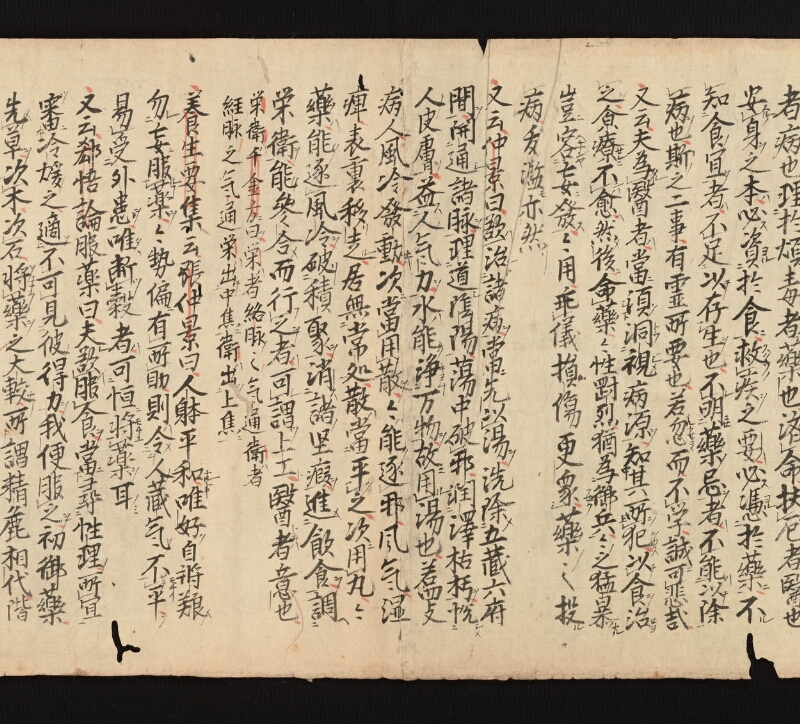
翻刻
安 ̄スルノ_レ身 ̄ヲ之本 ̄ハ必 ̄ス資(ヨル)_二於食 ̄ニ_一救(スクウノ)_レ疾 ̄ヲ之要 ̄ハ必 ̄ス憑(ヨル)_二於薬 ̄ニ_一不 ̄ル
_レ知_二食 ̄ノ宜 ̄ヲ_一者 ̄ハ不_レ足_二以 ̄テ存_一レ生 ̄ヲ也不 ̄ル_レ明 ̄ニセ_二薬 ̄ノ忌 ̄ヲ_一者 ̄ハ不_レ能 ̄ハ_二以 ̄テ除_一
_レ病 ̄ヲ也斯 ̄ノ之二事有霊所要也若忽(イルカセニメ)而不_レ学誠 ̄ニ可_レ悲哉
又云夫為 ̄タル_レ医者 ̄ハ当 ̄ニ《振り仮名:須| ク|シ》_下洞(トウ)_二₋視 ̄ジメ病₋源 ̄ヲ_一知_中其所 ̄ヲ_上レ犯(ヲカス)以 ̄テ_レ食 ̄ヲ治 ̄セヨ
_レ之 ̄ヲ兌#1₋療 ̄セシニ不 ̄ンハ_レ愈 ̄ハ然 ̄メ後 ̄ニ命_レ薬々性剛₋烈猶為_二《振り仮名:御||フセク》₋兵_一々 之(ノ)猛₋暴 ̄ナル
豈 ̄ニ容(ヘケンヤ)_二妄 ̄ニ発 ̄ス_一々用乖_レ儀損₋傷更衆《振り仮名:衆|| シ》薬 之(ノ)投 ̄ル
_レ病発濫 ̄モ亦然 ̄リ
又云仲景曰欲 ̄ハ_レ治 ̄ント_二諸病 ̄ヲ_一当 ̄ニ先以_レ湯 ̄ヲ洗除 ̄メ_二 五蔵六府
間 ̄ヲ_一開_二₋通 ̄シ諸脈 ̄ヲ_一理_二₋道 ̄シ陰₋陽_一蕩中破_レ邪潤_二沢枯朽 ̄ヲ_一悦 ̄シメ_二
人 ̄ノ皮膚 ̄ヲ_一益 ̄ス_二 人 ̄ノ気力 ̄ヲ_一水 ̄ハ能 ̄ク浄(キヨム)_二万物 ̄ヲ_一故 ̄ニ用 ̄ル_レ湯也若四支
病人風冷発₋動 ̄セハ次 ̄ニ当_レ用_レ散 ̄ヲ々( ハ)能 ̄ク逐_レ邪風気湿
痺表裏移 ̄リ走 ̄ル居無_二常処_一散 ̄ハ当_二平 ̄ク_一レ之次 ̄ニ用_レ丸々
薬 ̄ハ能 ̄ク逐_レ風冷 ̄ヲ破 ̄リ_二積₋聚_一消 ̄ス_二諸 ̄ノ堅瘕 ̄ヲ_一進 ̄メ_二飲食 ̄ヲ_一調 ̄ヘ_二
栄衛 ̄ヲ_一能 ̄ク参合 ̄メ而行 ̄フ_レ之 ̄ヲ者 ̄ハ可 ̄シ_レ謂 ̄ツ上₋工 ̄ト医 者(ト云ハ)意也
《割書:栄衛千金方 ̄ニ曰 ̄ク栄 ̄ハ者絡₋脈 ̄ノ之気₋通衛 ̄ハ者|経脈之気通栄出 ̄テ_二 中焦 ̄ニ_一衛 ̄ハ出 ̄ソ_二 上焦 ̄ニ_一》
養生要集云張仲景曰人₋体平₋和 ̄ナルトキ唯好 ̄ク自《振り仮名:将養||モチイ》 ̄メ
勿 ̄シ_二妄 ̄ニ服 ̄ルヿ_一レ薬 ̄ヲ々勢偏 ̄ニ有_レ所_レ助則 ̄ハ《振り仮名:令|| ム》 ̄メ_二 人 ̄ノ蔵₋気 ̄ヲ不 ̄サラ_一レ平 ̄ラ
易_レ受_二外患 ̄ヲ_一唯(タヽ)断 ̄ツ_レ穀者 ̄ハ可_二恒 ̄ニ将(モチユ)_一レ薬 ̄ヲ耳(ノミ)
又云郄悟論服薬曰夫 ̄レ欲 ̄ハ_レ服_レ食 ̄ヲ当 ̄ニ_下尋_二性₋理 ̄ノ所_レ宜_一
審(ツ ) ̄ニ_中冷煖之適 ̄ヲ_二不_レ可_レ見_二彼 ̄ノ得力 ̄ヲ_一我便服_レ之 ̄ヲ初御薬
先 ̄メ_レ草 ̄ヲ次_レ木次_レ石 将(ヲコナウ)_レ薬 ̄ヲ之大₋較 ̄ナリ所謂精麁相代階
現代語訳
## 【服薬節度 第三・続き】
身(からだ)を安(やす)んじる根本は、必ず食(しょく・食事)に資(よ)る(頼る)ものであり、疾(やまい)を救う要(かなめ)は、必ず薬に憑(よ)る(頼る)ものである。食の宜(よろし)きを知らない者は、もって生を存(たも)つに足りない。薬の忌(いみ)を明らかにしない者は、もって病を除くことができない。この二つのことは、霊験(れいけん)ある(重要な)所要(必要なこと)である。もし忽(おろそ)かにして学ばなければ、誠(まこと)に悲しむべきことではないか。
---
また云う——およそ医(いしゃ)たる者は、まさに病源(びょうげん・病の根源)を洞視(とうし・見通し)し、その犯す(冒している)ところを知り、もって食(しょく・食事療法)をもってこれを治するべきである。食療(しょくりょう)して愈(い)えない場合、然(しか)る後に薬を命(めい)ずる。薬の性(せい)は剛烈(ごうれつ・激しく強い)であり、なお御兵(ふせく(御す)兵・抑え制する兵)のようなものである。兵の猛暴(もうぼう)なること、どうして妄(みだ)りに発(はっ)することを容(ゆる)すことができようか。用い方が儀(ぎ・道理)に乖(そむ)けば、損傷はかえって多くなる。衆薬(しゅうやく・多くの薬)を病に投(とう)じることも、濫(みだ)りに発することは、またこれと同じである。
---
また云う——仲景(ちゅうけい)曰く、「諸病を治せんと欲する者は、まず湯(とう・煎じ薬・湯液)をもって五蔵六府(ごぞうろっぷ)の間を洗除(せんじょ・洗い清め)し、諸脈(しょみゃく)を開通させ、陰陽(いんよう)を理道(ことわ)り(整理し)、蕩中(とうちゅう・腸中・体内)の邪(じゃ)を破り、枯朽(ここう・乾き朽ちたもの)を潤沢(じゅんたく・潤わせ)し、人の皮膚を悦(よろこ)ばせ(潤し)、人の気力を益す(増やす)べきである。水は能く万物を浄(きよ)める、ゆえに湯を用いるのである。もし四支(しし・四肢)の病に、風冷(ふうれい・風邪と冷え)が発動すれば、次に散(さん・散薬・粉薬)を用いるべきである。散は能く邪風(じゃふう)・気湿(きしつ)・痺(ひ・しびれ)を逐(お)い、表裏(ひょうり)を移り走り、常処(じょうしょ・一定の場所)がないものを、散はよく平(たい)らかにする。次に丸(がん・丸薬)を用いる。丸薬は能く風冷を逐い、積聚(しゃくじゅ・腹中のしこり)を破り、諸(もろもろ)の堅瘕(けんか・かたいしこり)を消し、飲食を進め、栄衛(えいえ・営気と衛気)を調える。能くこれらを参合(さんごう・組み合わせ)してこれを行う者は、上工(じょうこう・最上の医者)と謂(い)うべきである。医とは意(い・思慮・工夫)である。」
【割注:栄衛について——『千金方』に曰く、「栄(えい)とは絡脈(らくみゃく)の気の通じることであり、衛(え)とは経脈(けいみゃく)の気の通じることである。栄は中焦(ちゅうしょう)に出(い)で、衛は上焦(じょうしょう)に出(い)ず。」】
---
### 養生要集(ようじょうようしゅう)に云う——
張仲景(ちょうちゅうけい)曰く、「人体が平和(へいわ・平穏で調和がとれている)なるとき、ただ自らよく将養(しょうよう・養生)し、妄(みだ)りに薬を服することなかれ。薬の勢(いきお)いは偏(かたよ)りて助くるところがある。すなわち人の蔵気(ぞうき・五臓の気)を平らかならしめず、外患(がいかん・外からの病邪)を受けやすくする。ただ断穀(だんこく・穀物を断って仙道修行を行う)する者だけは、恒(つね)に薬を将(もち)いてよいのみ。」
---
また云う——郄悟(きくご)の「論服薬(ろんふくやく・服薬を論ず)」に曰く、「それ(薬を)服食(ふくしょく)せんと欲するには、まさに性理(せいり・薬の性質と道理)の宜(よろし)きところを尋ね、冷煖(れいだん・寒涼と温熱)の適(かな)うことを審(つまび)らかにすべきである。彼(かれ)(他人)が力(効き目)を得るを見て、我(われ)もすなわちこれを服するというのではいけない。初めて御薬(おんやく・薬を服用する)には、まず草(そう・草類の薬)を先にし、次に木(もく・木類の薬)、次に石(せき・鉱物類の薬)とする。薬を将(おこな)う(用いる)大較(たいかく・おおよその規則)がこれである。いわゆる精麁(せいそ・精製度の高いものと粗いもの)が相代(あいかわ)り、階(きざはし・段階的に)……」
(以下次ページへ続く)
英語訳
## [Section Three: The Proper Measure of Taking Medicine, Continued]
The foundation of keeping the body at peace necessarily relies upon food; the essential means of rescuing illness necessarily relies upon medicine. One who does not know what foods are suitable is not sufficient to preserve life. One who does not make clear the contraindications of medicine is unable to eliminate disease. These two matters are what is vitally and efficaciously required. If one neglects them and does not study, is this not truly a thing to lament?
---
It further states: In general, one who serves as a physician ought to penetrate and perceive (*tōshi*, see through) the source of the disease, know what it is that has been violated, and first treat it through food [i.e., dietary therapy]. If dietary treatment does not bring about a cure, only then should medicine be prescribed. The nature of medicine is harsh and intense; it is like a soldier held in restraint. Given the ferocity and violence of soldiers, how could one permit their deployment at random? If the manner of their use deviates from proper principle, the harm caused will be all the greater. The indiscriminate use of many medicines upon a disease is likewise the same.
---
It further states: Zhongjing (仲景, Zhang Zhongjing) said: "For those who wish to treat all manner of diseases, one should first use a *tō* (湯, decoction/liquid medicine) to wash and cleanse the spaces of the Five Viscera and Six Bowels (*gozō roppū*), open and unblock all the vessels (*myaku*), regulate and order *yin* and *yang*, break through the evil pathogen (*ja*) within the body's interior (*tōchū*), moisten and enrich what is dried and withered (*koko*), please and refresh the skin of the person, and augment the person's vital energy and strength. Water is capable of purifying all things — therefore the decoction is used. If in diseases of the four limbs, wind-cold (*fūrei*) flares up and stirs, one should next use a *san* (散, powder/powdered medicine). Powder is capable of driving out evil wind (*jafū*), damp-*qi* (*kishitsu*), and *bi* (痺, obstruction/numbness), which move about between the exterior and interior without any fixed location — the powder can pacify these. Next, use *gan* (丸, pills). Pill medicines are capable of driving out wind-cold, breaking up *shakuju* (積聚, accumulations and gatherings, i.e., abdominal masses), dispersing all manner of firm and hard masses (*kenka*), promoting the intake of food and drink, and regulating *ei-e* (栄衛, *ying* and *wei*, construction and defence *qi*). One who is able to combine and employ all of these appropriately may be called an *upper-grade physician* (*jōkō*, physician of the highest rank). The physician [*i*, 医] is [one of] intention and deliberation [*i*, 意]."
[Interlinear note: Regarding *ei-e* (栄衛, *ying* and *wei* qi) — the *Senkin-hō* (千金方, *Prescriptions Worth a Thousand Gold*) states: "*Ei* (栄, construction *qi*) is the passage of *qi* through the *rakumyaku* (絡脈, collateral vessels); *wei* (衛, defence *qi*) is the passage of *qi* through the *keimyaku* (経脈, primary channels). *Ei* issues from the *chūshō* (中焦, the Middle Burner); *wei* issues from the *jōshō* (上焦, the Upper Burner)."]
---
### The *Yōjō Yōshū* (養生要集, *Essential Collection for Cultivating Life*) states:
Zhang Zhongjing (張仲景) said: "When the human body is in a state of peace and harmony (*heika*), one should simply take good care of oneself (*shōyō*, nourish and foster oneself), and must not carelessly take medicine. Medicine's power (*ikioi*, force) tends to be one-sided in the aid it renders; this will cause the visceral *qi* (*zōki*) of the person to become uneven and unstable, making one susceptible to receiving external pathogenic harm (*gaikan*). Only those who practise *dankoku* (断穀, abstaining from grain, a Daoist/ascetic practice) may regularly use medicine."
---
It further states: Xu Wu's (郄悟) "Discussion on Taking Medicine" (*Ronpukuyaku*, 論服薬) states: "For those who wish to take medicinal food, one should first seek out what is suitable according to the nature and principle (*seiri*) of the substance, and carefully discern whether the cold/cooling or warm/warming quality is fitting. One must not simply take something oneself because one has seen another person obtain benefit from it. When first administering medicine (*on'yaku*), first give priority to those derived from **grasses/herbs** (*sō*), then to those from **wood** (*moku*, woody plants/bark/timber), then to those from **stone** (*seki*, minerals). This is the general rule (*taikaku*, the broad principle) for administering medicine. The so-called [principle by which] the refined and the coarse alternate in stages (*kizahashi*, step by step)…"
(Continues on the following page.)