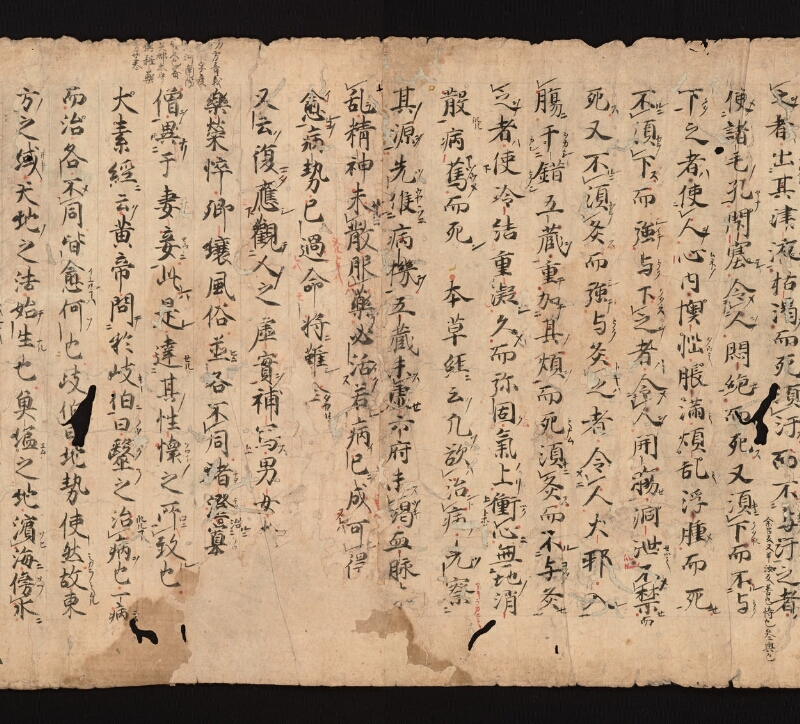
翻刻
_レ之 ̄ヲ者 ̄ハ出(イタス)_二其津₋液 ̄ヲ_一枯渇而死 ̄ヌ湏 ̄ヘキニ_レ汗 ̄ス不_二《振り仮名:与||余呂反羊汝反善也待也参与也》汗_一之者 ̄ノ
使 ̄シメ_二諸₋毛 ̄ノ孔(アナ)_一閉₋塞 ̄シ《振り仮名:令|シメ| テ》_二レ 人 ̄ヲ悶₋絶 ̄せ而死 ̄ス又湏 ̄キニ_レ 下(クタス)而不 ̄ル_二与 ̄ラク
下(クタ)_一之者 ̄ハ使_二レ 人 ̄ヲ心(ムネノ)内懊₋悩(タウシ)脹₋満 ̄シ煩₋乱 ̄シ浮₋腫 ̄シメ而死 ̄せ_一
不 ̄ルニ_レ湏 ̄カラ_レ 下 ̄ス而 強(シイテ)与 ̄ラク下(クタス)_レ之 ̄ヲ者(ハ)《振り仮名:令|シメ| テ》_二レ 人 ̄ヲ開₋腸 ̄せ_一洞₋《振り仮名:泄|セツシ| スル》不(シメ)_レ禁 ̄せ而
死 ̄ス又不 ̄ルニ_レ湏 ̄カラ_レ灸 ̄ス而 強(シイテ)与 ̄ラク灸 ̄トキハ_レ之者《振り仮名:令||シメ》_二レ 人火邪入 ̄ル_一
_レ腸 ̄ニ《振り仮名:干_二₋錯|ツカシ|カン サクシ》五₋蔵 ̄ヲ_一重 ̄テ加 ̄テ_二其 ̄ノ煩 ̄ヲ_一而 死(シナム)湏 ̄キニ_レ灸 ̄ス而不不 ̄ル_二与 ̄ラク灸 ̄せ_一
_レ之 ̄ヲ者 ̄ハ使_下冷₋結重₋凝 ̄シ久 ̄シテ而弥 固(ミクム)気 ̄ノ上 ̄リ《振り仮名:衝|ツク|トホリ》_レ上心 ̄ニ無_二 地 ̄ノ消
散 ̄スル_一病 篤(アツウシテ)而死 ̄ン本草経 ̄ニ云 ̄ク凡 ̄ソ欲 ̄ハ_レ治 ̄ント_レ病 ̄ヲ先 ̄ツ察(アキラカニシ)_二
其 ̄ノ源 ̄ヲ_一先 ̄ツ候(ウカヽウニ)_二病₋機 ̄ヲ_一 五₋蔵未 ̄ス_レ虚 ̄せ六₋府未 ̄ス_レ竭(ツキ)血₋脈未
_レ乱 ̄ラ精神 未(サルニ)_レ散服_レ薬 ̄ヲ必《振り仮名:活|イク| ス》若 ̄シ病 ̄イ已 ̄ニ《振り仮名:成|トキハ| ヌレハ》可_レ得□
愈(イ) ̄ルヿヲ_一病₋勢已《振り仮名:過命|ヌルトキハ| レハ モ》将 ̄ニ難 ̄シ全 ̄タカリ
又云 ̄ク復(マタ)応 ̄シ_下観 ̄テ_二 人 ̄ノ之虚₋実 ̄ヲ_一補写 ̄ス_上男女□□□
楽栄悴郷壌風俗並 ̄ヒニ各不_レ同 褚(チヨ)澄(チヨ)治 ̄ルニ_二寡(クワ)□□
僧 ̄ヲ_一異 ̄ナリ_二于 妻(サイ)妾(セウ) ̄ニ_一此 ̄レハ是 ̄レ達 ̄セル_二其 ̄ノ性₋懐(クワイ) ̄ノ之所 ̄ロニ_一レ致 ̄ル也
大素経 ̄ニ云 ̄ク黄帝問 ̄テ_二於 岐(キ)伯 ̄ニ_一曰(ノタマハク)医 ̄ノ之治 ̄スルヿ_レ病 ̄ヲ也一₋病 ̄ニハ
而治各不 ̄シメ_レ同皆 愈(イエルヿハ)何 ̄ソ也岐伯曰地勢使 然故(シカラシムル)東
方 ̄ノ之 域(ヰキ)大地 ̄ノ之法始 ̄テ生 ̄ナル也魚₋塩(エム)之地浜 ̄ソヒ_レ海 ̄ニ傍(ソフ)_レ水 ̄ニ
【欄外上部】
□方音義
□□字彦
□河南陽
翟人也斉
呉郡太守
撰雑薬
方廿巻#1
現代語訳
【現代語訳(続き)】
…(汗を発すべきでないのに)強いて汗を発させた者は、その津液(体内の水分・体液)を流出させ枯渇させて死に至らしめる。汗を発すべき時に汗を発させない者は、諸々の毛孔を閉塞させ、人を悶絶させて死に至らしめる。また、(薬で)下すべき時に下させない者は、人の胸の内を懊悩(苦悶)させ、脹満・煩乱・浮腫を起こさせて死に至らしめる。下すべきでないのに強いて下させた者は、人の腸を開いて(下痢を)禁じ得ないようにして死に至らしめる。また、灸を据えるべきでないのに強いて灸を据えた者は、人に火の邪気を腸に入らせ、五臓を錯乱させ、その煩わしさをさらに重ねて死に至らしめる。灸を据えるべき時に灸を据えない者は、冷結(冷えによる凝り固まり)を重く凝らせ、長い間にますます固まって、気が上衝して心に至り、(その邪気が)消え散る余地もなく、病が重篤となって死に至らしめる。
『本草経』に云う。おおよそ病を治療しようとするには、まずその病の根源を明らかにし、病機(病の進行・変化の機序)を窺い、五臓がいまだ虚していず、六腑がいまだ竭(つき)ていず、血脈がいまだ乱れておらず、精神がいまだ散じていない(うちに)、薬を服用すれば必ず(命を)活かすことができる。もし病がすでに(深く)成ってしまっていれば、癒えることを得るのは(難しく)……病勢がすでに(命の限りを)過ぎてしまった時には、全うすることはなお難しい。
また云う。また、人の虚実を観て補写(補法・瀉法)を行うべきであり、男女(の別)、〔楽・栄・悴〕、郷壌(風土)・風俗はいずれも各々同じではない。褚澄が寡(婦)〔や尼〕僧を治療するに(あたって)は、妻妾とは(治療法を)異にした。これはその性懐(気質・心情)の致すところを達観したものである。
『大素経』に云う。黄帝が岐伯に問うて仰せになった。「医が病を治療するにあたって、一つの病に対して治療がそれぞれ同じでなくても、みな癒えるのはなぜか」。岐伯が曰く。「地勢がそうさせるのです。ゆえに、東方の地域は、大地の法として(万物が)始めて生じる(場所)である。魚と塩の地で、海に沿い水に傍う……」
【欄外上部の注記】
〔□方の〕音義:
〔□□〕字は彦(?)、
河南陽翟の人なり。
斉・呉郡の太守にして、
雑薬方廿巻を撰す。
英語訳
**[Translation of the current page, continuing Chapter 1: General Principles of Treating Disease]**
…[A physician who,] when sweating is not needed, forcibly induces sweating, will cause the patient's *jin-ye* (bodily fluids and moisture) to be expelled and exhausted, leading to death. One who does not induce sweating when sweating is needed will cause all the pores to become blocked and obstructed, bringing the patient to a state of suffocation and death. Furthermore, one who does not administer a purgative when purging is needed will cause the patient's chest and interior to become afflicted with anguish and distress, abdominal fullness and distension, mental agitation, and edema, leading to death. One who forcibly administers a purgative when it is not needed will cause the patient's intestines to open uncontrollably [in unrelenting diarrhea], leading to death. Furthermore, one who forcibly applies moxibustion when moxibustion is not needed will cause the pathogenic fire (*huo xie*) to enter the patient's intestines, throwing the five viscera into disorder, further adding to the patient's distress and torment, leading to death. One who does not apply moxibustion when moxibustion is needed will allow cold congelation to accumulate and congeal ever more solidly over time, causing the qi to surge upward, striking the heart, with no possibility for the evil influence to dissipate and disperse—the illness will become critical and the patient will die.
The *Bencao Jing* (Classic of Materia Medica) states: In general, when one wishes to treat an illness, one must first clearly discern its source and root, and first observe the pathodynamic (*bìng jī*)—the mechanism by which the illness is progressing. While the five viscera have not yet become deficient, the six bowels have not yet become exhausted, the blood and vessels have not yet fallen into disorder, and the spirit and vitality have not yet scattered—if medicine is taken at this stage, the patient can certainly be saved. However, if the illness has already become fully established, recovery [becomes difficult]…; if the force of the illness has already passed the point of no return, it will be even more difficult to restore the patient to wholeness.
It is also said: Furthermore, one should observe the patient's deficiency or excess (*xu-shi*) and apply supplementing or draining treatments (*bu-xie*) accordingly. Men and women [differ], as do [those of ease and hardship, of flourishing and decline,] the local climate and soil, and customs and practices—none of these is the same. [The physician] Chu Cheng, in treating widows [and nuns and monks], used different methods from those used for wives and concubines. This is because he had fully grasped what their particular natures and dispositions (*xìng huái*) brought about.
The *Taisu Jing* (Grand Basis Classic) states: The Yellow Emperor asked Qi Bo: "When a physician treats illness, if for a single illness the treatments used are each different, yet all result in recovery, why is this so?" Qi Bo replied: "It is the configuration of the land that makes it so. Therefore, the eastern region, according to the principle of the earth, is where [all things] first come into being. It is a land of fish and salt, situated along the sea and beside the water…"
**[Marginal note at the top of the page]**
[Sound and meaning of □ formula/recipe (fāng)]:
The character [□□] is read as *yàn* (?);
a person from Yangzhai in Henan.
He served as Grand Administrator (*tài shǒu*) of [the kingdoms of] Qi and Wu Commandery,
and compiled the *Za Yao Fang* (Miscellaneous Medicinal Formulas) in twenty volumes.