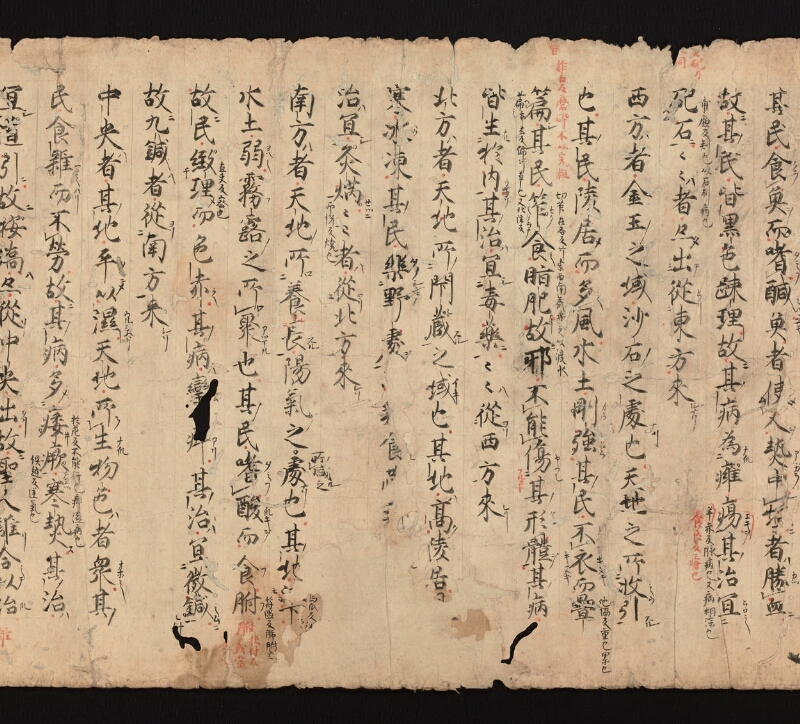
翻刻
其民 食(クラ)_レ魚 ̄ヲ而 嗜(タシフ)醎(シハヽユキ)魚者《振り仮名:使|シメ|ム》_レ 人 ̄ヲ熱中(アツカラ)_レ塩 ̄ニ者 ̄ハ勝(カツ)血
故 ̄ニ其 ̄ノ民皆黒色踈₋理故 ̄ニ其 ̄ノ病為(ナス)_二癕《振り仮名:痬|エキヲ|羊赤反脈病也又病相染也食良反瘡也》_一其 ̄ノ治宜(ヨロシ)_二
《振り仮名:砭|甫廉反刺也以石刺病也|ヘム》#1石 ̄ニ_一々々 者(ハ)亦 ̄タ出 ̄テ_三従 ̄ヨリ_二東方_一来 ̄ルナリ
西方 ̄ハ者金玉 之(ノ)域沙₋石 之(ノ)処 也(ナリ)天地之所_二収(シウ)₋引 ̄スル_一
也其 ̄ノ民陵居 ̄メ而多 ̄シ風水土 剛(カウ)₋強(キヤウ)其 ̄ノ民不_レ《振り仮名:衣|キヌキ|キヌキ》而 ()《振り仮名:畳|他協反重也累也》₋
【欄外上部 笮 詐白反磨砕不以完粒】
《振り仮名:篇||萹之布玄反編竹草也又北陔反》 ̄ン其民《振り仮名:笮|サク|シタムテ》《振り仮名:₋食 ̄シ脂₋肥 ̄ナリ|切笮在各反竹索西南夷尋之以渡水|》故 ̄ニ邪不_レ能_レ《振り仮名:傷|ヤフレ|フルコト》_二其 ̄ノ形体 ̄ヲ_一其 ̄ノ病
皆生 ̄ナル_二於 内(ウチヨリ)_一其 ̄ノ治 ̄ハ宜 ̄シ_二毒薬 ̄ニ_一々々( ハ)従 ̄ヨリ_二西方_一来 ̄レリ
北方 ̄ハ者天地所 ̄ノ_二閉₋蔵 ̄スル_一之 域(イキ)也其地 ̄ハ高 ̄ク陵居□
寒 氷(ヘウ)凍其 ̄ノ民 楽(タノシンテ)_二野₋処□□食□□□□□
治 ̄ハ宜 ̄シ_二灸₋《振り仮名:焫|セツニ|而悦反焼也》_一々々 者(ハ)従 ̄ヨリ_二北方_一来 ̄レリ
所 ̄ノ_レ盛 ̄カル之
南₋方 ̄ハ者天₋地 ̄ノ所 ̄ロ_二養長 ̄スル_一陽気 之(ノ)処 也(ナリ)其 ̄ノ地□₋ 《振り仮名:下|馬瓜反|キ》
水土 其弱(ヨハシ)霧 ̄フ露 之(ノ)所 ̄ロ_レ聚(アツマル)也其 ̄ノ民 嗜(タシフ)_レ酸(スキ)而(ヲ)食 ̄フ胕(フ 符遇反肺胕也)
【欄外下部 胕 扶付反/義当/為腐】
故 ̄ニ民《振り仮名:緻|直吏反密也|チ》₋理 ̄メ而色赤 ̄シ其 ̄ノ病 ̄ハ攣 ̄レム痺 ̄アリ其 ̄ノ治 ̄ハ宜_二微₋鍼 ̄シムニ_一
【欄外下部 レ針】
故 ̄ニ九₋鍼 ̄ハ者従 ̄ヨリ_二南方_一来 ̄レリ
中央 ̄ハ者其 ̄ノ地 平(タ) ̄ニシテ以 湿(ウルヲヘリ)天地所 ̄ノ_レ生 ̄ナス物色 ̄ハ者 衆(オホシ)其 ̄ノ
【痿 ヰ 於花反不能行也痺湿病也】
民食 雑而(マシハリ)不_レ労故 ̄ニ其 ̄ノ病多 ̄メ_二痿₋厥_一寒₋熱 ̄ス其 ̄ノ治 ̄ハ
【厥 クヱツ 俱越反逆気也】
宜 ̄シ_二道引 ̄ニ_一故 ̄ニ按矯 ̄ハ亦従 ̄リ_二 中央_一出 ̄タリ故 ̄ニ聖₋人離(リ)₋合 ̄シテ以治 ̄ス
現代語訳
【現代語訳(続き)—『大素経』より】
その民は魚を食べ、塩辛いものを好む。魚は人の体を熱中(体内に熱がこもること)させ、塩は血に勝つ(血を損なう)。ゆえにその民はみな肌の色が黒く、皮膚の理(きめ)が粗い。ゆえにその病は癰疽(ようそ)・瘍(できもの・潰瘍)となる。その治療には砭石(へんせき/石針)が適している。(この)砭石というものもまた東方から出て来たものである。
西方は金玉の域、砂石の処である。天地が(万物を)収め引き締める(収斂する)ところである。その民は丘陵に住み、風が多く、水土が剛強である。その民は(絹の)衣をまとわず、(草や竹を編んだもので)重ね(席のようなものを敷き)、その民は(圧搾して)脂肪分の多いものを食べる。ゆえに邪気はその形体(肉体)を傷つけることができない。その病はみな内(身体の内部)から生じる。その治療には毒薬(薬物療法)が適している。(この)毒薬(の治療法)は西方から来たものである。
北方は天地が(陽気を)閉じ蔵する(閉蔵する)地域である。その地は高く、丘陵に住〔み〕、寒く氷が凍る。その民は野外での生活を楽しみ、〔(遊牧・狩猟をし、)乳製品などを〕食べ……(その)治療には灸・焫(もぐさを燃やす術)が適している。(この)灸・焫というものは北方から来たものである。
南方は天地が陽気を養い育てる(養長する)ところである。その地は〔低〕く、水土は弱く、霧・露の集まるところである。その民は酸っぱいものを好み、(腐らせた・発酵させた)食物を食べる。ゆえにその民は皮膚のきめが緻密で色が赤く、その病は攣痺(けいれん・しびれ)がある。その治療には微鍼(細い鍼)が適している。ゆえに九鍼(きゅうしん)は南方から来たものである。
中央は、その地が平らで湿っており、天地が(万物を)生み出すものの種類が多い。その民は様々なものを雑食し、労働しない。ゆえにその病には痿厥(いけつ)・寒熱(かんねつ)が多い。その治療には道引(導引)が適している。ゆえに按矯(あんきょう・按摩と矯正の術)もまた中央から出たものである。ゆえに聖人は(これらの治法を)離合して(状況に応じて組み合わせ・使い分けて)治療するのである。
【欄外注記】
#1「砭」:甫廉反、刺すこと。石で病を刺すことである。
「笮」:詐白反、磨り砕くこと、完粒のままにしないこと。また、竹索(竹で編んだ綱)で、西南夷がこれを用いて水を渡る(橋の意)。
「胕」:符遇反・扶付反、義は「腐」と当てるべきである。
「痿」:於花反、行くことのできないもの。痺は湿による病である。
「厥」:俱越反、逆気(気の逆上)である。
英語訳
**[Translation continuing from the *Taisu Jing* (Grand Basis Classic / *Tàisù Jīng*)]**
The people of [the eastern region] eat fish and are fond of salty foods. Fish causes heat to accumulate within the body (*rèzhōng*), and salt overpowers the blood (i.e., is detrimental to the blood). Therefore, the people there all have dark complexions and coarse skin texture. Hence, their diseases take the form of carbuncles and ulcers (*yōng yáng*). For treatment, *biān shí* (stone needles/lancets) are appropriate. These stone needles also originated from the East.
The western region is the domain of gold and jade, a place of sand and stone. It is where Heaven and Earth gather in and consolidate [all things]. The people there dwell on hillsides and ridges, and there is much wind; the water and soil are firm and strong. The people do not wear [silk] clothing but instead wrap and layer [mats woven from grass or bamboo], and they eat pressed, fatty foods. Therefore, pathogenic influences (*xié*) are unable to injure their physical bodies. Their diseases all arise from within [the body's interior]. For treatment, medicinal drugs (*dú yào*) are appropriate. [The practice of using] medicinal drugs came from the West.
The northern region is the domain where Heaven and Earth close off and store [yang qi] (*bì cáng*). Its land is high, the people dwell on ridges and hills, and the cold causes ice and frost to form. The people delight in living in the open wilderness, [herding and hunting,] and eat [dairy products and other such foods]…. For treatment, moxibustion and cauterization (*jiǔ ruò*) are appropriate. [The practice of] moxibustion and cauterization came from the North.
The southern region is where Heaven and Earth nurture and grow yang qi (*yǎng zhǎng*). Its land is [low-lying,] its water and soil are weak, and it is a place where mist and dew collect. The people there are fond of sour foods and eat fermented [or putrefied] foods. Therefore, the people have fine and dense skin texture and a ruddy complexion. Their diseases include cramps and numbness (*luán bì*). For treatment, fine needles (*wēi zhēn*) are appropriate. Therefore, the Nine Needles (*jiǔ zhēn*) came from the South.
The central region has land that is flat and moist; it is where Heaven and Earth give birth to [all] things, and the variety of [living] things is great. The people there eat a mixed and varied diet and do not labor [strenuously]. Therefore, their diseases frequently include wilting reversal (*wěi jué*) and cold-heat [disorders]. For treatment, *dǎo yǐn* (guiding and pulling; therapeutic exercises/breathing techniques) is appropriate. Therefore, *àn jiǎo* (massage and manipulation therapy) also emerged from the Central [region]. Hence, the sage [physician] combines and adapts [all these methods]—joining and separating them as appropriate—in order to treat [illness].
**[Marginal annotations in the original]**
- *Biān* 砭: Pronounced *fǔ lián fǎn*; means "to pierce/puncture." It is piercing disease with a stone.
- *Zé* 笮: Pronounced *zhà bái fǎn*; means "to grind and crush, not leaving [grain] as whole pieces." Also refers to a bamboo rope (bamboo-woven cord) used by the southwestern Yi people to cross water [i.e., a rope bridge].
- *Fū* 胕: Pronounced *fú yù fǎn* / *fú fù fǎn*; the meaning should correspond to "rot/putrefy" (腐 *fǔ*).
- *Wěi* 痿: Pronounced *yū huā fǎn*; refers to the inability to walk. *Bì* is illness caused by dampness.
- *Jué* 厥: Pronounced *jū yuè fǎn*; means counterflow qi (qi rising in rebellion).