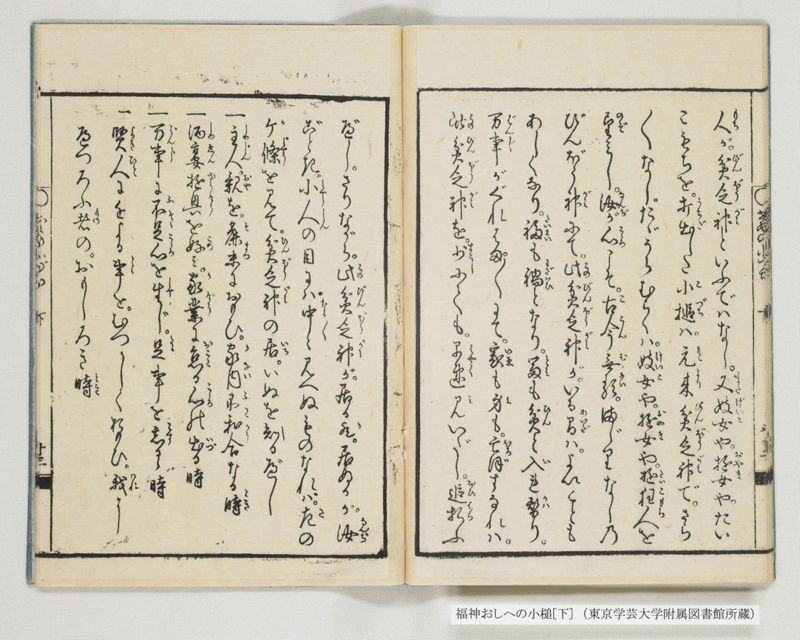
翻刻
人(もち)が。貧乏神(びんぼうがみ)といふではなし。又(また)妓女(げいこ)や。遊女(おやま)や。たい
こもちを。打出(うちだ)した小槌(こづち)は。元来(もとより)貧乏神(びんぼうがみ)で。さら
〳〵なし。たゞうらむらくは。妓女(けいこ)や。遊女(おやま)や。遊狂人(たいこもち)を
望(のぞ)みし。汝(なんぢ)が心(こゝろ)こそ。古今(ここん)無類(むるい)。まじりなしの
びんぼう神(がみ)にて。此(この)貧乏神(びんぼうがみ)が。いる間(あいだ)は。よいことも
あしくなり。福(さいわい)も禍(わざはひ)となり。冨(とみ)も貧(ひん)と入(い)れ替(かは)り。
万事(ばんじ)がぐれはま。〳〵にて。家(いゑ)も身(み)も。亡(ほろ)ぼするれは。
此(この)貧乏神(びんぼうがみ)を。少(すこし)にても。早速(はやく)見(み)いだし。追払(おひはら)ふ
べし。さりながら。此(この)貧乏神(びんぼうがみ)が。居る歟(か)。居ぬるが。汝(なんぢ)
ごとき。小人(しやうしん)の目には。中々(なか〳〵)見へぬものなれば。左(さ)の
《振り仮名:ケ条|かじやう》を見て。貧乏神(ひんぼうがみ)の居(いる)。いぬを知(し)るべし
一 主人(しゆじん)。親(おや)を。麁末(そまつ)におもひ。家内(かない)不和合(ふわかう)なる時(とき)
一 酒宴(しゆゑん)遊興(ゆうけう)を好(この)み。家業(かげう)に怠(おこた)る心(こゝろ)の出(いづ)る時
一 万事(ばんじ)に不足(ふそく)心(こゝろ)を生(しやう)じ。足(たる)事を忘(わす)るゝ時
一 賢人(よきひと)に近よる事(こと)を。むつかしくおもひ。我(われ)に
へつろふ者(もの)の。おもしろき時(とき)
現代語訳
(幇間)が貧乏神というわけではない。また、芸子や遊女や幇間を打ち出した小槌は、もとより貧乏神などでは全くない。ただ恨むべきは、芸子や遊女や幇間を望んだお前自身の心こそが、古今無類、混じりけなしの貧乏神であって、この貧乏神がいる間は、良いことも悪くなり、福も禍となり、富も貧に入れ替わり、万事がぐれはまぐれはまにて、家も身も滅ぼしてしまうのだ。だから、この貧乏神を少しでも早く見つけ出して、追い払うべきである。しかしながら、この貧乏神がいるのかいないのか、お前のような小人の目にはなかなか見えないものであるから、以下の箇条を見て、貧乏神のいる・いないを知るべきである。
一、主人が親を粗末に思い、家内が不和合である時
一、酒宴や遊興を好み、家業を怠る心が出る時
一、万事につき足りない心が生じ、足るを忘れる時
一、賢人(良き人)に近寄ることを難しく思い、自分にへつらう者をおもしろく感じる時
英語訳
— are not themselves the poverty god. Nor is the magic mallet that produced the geisha, courtesans, and jesters in any way the poverty god. The only thing to be blamed is your own heart that desired the geisha, courtesans, and jesters — that heart itself is the poverty god, without equal throughout all ages, utterly undiluted. And so long as this poverty god resides within you, even good things will turn bad, fortune will turn to misfortune, wealth will be exchanged for poverty, and everything will go topsy-turvy, bringing both your household and your person to ruin. Therefore, you must find this poverty god, even the smallest trace of it, and drive it out as swiftly as possible. However, since whether this poverty god is present or absent is something that the eyes of a small-minded person such as yourself can hardly perceive, you should look upon the following articles and thereby come to know whether the poverty god dwells within you or not.
Article One: When the master thinks lightly of his parents and there is discord within the household.
Article Two: When a fondness for drinking parties and amusements arises and one becomes neglectful of one's trade and livelihood.
Article Three: When a spirit of dissatisfaction arises in all matters and one forgets to be content with what one has.
Article Four: When one finds it troublesome to draw close to men of wisdom and virtue, and instead finds those who flatter one to be agreeable.