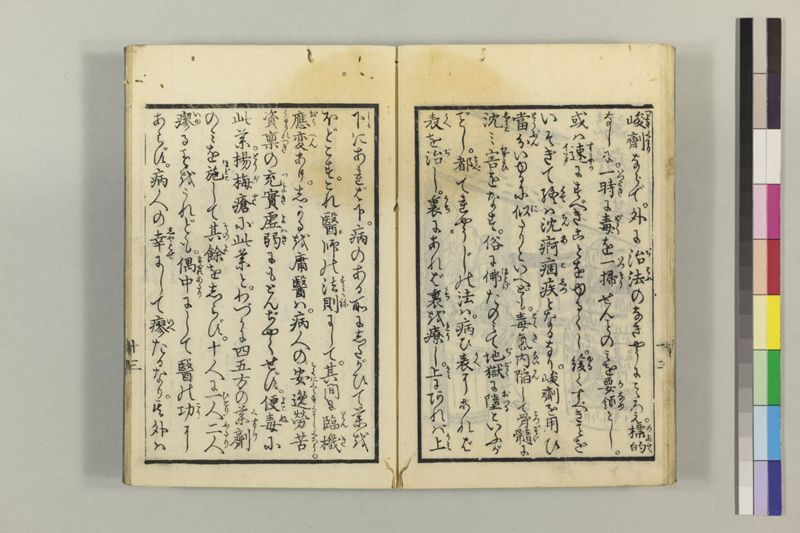
翻刻
【右丁】
峻(つよき)剤(くすり)ならで。外に治法(ぢはふ)のなきやうにこゝろえ。標的(めあて)
なしに。一時(いつとき)に毒(どく)を一掃(いつそう)せんことのみを要領(かなめ)とし。
或は速(すみやか)【左ルビ:イソグ】にすべきことをゆるくし。緩(ゆる)くすべきことを
いそぎて終(はて)は沈痾(ちんあ)痼疾(こしつ)となるなり。峻剤を用ひ
当分(とうぶん)いゆるに似(に)たりといへども。毒気(どくき)内陥(ないかん)して骨髄(こつずい)に
沈(しみこ)み害(わざわひ)をなす。俗に仏(ほとけ)たのみて地獄(ぢごく)に堕(おつる)といふが
ごとし。都(すべ)てれやうじの法は。病ひ表(うへ)にあれば
表(うへ)を治(ぢ)し。裏(うち)にあれば裏(うち)を療(れう)し。上(かみ)にあれば上(かみ)
【左丁】
下(しも)にあれば下。病のある所にしたがひて薬を
ほどこす。これ医師の法則(すみかね)にして。其間に臨機(りんき)
応変(おうへん)あり。しかるを庸医は。病人の安逸(らくにくらす)労苦(くるしみくろう)。
資稟(うまれつき)の充実(つよき)虚弱(よはき)にもとんぢやくせず。便毒(よこね)に
此薬。楊梅瘡(とうがさ)に此薬と。わづかに四五方の薬剤(くすり)
のみを施(ほどこ)して其余(そのよ)をしらず。十人に一人(ひとり)二人(ふたり)
瘳(いゆ)ることをうれども。偶中(まぐれあたり)にして医の功(こう)に
あらず。病人の幸(しやはせ)にして瘳(いへ)たるなり。其外は
現代語訳
【右丁】
強い薬でなければ他に治療法がないように心得て、目標もなしに一度に毒を一掃することのみを要点とし、或いは速やかにすべきことを緩やかにし、緩やかにすべきことを急いで、終いには慢性的な病気となってしまう。強い薬を用いて当分治ったように見えても、毒気が体内に入り込んで骨髄に染み込み害をなす。俗に「仏を頼んで地獄に落ちる」というようなものである。すべて療治の法は、病が表にあれば表を治し、裏にあれば裏を療し、上にあれば上を
【左丁】
下にあれば下を。病のある所に従って薬を施す。これが医師の法則であって、その間に臨機応変がある。しかるに庸医は、病人の安楽な暮らしや苦労、生まれつきの丈夫さや虚弱さにも注意せず、梅毒にはこの薬、楊梅瘡にはこの薬と、わずかに四、五種類の薬剤のみを施してその他を知らない。十人に一人、二人治ることを喜んでも、それは偶然当たっただけで医の功績ではない。病人の幸せで治ったのである。その他は
英語訳
【Right page】
Thinking that there is no other treatment method besides strong medicine, and focusing only on completely eliminating the poison at once without any clear target, either doing slowly what should be done quickly, or rushing what should be done slowly, ultimately resulting in chronic ailments. Even when strong medicine is used and appears to heal temporarily, the toxic qi penetrates internally and seeps into the bone marrow causing harm. This is like the common saying "praying to Buddha but falling into hell." In all methods of treatment, if the illness is on the surface, treat the surface; if it's inside, treat the inside; if it's above, treat above
【Left page】
if it's below, treat below. Apply medicine according to where the disease is located. This is the physician's principle, and there must be flexibility to respond appropriately to circumstances. However, incompetent doctors pay no attention to whether patients live comfortably or suffer hardship, or whether they are constitutionally strong or weak by nature. They only know to apply a mere four or five types of medicine - this medicine for syphilis, that medicine for syphilitic sores - and know nothing else. Even when one or two out of ten people recover, this is merely coincidental success, not the physician's achievement. The patients recovered through their own good fortune. As for the others...