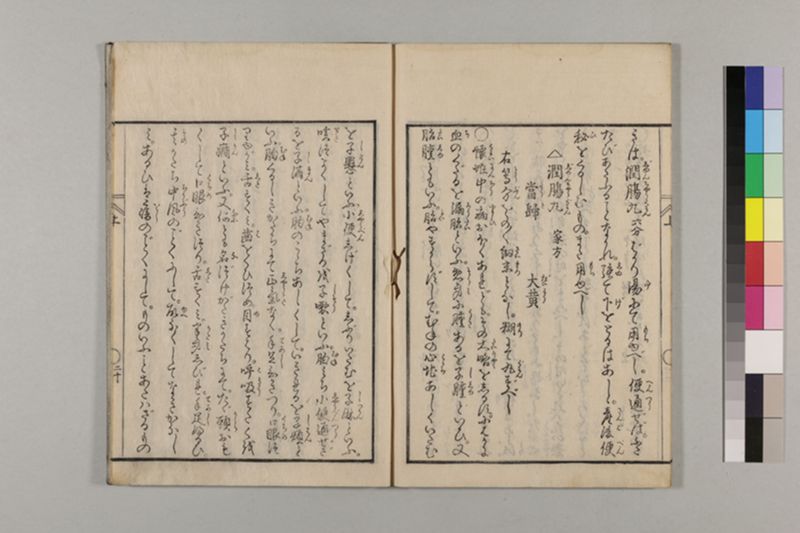
翻刻
【右丁】
きは。潤腸丸(じゆんちやうくわん)《割書:六分》ばかり湯(ゆ)にて用(もち)ゆべし。便(へん)通(つう)ぜば。ふた
たびあたふることなかれ。強(しゐ)て下(げ)をとるはあしゝ。産後(さんご)便(べん)
秘(ひ)をくるしむもの。また用(もち)ゆべし
△潤腸丸(じゆんちやうぐわん) 家方
当帰(たうき) 大黄(だいわう)
右 等分(とうぶん)をの〳〵細末(さいまつ)となし。糊(のり)にて丸(ぐわん)ずべし
○懐妊中(くわいにんちう)の病(やまひ)おほくあれども。その大略(たいりやく)をしるす。にはかに
血(ち)のくだるを漏胎(ろうたい)といふ。総(そう)【惣】身(み)に腫(うき)あるを子腫(ししゆ)といひ。又
胎腫(たいしゆ)ともいふ。胎(たい)やすからずして。むねの心地(こゝち)あしくいたむ
【左丁】
を子懸(しけん)といふ。小便(しやうべん)しげくして。しぶりいたむを子淋(しりん)といふ。
咳(せき)つよくしてやまざるを子嗽(しそう)といふ。胸(むね)みち小便(しやうべん)通(つう)ぜざ
るを子満(しまん)といふ。胸(むね)のこゝちあしくして。いきれるを子煩(しはん)と
いふ。胸(むね)くるしきかたちにて正気(しやうき)なく。手足(てあし)ひきつり。口眼(くちめ)つ
りゆがみ。舌(した)すくみ。歯(は)をくひつめ。目(め)すはり。呼吸(こきう)すたくを
子癇(しかん)といふ。又 何(なに)とも名(な)づけがたきかたちにて。たゞ頭(かしら)おも
くして口眼(くちめ)ひきつり。舌(した)すくみ。半身(かたみ)しびれ。手足(てあし)ふるひ。
其(その)かたち中風(ちうぶう)のごとくにして。故(ゆへ)なくしてなきかなし
み。あるひは瘖(をし)のごとくにして。ものいふことあたはざるもの
現代語訳
【右丁】
きは、潤腸丸(約六分)ほどをお湯で服用すべきである。便通があれば、再
び与えてはいけない。強引に下剤を用いるのは良くない。産後に便
秘で苦しむ者も、また用いるべきである。
△潤腸丸 家方
当帰 大黄
右 等分をそれぞれ細末にして、糊で丸薬にすべきである
○妊娠中の病気は多くあるが、その大略を記す。にわかに
血が下るのを漏胎という。全身にむくみがあるのを子腫といい、また
胎腫ともいう。胎児が安定せず、胸の具合が悪く痛む
【左丁】
のを子懸という。小便が頻繁で、しぶり痛むのを子淋という。
咳が強くて止まないのを子嗽という。胸がつかえて小便が通じな
いのを子満という。胸の調子が悪くて、息苦しいのを子煩と
いう。胸が苦しい様子で正気を失い、手足がひきつり、口や目がつ
り歪み、舌がこわばり、歯を食いしばり、目がすわり、呼吸が止まるのを
子癇という。また何とも名付けがたい症状で、ただ頭が重
くて口や目がひきつり、舌がこわばり、半身がしびれ、手足が震え、
その様子が中風のようで、理由もなく泣き悲し
み、あるいは口がきけない者のように、ものを言うことができないもの
英語訳
【Right page】
In such cases, about six parts of Junchōgan (Intestine-Moistening Pills) should be taken with hot water. Once bowel movements occur, do not give it again. Forcibly inducing bowel movements is harmful. Those who suffer from constipation after childbirth should also use this.
△Junchōgan (Intestine-Moistening Pills) Family Formula
Angelica Root (Dang Gui) Rhubarb (Da Huang)
The above ingredients in equal parts should each be made into fine powder and formed into pills with paste.
○Although there are many illnesses during pregnancy, I will record their general outline. Sudden bleeding from below is called "leaking fetus" (rōtai). Swelling throughout the entire body is called "child swelling" (shishū), also called "fetal swelling" (taishū). When the fetus is unstable and the chest feels unwell and painful,
【Left page】
this is called "child suspension" (shiken). Frequent urination with painful straining is called "child strangury" (shirin). Strong persistent coughing is called "child cough" (shisō). When the chest is congested and urine does not flow, this is called "child fullness" (shiman). When the chest feels unwell and one feels suffocated, this is called "child vexation" (shihan). When the chest is distressed, consciousness is lost, hands and feet convulse, mouth and eyes are distorted, the tongue becomes stiff, teeth are clenched, eyes stare fixedly, and breathing stops, this is called "child epilepsy" (shikan). There are also conditions that are difficult to name, where the head simply feels heavy, mouth and eyes convulse, tongue becomes stiff, half the body becomes numb, hands and feet tremble, appearing like apoplexy, crying and grieving without reason, or being like a mute person, unable to speak.