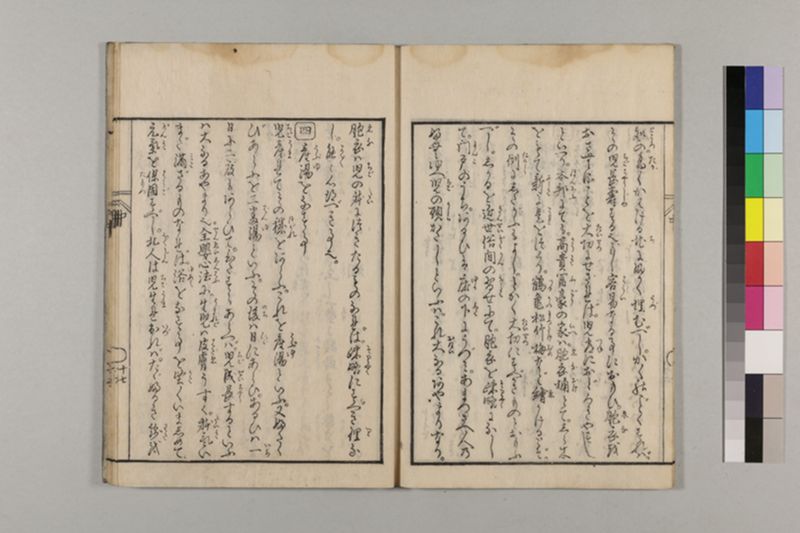
翻刻
【右丁】
処(ところ)の。高(たか)くかはける地(ち)にふかく埋(うづ)むべし。かくのごとくすれば。
その児(ちご)長寿(ちやうじゆ)する也。もし容易(ようい)なる事におもひ。胞衣(ゑな)を
おさむることを大切にせされば。児 常(つね)におどろきやすし
といへり。本邦(ほんほふ)にても。高貴(かうき)富豪(ふごう)の家(いへ)は。胞衣桶(ゑなおけ)とて。しら木
をもて新(あらた)に是(これ)をつくり。鶴亀(つるかめ)松竹(まつたけ)梅(むめ)など絵(ゑ)かけるとぞ。
その例(ためし)にしたがふもよし。とかく大切(たいせつ)にすべきものとおもふ
べし。しかるを近世(きんせい)俗間(ぞくかん)の習(ならは)せにて。胞衣を疎略(そりやく)になし
て。門戸(もんこ)のうち。あるひは床(ゆか)の下(した)にうづみ。あまつさへ人の
ふむゆへ児(ちご)の頭(かしら)かたしといふは。これ大(おほい)なるあやまりなり。
【左丁】
胞衣(ゑな)は児(ちご)の体(たい)につきたるものなれば。疎略(そりやく)にすべき理(り)な
し。能々(よく〳〵)心得べき事也。
四【四角で囲む】産湯(うぶゆ)をなす事
児(ちご)産(うま)れてその穢(けがれ)をあらふ。これを産湯(うぶゆ)といふ。又ふたく
びあらふを二 番湯(ばんゆ)といふ。その後(のち)は日(ひゞ)にあらひ。あるひは一(いち)
日に二度もあらひて。ひたすらあらへば。児(ちご)成長(せいちやう)するといふ
は大なるあやまり也。全嬰心法(せんゑいしんはふ)に。生児(うまれご)は皮膚(はだゑ)うすく。体気(たいき)い
まだ満(みた)ざるものなれば。浴(ゆあみ)をなす事を堅(かた)くいましめて。
元気(げんき)を保固(はうご)【左ルビ:たもつ】すべし。北人(ほくじん)は児(ちご)生(うま)れ出(いづ)れば。たゞふるき綿(わた)を
現代語訳
【右丁】
場所の、高く乾燥した土地に深く埋めるべきである。このようにすれば、その子は長寿する。もし簡単なことと思い、胞衣を保管することを大切にしなければ、子は常に驚きやすくなると言われている。我が国でも、高貴で富豪の家では、胞衣桶と言って、白木で新しくこれを作り、鶴亀松竹梅などの絵を描いているとのことである。その例に従うのも良い。とにかく大切にすべきものと思うべきである。ところが近世の庶民の習慣で、胞衣を粗末に扱い、門の内や床の下に埋め、その上人が踏むので子の頭が固いと言うのは、これは大きな間違いである。
【左丁】
胞衣は子の体についていたものなので、粗末に扱うべき理由はない。よくよく心得るべきことである。
四【四角で囲む】産湯を使わせること
子が生まれてその汚れを洗う。これを産湯という。また二度目に洗うのを二番湯という。その後は毎日洗い、或いは一日に二度も洗って、ひたすら洗えば子が成長するというのは大きな間違いである。『全嬰心法』に、生まれたばかりの子は皮膚が薄く、体の気がまだ十分でないので、入浴することを固く戒めて、元気を保持すべしとある。北方の人は子が生まれ出ると、ただ古い綿を
英語訳
【Right page】
in a high, dry place and bury it deeply. If done this way, the child will have a long life. If one thinks this is a trivial matter and does not take care in storing the placenta, the child will be easily startled, it is said. Even in our country, noble and wealthy families use what is called a placenta bucket, newly made from white wood with pictures of cranes, turtles, pine, bamboo, plum blossoms, and such painted on it. Following such examples is also good. In any case, one should think of it as something to be treated with great care. However, due to recent common folk customs, the placenta is treated carelessly, buried within the gate or under the floor, and moreover people step on it, so they say the child's head becomes hard - this is a great error.
【Left page】
The placenta was attached to the child's body, so there is no reason to treat it carelessly. This is something that should be well understood.
Four【enclosed in square】Giving the first bath
When a child is born, its impurities are washed away. This is called the first bath (ubyu). Also, washing a second time is called the second bath. After that, washing daily, or even washing twice a day, thinking that constant washing will make the child grow - this is a great error. In the "Zen'ei Shinpō," it states that newborns have thin skin and their bodily energy is not yet sufficient, so bathing should be strictly avoided to preserve their vital energy. Northern people, when a child is born, simply use old cotton