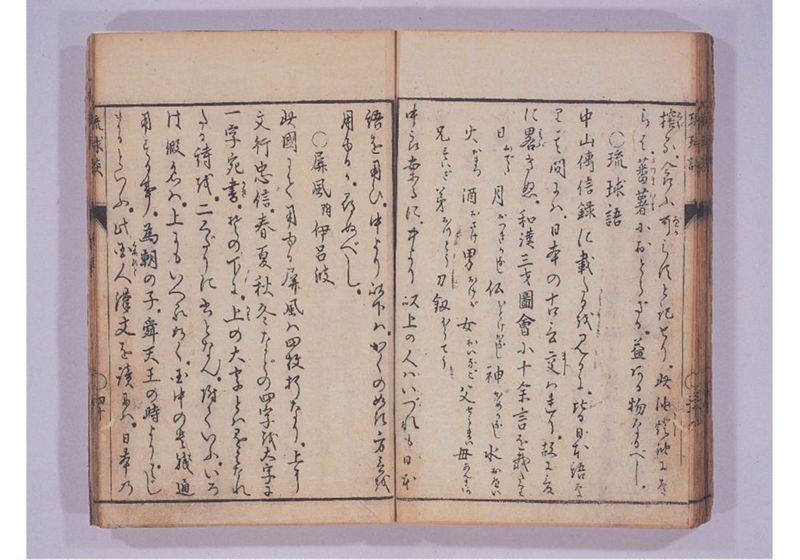
翻刻
搾(しぼ)る、食ふ可(べか)らすと記せり、此油 灯(ともし)油にな
らは、蕃薯(さつまいも)におとらざる、益ある物なるべし、
○琉球語
中山伝信録に載たるを見るに、皆日本語な
り其間には、日本の古言 交(まじ)はれり、故に爰
に略(はぶ)きぬ、和漢三才図会に十余言を載たり
日《割書:おでた|》月《割書:おつきかなし|》 仏《割書:ほとけかなし|》神《割書:かめかなし|》水《割書:おへい|》
火《割書:かまつ|》酒《割書:おさけ|》男《割書:おけが|》女《割書:おいなご|》父《割書:せうまい|》母《割書:あんまあ|》
兄《割書:すいざ|》弟《割書:おつとう|》刀釼《割書:ほうてう|》
中良案るに、中より以上の人はいづれも日本
語を用ひ、中より以下は、かくの如き方言を
用ゆるか、尋ぬべし、
○屏風《割書:附|》伊呂波
此国にて用ゆる屏風は四枚折なり、上に
文行忠信、春夏秋冬などの四字を大字に
一字宛 書(かき)、その下に、上(かみ)の大字とは懸はなれ
たる詩を、二くだりに書となん、附ていふ、いろ
は仮名は、上にもいへる如く、国中の貴賤通
用する事、為朝の子、舜天王の時より、はじ
まるといふ、此 国人(くにひと)漢文を読には、日本の
現代語訳
搾る、食べることはできないと記されている。この油は灯火の油になれば、薩摩芋に劣らない有益な物であろう。
○琉球語
中山伝信録に載せられているものを見ると、皆日本語である。その間には、日本の古語が交じっている。故にここでは省略した。和漢三才図会に十余の言葉が載せられている。
日(おでた)月(おつきかなし)仏(ほとけかなし)神(かめかなし)水(おへい)
火(かまつ)酒(おさけ)男(おけが)女(おいなご)父(せうまい)母(あんまあ)
兄(すいざ)弟(おつとう)刀剣(ほうてう)
中良が案ずるに、中流以上の人はいずれも日本語を用い、中流以下は、このような方言を用いるのか、尋ねてみるべきである。
○屏風(附)伊呂波
この国で用いる屏風は四枚折りである。上に文行忠信、春夏秋冬などの四字を大字で一字ずつ書き、その下に、上の大字とは関係のない詩を、二句に分けて書くという。付け加えて言うと、いろは仮名は、上にも言ったように、国中の貴賤が通用することは、為朝の子、舜天王の時より始まるという。この国の人が漢文を読むには、日本の
英語訳
They squeeze out oil, and it is recorded that it cannot be eaten. If this oil could be used as lamp oil, it would be as beneficial as sweet potatoes.
○Ryukyu Language
Looking at what is recorded in the Chuzan Denshinroku, it is all Japanese language. Among it, ancient Japanese words are mixed in. Therefore, it is omitted here. The Wakan Sansai Zue records over ten words:
Sun (odeta), Moon (otsukikanashi), Buddha (hotokenashi), God (kamekanashi), Water (ohei)
Fire (kamatsu), Sake (osake), Man (okega), Woman (oinago), Father (seumai), Mother (anmaa)
Elder brother (suiza), Younger brother (ottou), Swords (houteu)
Nakara speculates that people of middle class and above all use Japanese, while those of middle class and below use such dialects - this should be investigated further.
○Folding Screens (Supplement) Iroha
The folding screens used in this country have four panels. At the top, four characters such as "bungyouchushin" (literary virtue, loyalty, faith) or "shunkashutou" (spring, summer, autumn, winter) are written in large characters, one character each, and below that, poems unrelated to the large characters above are written in two lines. Additionally, the iroha syllabary, as mentioned above, has been in common use among all social classes throughout the country since the time of King Shunten, son of Tametomo. When people of this country read Chinese texts, they use the Japanese