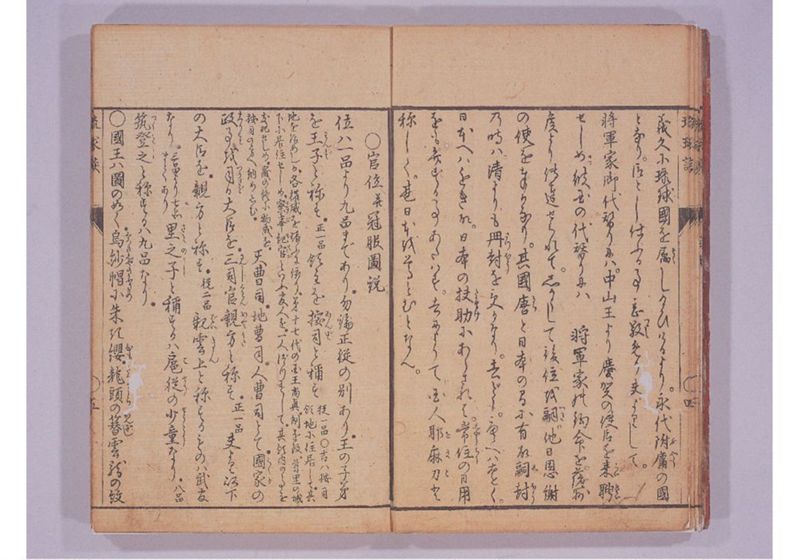
翻刻
【右丁】
義久に琉球国を属し給ひけるより。永代 附傭(ふやう)の国
となり。臣とし仕ふる事甚 敬(つゝし)めり夫よりして。
将軍家御代替りには。中山王より慶賀の使臣を来聘(らいへい)
せしめ。彼国の代替りには 将軍家の鈎命を薩州
候より伝達せられて。しかうして後位を嗣((つき)。他日恩謝
の使を奉るなり。其国 唐(から)と日本の間に有故 嗣封(しほう)
の時は。清
よりも冊封(さつほう)を受るなり。去ども。唐へは遠く。
日本へは近き故。日本の扶助(たすけ)にあらされは。常住(しやうちう)の日用
をも弁ずる事あたはす。去によりて。国人 耶摩刀(をまと)と
称して。甚日本を尊とむとなん。
【左丁】
〇官位幷冠服図説
位は一品より九品まであり•勿論正従の別あり•王の子弟
を王子(わんず)と称す•《割書:正一品|》領主を按司(あんず)と称す《割書:従一品〇古は按司|領地に住居して•其》
《割書:地を治めしか•各権威を振ふに依り•第十七代の国王尚真•制を改•首里の城|下に住居せしめ•察事(さつじ)記官(きくはん)といふ官人を•一人づつ遣して•其領内の事を》
《割書:支配せしめ•歳の終に物成を•|按司の方へ納めしむ•》天曹司•地曹司•人曹司とて•国家の
政事(まつりごと)を司(つかさど)る大臣を•三司官(さんしくわん)親方(おやかた)と称す•《割書:正一品|》夫より以下
の大臣を•親方と称す•《割書:従二品|》親雲上(ばいきん)と称するものは武官
なり•《割書:三品より七品|まてあり》里之子(さとのし)と称するは扈従(こせう)の小童(せうとう)なり•《割書:八品|》
筑登之(つくとし)と称するは九品なり•
〇国王は図の如く•烏紗帽(くろきしやのかふりもの)に朱き纓(ひも)•龍頭(たつかしら)の簪(かんざし)雲龍の紋
現代語訳
【右丁】
義久に琉球国を属させたことから、永代にわたって付庸の国となり、臣として仕える態度は非常に慎み深いものであった。それ以後、将軍家の代替わりには、中山王から慶賀の使臣を来聘させ、彼国の代替わりには、将軍家の勅命を薩摩藩主より伝達されて、そうしてから後に王位を継承し、後日恩謝の使者を派遣するのである。その国は中国と日本の間にあるため、王位継承の時は、清朝からも冊封を受けるのである。しかしながら、中国へは遠く、日本へは近いため、日本の扶助がなければ、日常の生活用品をも調達することができない。そのため、国人は「おおやまと」と称して、非常に日本を尊敬するのである。
【左丁】
〇官位並びに冠服図説
位は一品から九品まであり、もちろん正従の別がある。王の子弟を王子(わんず)と称する《正一品》。領主を按司(あんず)と称する《従一品。古くは按司が領地に住居してその地を治めていたが、各々が権威を振るうため、第十七代の国王尚真が制度を改め、首里の城下に住居させ、察事、記官という官人を一人ずつ派遣して、その領内の事を支配させ、年の終わりに年貢を按司の方へ納めさせた》。天曹司、地曹司、人曹司といって、国家の政事を司る大臣を、三司官親方と称する《正一品》。それより以下の大臣を、親方と称する《従二品》。親雲上(ぺーちん)と称するものは武官である《三品から七品まである》。里之子(さとのし)と称するのは側近の小童である《八品》。筑登之(つくとし)と称するのは九品である。
〇国王は図のように、烏紗帽(黒い紗の帽子)に朱い紐、龍頭の簪、雲龍の紋
英語訳
[Right Page]
Since Yoshihisa was granted sovereignty over the Ryukyu Kingdom, it became a tributary state for all generations, and their service as vassals was conducted with great reverence. From then on, whenever there was a succession in the Shogun's house, the King of Chūzan would send congratulatory envoys, and when there was a succession in their own country, the Shogun's command would be transmitted through the Satsuma lord, and only after that would the succession to the throne take place, with envoys of gratitude sent later. Since that country lies between China and Japan, during royal successions, they also receive investiture from the Qing dynasty. However, since China is far and Japan is near, without Japan's assistance, they cannot even procure daily necessities. Therefore, the people of the country call it "Great Yamato" and hold Japan in very high esteem.
[Left Page]
○ Explanation of Official Ranks and Court Dress Illustrations
Ranks range from first grade to ninth grade, with distinctions between senior and junior grades naturally existing. The king's sons and brothers are called princes (wanzu) 《senior first grade》. Feudal lords are called aji (anzu) 《junior first grade. In ancient times, aji lived in their territories and governed those lands, but because each wielded authority, the seventeenth king Shō Shin reformed the system, making them reside in the castle town of Shuri, and dispatched officials called satuji and kikan one by one to govern the affairs of their territories, having the harvest tributes delivered to the aji at year's end》. The ministers who oversee state affairs are called the three chief ministers and oyakata, namely the Tencaushi, Chicaushi, and Jincaushi 《senior first grade》. Ministers below them are called oyakata 《junior second grade》. Those called pechin are military officials 《ranging from third to seventh grade》. Those called satunushi are young attendants in personal service 《eighth grade》. Those called tsukutushi are ninth grade.
○ The king, as shown in the diagram, wears a black gauze cap with a red cord, a dragon-head hairpin, and cloud-dragon patterns