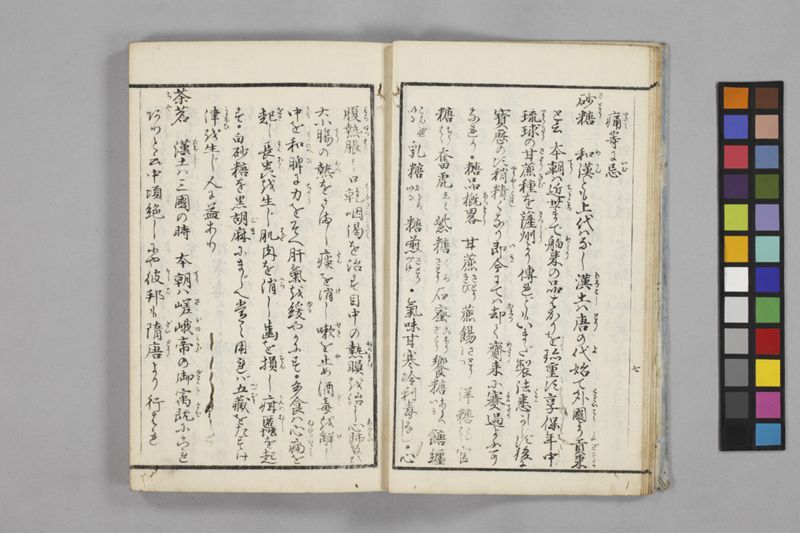
翻刻
【右丁】
痛(いたみ)等に忌(いむ)
砂糖(さとう) 和漢(わかん)とも上代はなし漢土(もろこし)は唐(とう)の代(よ)始めて外国(くわいこく)より貢(みつぎ)来(きたる)
と云 本/朝(てう)は近世(ちかころ)まで舶来(わたり)の品はかりを珍重す享保年中
琉球(りうきう)の甘蔗種(さとうきび)を薩州(さつしう)より伝れどもいまだ製法/悉(くわ)しからず後に
宝暦#1の頃/稍(やうやく)精(くわし)くなり即今(いま)にては却(かえつ)て齎来(わたり)に賽過(まさる)よふに
なれり●#2糖品/概略(あらまし) 甘蔗《割書:さとう|きび》 蔗餳《割書:さとう|みつ》 洋糖《割書:たい|はく》 官
糖《割書:ちう|はく》 奮虎《割書:しみ|》 紫糖《割書:くろ|さとう》 石蜜《割書:こほり|ざとう》 饗糖《割書:あるへ|いる》 餹纏
《割書:こんべ|いる》 乳糖《割書:かるめ|いる》 糖煎《割書:さとう|づけ》●気味甘寒冷利毒なし●心
【左丁】
腹(はら)熱張(ねつはり)し口 乾(はしやき)咽渇(のどかはく)を治す目中の熱瞙(ねつまけ)を治し心肺(しんはい)及ひ
大小 腸(てう)の熱(ねつ)をさまし痰(たん)を消(け)し嗽(せき)を止(や)め酒/毒(どく)を解(け)し
中(うち)を和(とゝのへ)脾(ひ)に力(ちから)をそへ肝気を緩(ゆる)やかにす●多食は心痛(むねのいたみ)を
起(をこ)し長虫(すんばく)を生じ肌(はだ)肉を消(へら)し歯を損(そん)し疳䘌(かんのむし)を起
す●白砂糖を黒/胡麻(ごま)にまじへ常々用れば五臓(ごぞう)をたすけ
津(うるほひ)を生じ人に益あり
《振り仮名:茶茗| |ちや 》 漢土(もろこし)は三国の時 本 朝(てう)は嵯峨帝(さがのみかど)の御寓(ぎょう)既(すで)にこれ
ありと云中頃絶しにや彼邦(かしこ)も隋(ずい)唐(とう)より行はれ
現代語訳
【右丁】
……(疳の病・骨の痛み・)歯の痛み等には(飴糖の使用を)忌む。
**砂糖** 和漢(日本・中国)ともに、上代にはなかった。中国では唐の時代に初めて外国から献上されてきたと言われる。本朝(日本)では近世になるまで舶来品ばかりを珍重していた。享保年中に、琉球の甘蔗(さとうきび)の種が薩摩藩から伝えられたが、いまだ製法が十分に知られていなかった。後に宝暦のころになってようやく詳しくなり、今日では、かえって舶来品よりも優れるようになった。
●糖の品の概略:
甘蔗(さとうきび)・蔗餳(砂糖蜜)・洋糖(太白糖)・官糖(中白糖)・奮虎(白砂糖の一種〔しみ〕)・紫糖(黒砂糖)・石蜜(氷砂糖)・饗糖(アルヘイル糖)・餹纏(こんぺいとう)・乳糖(カルメル焼き)・糖煎(砂糖漬け)
●気味は甘・寒・冷利で、毒はない。●心
【左丁】
腹(はら)の熱と張りを治し、口の渇きおよび咽の渇きを治す。目の熱による翳り(ねつまけ)を治し、心肺および大小腸の熱を冷まし、痰を消し、咳を止め、酒毒を解し、中(体の内)を整え、脾を補い、肝気を穏やかにする。
●多食すると、心(胸)の痛みを起こし、回虫(寸白)を生じ、肌肉を削り、歯を損じ、疳虫を起こす。
●白砂糖を黒胡麻に混ぜて常々用いれば、五臓を助け、潤いを生じ、人に益がある。
**茶茗(ちゃ)** 中国では三国時代(に既にあった)、本朝(日本)では嵯峨天皇の御代に既にこれがあったと言われる。中頃に一度絶えたのだろうか。中国でも隋・唐の時代より行われ……
英語訳
**[Right Page]**
……(Malt sugar) should be avoided for conditions such as *kan* disorders, bone pain, and dental pain.
**Sugar** Sugar did not exist in ancient times in either Japan or China. In China, it is said to have first been brought as tribute from foreign lands during the Tang dynasty. In Japan, until recent times, only imported goods were treasured. During the Kyōhō era, sugarcane (*Saccharum officinarum*) from the Ryūkyū Kingdom was introduced via Satsuma domain, but the production methods were not yet well understood. Later, around the Hōreki era, knowledge of these methods gradually became more refined, and today domestic sugar has in fact come to surpass imported varieties.
●Overview of sugar products:
Sugarcane (*kib*i) · Cane syrup (*sato-mitsu*) · White refined sugar (*taihaku*) · Medium white sugar (*chūhaku*) · *Shimi* (a type of granulated white sugar) · Brown sugar (*kuro-satō*) · Rock candy (*kōrizatō*) · *Aruheiro* sugar (a Portuguese-derived sugar confection) · *Konpeitō* (star-shaped sugar candy) · *Karameru* (caramelized sugar / caramel) · Candied preserves (*satōzuke*)
●Its flavor is sweet, cold, and cooling in action, with no toxicity. ●For heart and
**[Left Page]**
abdominal heat and fullness, it treats dryness of the mouth and thirst in the throat. It treats heat-induced cloudiness of the eyes, cools the heat of the heart, lungs, and large and small intestines, dissolves phlegm, stops coughing, resolves alcohol toxicity, regulates the interior of the body, fortifies the spleen, and calms the liver qi.
●Excessive consumption can cause chest pain, generate intestinal worms (*sunhaku* / roundworms), deplete the flesh, damage the teeth, and provoke *kan* parasites.
●If white sugar is mixed with black sesame seeds and taken regularly, it supports the five viscera (*gozō*), generates moisture and fluids, and is beneficial to people.
**Tea** (*Chā / Chamei*) In China, it is said to have already existed during the Three Kingdoms period; in Japan, it is said to have already been present during the reign of Emperor Saga. It seems to have died out at some point in the intervening period. In China too, it came into common use from the Sui and Tang dynasties onward……