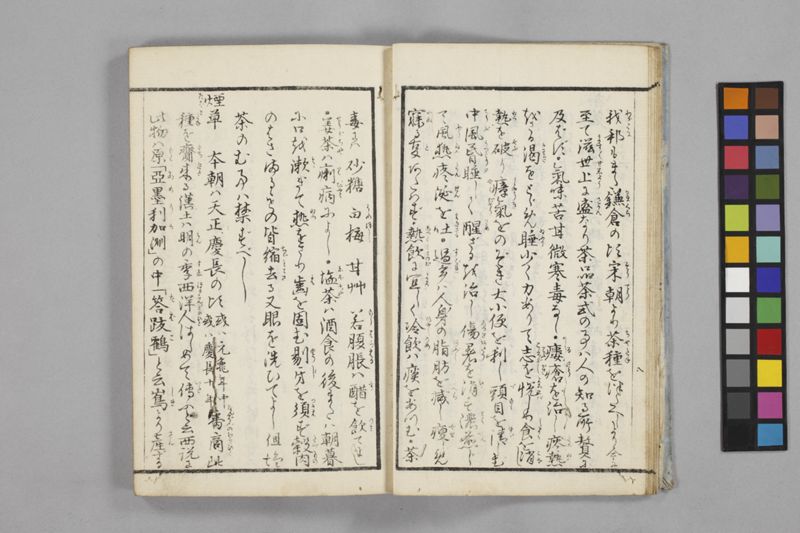
翻刻
【右丁】
我邦(わがくに)もまた鎌倉(かまくら)の頃 宋朝(そうてう)より茶種(ちゃたね)をつたへしより今に
至て滋(ますます)世上(せしよう)に盛(さかん)なり茶品茶式の事は人の知る所贅に
及ばず●気味苦甘微寒毒なし●《振り仮名:瘻瘡|るさう|こぶがさ 》を治し痰熱(たんねつ)
をさる渇(かわき)をとゞめ睡(ねふり)少く力ありて志(こころざし)を悦(よろこば)しめ食(しょく)を消(こな)し
熱(ねつ)を破(やぶ)り《振り仮名:瘴気|しやうき|やくびやう 》をのぞき大小便を利し頭目(づもく)を清(すゞ)しむ
中風(ちうぶ)眠睡(うつとりと)して醒(さめ)ざるを治し傷暑(あつさあたり)を消(け)す濃(こく)煎(せん)じ
て風(ふう)熱(ねつ)疼(たん)【ママ】涎(せん)を吐(はきさる)●過多(すぐれ)は人身の脂肪(あぶら)を減(へら)し痩(やせ)しめ
寐(いぬ)る事([こ]と)あたはず●熱飲(あつくしてのむ)に宜(よろ)しく冷飲(ひやしのめ)は痰をあつむ●茶
【左丁】
毒には 砂糖 白梅(うめほし) 甘草 若(もし)腹張(はらはる)は醋(す)を飲(のみ)てよし
●姜茶(せうがちゃ)は痢病(りびやう)によし●塩茶(しほちゃ)は酒食の後または朝暮
に口を漱(そゝ)ぎて熱(ねつ)をさり歯(は)を固む剔牙(やうじ)を須(つかは)ず穀肉(たべもの)
のはさまるもの皆 縮(ちぢみて)去(さ)る又眼を洗ひてよし但塩
茶のむ事は禁ずべし
《振り仮名:煙草| |たばこ 》 本朝は天正、慶長の頃《割書:或は元亀年中|或は慶長十年》蕃商(なんばんのあきひと)此
種(たね)を齎来(もちきた)る漢土は明(みん)の季(すゑ)西洋人(ほるらんどのひと)はしめて伝(つた)ふと云西説に
此物は原(もと)「亜墨利加(あめりか)州」の中「答跋鶴(たばこ)」と云う島(しま)より産(さん)ずる
現代語訳
【右丁】
我が国でも鎌倉のころに宋朝より茶の種が伝えられて以来、今日に至るまでますます世間に盛んになった。茶の品種や茶の作法については人の知るところゆえ、ここでは詳しく述べない。
●気味は苦・甘・微寒で毒はない。●瘻瘡(こぶがさ)を治し、痰熱を除き、渇きを止め、眠りを少なくし、力があって心志を晴れやかにし、食物を消化し、熱を破り、瘴気(疫病)を除き、大小便を通じさせ、頭と目をすっきりさせる。中風によって意識がぼんやりして覚めない状態を治し、暑さ当たりを消す。濃く煎じて(飲めば)、風熱・疼痛・涎(よだれ)を吐き出させる。
●飲み過ぎは人体の脂肪を減らして痩せさせ、眠れなくなる。●熱くして飲むのがよく、冷やして飲めば痰が集まる。●茶
【左丁】
の毒には、砂糖・白梅(梅干し)・甘草が(解毒薬として)よい。もし腹が張る場合は、酢を飲むとよい。
●生姜茶は痢病(下痢・赤痢)によい。●塩茶は、酒食の後、または朝晩に口をすすぐことで、熱を除き、歯を固める。楊枝を使わなくても、食物が歯の間に詰まったものが皆縮んで取れる。また、目を洗うのにもよい。ただし、塩茶を(常飲として)飲むことは禁ずべきである。
---
**煙草(たばこ)** 本朝(日本)では天正・慶長のころ(ある説では元亀年中、ある説では慶長十年)に南蛮の商人がこの種を持ってきた。中国では明の末期に西洋人(オランダ人)が初めて伝えたと言われる。西洋の説によれば、この物はもともと「亜墨利加(アメリカ)州」の中の「答跋鶴(たばこ)」という島より産するという。
英語訳
**[Right Page]**
In our country as well, since tea seeds were transmitted from Song-dynasty China around the Kamakura period, tea has grown ever more prevalent in society up to the present day. As for varieties of tea and the etiquette of tea, these are well known to people and need not be elaborated upon here.
●Its flavor is bitter, slightly sweet, and mildly cold, with no toxicity. ●It treats scrofulous sores (*rōsō* / *kobugasa*), removes phlegm-heat, stops thirst, reduces drowsiness, invigorates and gladdens the spirit, aids digestion, dispels heat, removes miasma (*shōki* / pestilential vapors), promotes urination and bowel movement, and clears the head and eyes. It treats stroke conditions where one remains stuporous and cannot be roused, and dispels heatstroke. When brewed strong, it expels wind-heat, pain, and excessive salivation.
●Excessive consumption reduces bodily fat, causes emaciation, and makes it impossible to sleep. ●It is best drunk hot; drinking it cold accumulates phlegm. ●For tea
**[Left Page]**
poisoning (adverse effects from tea), sugar, dried white plum (*shiroboshi ume*), and licorice root (*kanzō*) are effective antidotes. If the abdomen becomes bloated, drinking vinegar is beneficial.
●Ginger tea (*shōga-cha*) is good for dysentery and diarrheal ailments. ●Salt tea (*shio-cha*), used for rinsing the mouth after drinking alcohol or eating, or morning and evening, removes heat and strengthens the teeth. Without needing to use a toothpick, food particles caught between the teeth will all shrink and fall away. It is also good for washing the eyes. However, drinking salt tea (as a regular beverage) should be avoided.
---
**Tobacco** (*Tabako*) In Japan, around the Tenshō and Keichō eras (some accounts say during the Genki era; others say the tenth year of Keichō), Southern Barbarian (*Nanban*) merchants brought these seeds to Japan. In China, it is said to have first been introduced by Westerners (Dutchmen) at the end of the Ming dynasty. According to Western accounts, this plant originates from an island called "*Tabako*" (*Tobago*) within the "Americas" (*Amerika-shū*).