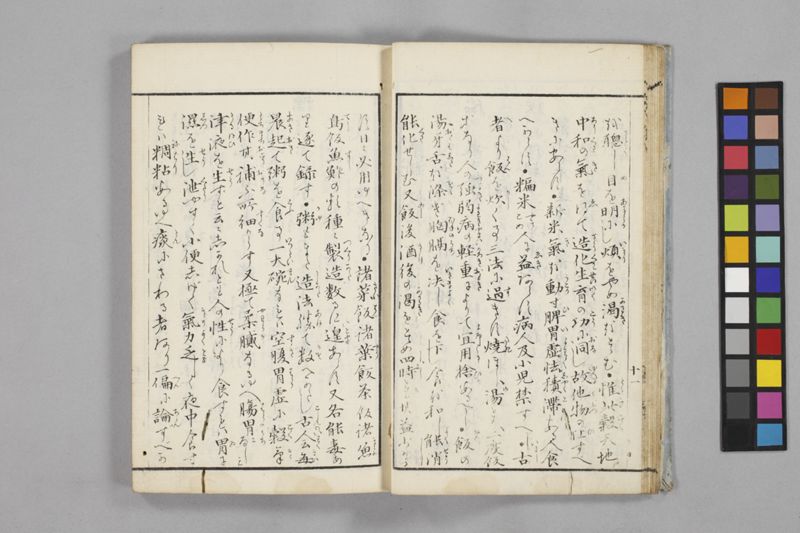
翻刻
【右丁】
を聡(さとく)し目を明(あきらか)にし煩(いきり)をやめ渇(かわき)をとゝむ●惟(たゝ)此(この)穀(こく)天地
中和(ちうくわ)の気(き)を得(ゑ)て造化(さうくわ)生育(せいいく)の功(こう)に同(おな)し故(ゆへに)他物(たぶつ)の比(ひ)すべ
きにあらす●新米 気(き)を動(うこか)す脾胃(ひい)虚怯(よわく)積(しやく)滞(と▢▢▢)ある人食
へからす●糄米《割書:やき|こめ》人に益(ゑき)あらす病人及小児禁すへし●古(いにし)
者(へ)より飯(はん)を炊(かし)く事三法に過(す)きす焼(たき)ほし、湯(ゆ)とり、二度飯
等なり人の強弱(つよきよわき)病(やまひ)の軽重(かろきおもき)によりて宜(よろしく)用捨(さしひき)あるへし●飯(めし)の
湯、牙(おくば)舌(した)を滌(そゝ)ぎ胸膈(むねのうち)を決(いさきよく)し食を下し食を和し《振り仮名:能消|よくせう|ーーー 》
能 化(くわ)せしむ又 飯(めし)後 酒(さけ)後の渇(かわき)をとヽめ四時(しいし)とも其益少から
【左丁】
す日々必用ゆへきなり●諸 菜飯(さいはん)諸 葉(やう)飯茶飯諸 魚(きよ)
鳥(てう)飯 魚鮓(すし)の類種々 製造(つくりかた)数るに遑(いとま)あらす又各能毒あ
り逐て録す●粥(かゆ)もまた造法(しかた)勝(あけ)て数(かそ)へかたし古人(こしんの)云(いわく)毎(まい)
晨(あさ)起(おき)て粥を食(くふ)事 一大碗(いつたいわん)なれは空腹胃(すきはら)虚に穀気(こくき)
便作其補(たちまちおこりおきな)ふ所 細(すくな)からす又極て柔膩(やわらか)なるゆへ腸胃(はらのうち)になしみ
津液(うるほひ)を生(せう)ずと云々しかれとも人の性(せう)により食すれは胃(ゐ)に
湿(しつ)を生(せう)し泄(くたり)やすく小便しげく気力(きりよく)乏(とも)しく夜中食す
れは𥺝(ねば)粘(り)あるゆへ痰(たん)にさわる者あり一 偏(へん)に論(ろん)ずべか
現代語訳
【右丁】
(前ページより続き)耳を鋭くし、目を明らかにし、煩いをやめ、渇きを止める。●ただし、この穀物は天地の中和の気を得て、造化・生育の功と同じものであるから、他の食物と比べることはできない。●新米は気を動かすため、脾胃が虚弱で積滞(消化不良)のある人は食べてはならない。●焼き米は人に益がない。病人および小児には禁じるべきである。●古来より、飯を炊く方法は三法に過ぎない。すなわち、炊き干し・湯取り・二度飯などである。人の体の強弱、病の軽重によって、適宜使い分けるべきである。●飯の湯(おもゆ・重湯)は、奥歯と舌を清め、胸の内を清々しくし、食を下し、食を和らげ、よく消化・吸収させる。また、食後・酒後の渇きを止め、四季を通じてその益は少なくない。
【左丁】
日々必ず用いるべきものである。●諸菜飯・諸葉飯・茶飯・諸魚飯・鳥飯・魚鮓(すし)の類など、種々の製造法は数えるに暇がない。また、それぞれに毒(害)があるものもあり、順を追って記録する。●粥もまた、作り方は挙げて数えがたいほどある。古人の言葉に、「毎朝起きて粥を一大碗食べれば、空腹で虚ろな胃に穀の気が生じ、直ちにその補いをなすことが少なくない。また、極めて柔らかく滑らかであるため、腸胃に馴染み、津液(体内の潤い)を生ずる」とある。しかしながら、人の体質によっては、食べると胃に湿を生じ、下痢をしやすく、小便が頻繁になり、気力が乏しくなる。また夜中に食すると、粘りがあるため、痰に障る者もある。一偏(一面的)に論ずべきではない。
英語訳
**[Right folio]**
*(Continuing from previous page)* …sharpens the ears, clarifies the vision, dispels irritation, and quenches thirst. ● This grain alone has received the balanced, harmonious qi (vital energy) of Heaven and Earth, and thus shares in the creative and nurturing power of nature itself—therefore it cannot be compared to any other food. ● New rice stirs the qi; those with a weak spleen and stomach, or with digestive stagnation (積滞), should not eat it. ● Roasted rice (*yakigome*) offers no benefit to people. It should be forbidden for the sick and for children. ● Since ancient times, there have been no more than three methods for cooking rice: the absorption method (*taki-hoshi*), the draining method (*yu-tori*), and the double-cooked method (*nido-meshi*). These should be appropriately selected according to the strength or weakness of the individual and the severity of any illness. ● Rice water (the liquid from cooked rice / thin rice gruel) rinses the back teeth and tongue, clears the chest and diaphragm, aids digestion, harmonizes food intake, and promotes good digestion and absorption. Furthermore, it quenches thirst after meals or after drinking sake, and its benefits are not small throughout all four seasons.
**[Left folio]**
It is therefore something that must be used daily. ● As for mixed rice dishes—vegetable rice, leaf rice, tea rice, fish rice, fowl rice, and varieties of *sushi* (fermented fish rice)—the methods of preparation are too numerous to count. Each also has its own potential harmful effects, which will be recorded in turn. ● As for rice porridge (*kayu*), the methods of preparation are likewise too many to enumerate. The ancients said: "If one rises each morning and eats a large bowl of rice porridge, the grain's vital energy immediately begins to nourish the empty stomach, and the benefit is not small. Furthermore, because it is extremely soft and smooth, it is gentle on the intestines and stomach, and generates bodily fluids (*津液*)." However, depending on one's constitution, eating porridge may generate dampness (*湿*) in the stomach, making one prone to diarrhea, frequent urination, and diminished vitality. Moreover, eating it late at night may disturb the production of phlegm (*痰*) due to its sticky, viscous nature. Therefore, one should not make one-sided pronouncements about it.