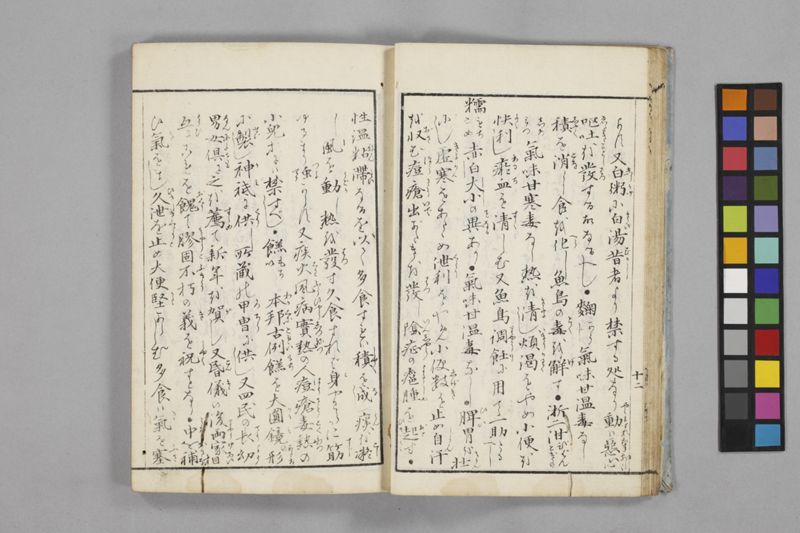
翻刻
【右丁】
らす又 白粥(しらかゆ)に白湯(さゆ)昔者(むかし)より禁する処なり動(やゝもすれ)は悪心(むねあしく)
嘔吐(えたきもとし)を発(はつ)する故なるへし●麹《割書:かう|じ》気味甘温毒なし
積(しやく)を消(こな)し食を化(へら)し魚鳥の毒(とく)を解(げ)す●淅二泔《割書:ひばん|とぎの》
《割書:しろ|みつ》気味甘寒毒なし熱を清(さま)し煩(いきり)渇(かわく)をやめ小便を
快(よく)利し瘀血(わるち)を清(すゝ)しむ又魚鳥 調飪(りやうり)に用て一助たるへし
糯《割書:もち|こめ》赤《振り仮名:白| |——》《振り仮名:大|——》《振り仮名:小|——》の異(ことなる)あり●気味甘温毒なし●脾胃(ひい)を壮(さかん)
にし虚寒(きよかん)をあたゝめ泄利(くたり)をやめ小便 数(しげき)を止め自汗(しかん)
を収(おさ)む疱瘡(ほうさう)出(いで)がたきを発(はつ)し陰症(いんしやう)の癰腫(ようしゆ)を《振り仮名:起|おこ|ひきよ》す●
【左丁】
性温 粘滞(ねんたい)なるを以て多食すれは積(しやく)を成(な)し 痰(たん)を凝(こら)
し《振り仮名:風|—》を動(うごか)し熱を発(はつ)す久食すれば身(み)やわらかに筋(すじ)
ゆるまり強(つよ)からず又痰 火(くわ)風病(ふうひやう)実熱(しつねつ)の人 疱瘡(はうさう)毒熱(とくねつ)の
小児等には禁すべし●餻《割書:もち|い》 本邦(わかくに)古例(これい)餻(もち)を大 円鏡(かゝみ)の形(かたち)
に製(せい)し神祇(かみ)に供(くう)し所蔵の甲冑(かちう)に供し又四民の長幼(てうよう)
男女(なんによ)倶(とも)に之を薦(すゝめ)て新年を賀(が)し又 昏儀(こんき)#1の後 両家(りやうけ)相(あい)
互(たかひ)にこれを餽(おくり)て膠固(きやうこ)不朽(ふきう)の義(き)を祝(しゆく)すとなり●中(うち)を補(おきな)
ひ気(き)をまし久(ひさしき)泄(くたり)を止(と)め大便 堅(かた)からしむ多食は気(き)を塞(ふさ)
現代語訳
【右丁】
(前ページより続き)一面的に論ずべきではない。また、白粥に白湯(さゆ)を加えることは、古来より禁じられているところである。ともすれば、むかつきや嘔吐を引き起こすからであろう。●麹(こうじ):気味は甘温で毒はない。積(消化不良による滞り)を消し、食を消化し、魚・鳥の毒を解する。●淅二泔(ひばんとぎのしろみず・米のとぎ汁):気味は甘寒で毒はない。熱を冷まし、煩いと渇きをやめ、小便の通りをよくし、瘀血(滞った悪い血)を清める。また、魚・鳥の調理に用いると一助となるであろう。
糯米(もちごめ):赤・白・大・小の違いがある。●気味は甘温で毒はない。●脾胃を盛んにし、虚寒(体の冷え)を温め、下痢を止め、小便の頻繁なのを止め、自汗(自然に汗が出ること)を収める。疱瘡(天然痘)が出にくいものを発疹させ、陰症の癰腫(化膿した腫れ物)を引き起こす(引き出す)。●
【左丁】
性質は温で粘り気があるため、多食すれば積(消化不良の滞り)を成し、痰を凝らし、風(中風・卒中)を動かし、熱を発する。長く食べ続ければ、体が柔らかく筋がゆるんで強くならない。また、痰・火・風病・実熱の人、疱瘡(天然痘)で熱毒のある小児などには禁ずべきである。●餅(もち):わが国の古来の例では、餅を大きな円い鏡の形に製して神祇に供え、所蔵の甲冑(武具)に供し、また四民(士農工商)の老若男女ともにこれを勧めて新年を賀し、また婚儀(婚礼)の後、両家が互いにこれを贈って、膠固(強固に結びついた)不朽(永久に朽ちない)の義(縁)を祝うとのことである。●(餅は)中(体の内)を補い、気を増し、長きにわたる下痢を止め、大便を固くする。多食は気を塞ぎ(以下次ページへ続く)
英語訳
**[Right folio]**
*(Continuing from the previous page)* …one should not make one-sided pronouncements about it. Furthermore, adding plain hot water (*sayu*) to white rice porridge has been prohibited since ancient times. This is presumably because it tends to cause nausea and vomiting. ● **Koji** (malted rice, *kōji*): Its flavor and nature are sweet and warming, with no toxicity. It dissolves digestive stagnation (*shaku*), aids in the digestion of food, and resolves the toxins of fish and fowl. ● **Seki-ji-kan** (米のとぎ汁, rice-washing water, the second rinsing): Its flavor and nature are sweet and cooling, with no toxicity. It clears heat, stops irritation and thirst, promotes smooth urination, and cleanses stagnant blood (*oketsu*). It may also be used as an aid when cooking fish and fowl.
**Glutinous rice** (*mochigome*): There are variations—red, white, large-grained, and small-grained. ● Its flavor and nature are sweet and warming, with no toxicity. ● It invigorates the spleen and stomach, warms deficiency-cold (*kyokan*) conditions, stops diarrhea, checks frequent urination, and controls spontaneous sweating (*jikan*). It brings out eruptions in cases of smallpox (*hōsō*) that are difficult to express, and draws out (*raises*) carbuncles and swellings (*yōshu*) of the *yin* type. ●
**[Left folio]**
Because its nature is warm and sticky, excessive consumption will cause digestive stagnation (*shaku*), congeal phlegm, stir up wind (*fū*, i.e., stroke/apoplexy), and generate heat. Prolonged consumption will make the body soft and loosen the sinews, leaving one without strength. It should also be forbidden for those with phlegm, fire, wind-disease, or excess-heat conditions, as well as for children suffering from the toxic heat of smallpox. ● **Mochi** (rice cakes): In our country's ancient custom, mochi is formed into the shape of a large round mirror (*kagami-mochi*) and offered to the gods (*jingi*), as well as presented before the stored armor and helmets (*kachū*) in one's possession. Furthermore, people of all four social classes (*shimin*)—old and young, men and women alike—present it to one another to celebrate the New Year. After a wedding ceremony (*konki*), the two families exchange it with one another, celebrating the bond of steadfast and everlasting union (*kyōko fukyū no gi*). ● Mochi nourishes the interior of the body, increases vital energy (*ki*), stops chronic diarrhea, and firms the stool. Excessive consumption obstructs the qi… *(continues on the next page)*