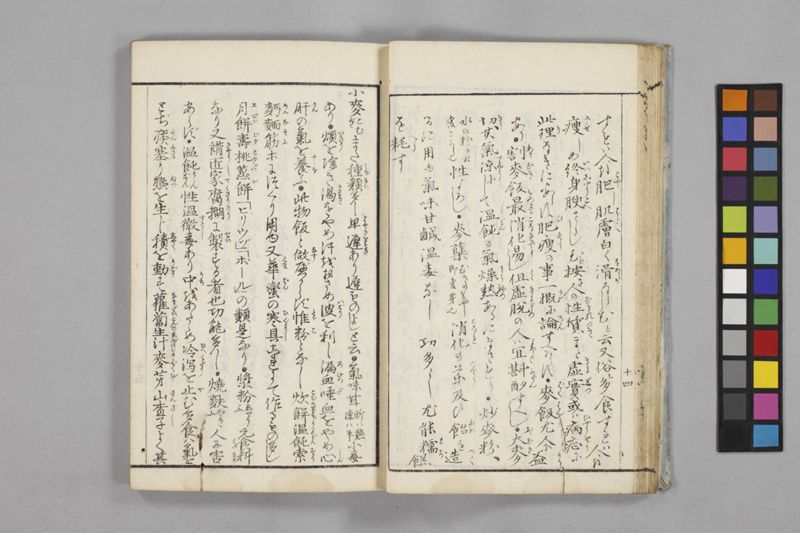
翻刻
【右丁】
すれは人を肥(こや)し肌膚(はたへ)白く滑(なめらか)ならしむと云又俗に多食すれは人を
痩(やせ)しめ終身(いつしやう)腴(こへ)さらしむと按に人の性質(むまれつき)また虚実(きよじつ)或は病症(ひやうせう)に
此 理(り)なきにあらす肥痩(ひそう)の事一 概(かい)に論(ろん)すへからす●麦飯(ばくはん)尤人に益
あり●割麦(わりむき)飯 最(もつとも)消化(こなれ)易(やす)し但(たゝ)虚脱(きよだつ)の人は宜(よろしく)斟酌(かげん)すへし●大麦(おゝむき)
切(きり)、其気 凉(りやう)にして温飩(うどん)の気 燥熱(さうねつ)あるにまされり●炒麦粉、
《割書:水の粉と云|麦こかし也》性よろし●麦蘖《割書:むきのもやし|即麦芽也》消化(こなれ)の薬(くすり)及ひ飴(あめ)を造(つく)
るに用ゆ気味甘鹹温毒なし 功多し尤能 糯餻(もち)
を耗(へら)す
【左丁】
小麦《割書:こむ|ぎ》また種類(しゆるい)多し早(はやき)遅(をそき)あり遅ものよしと云●気味甘《割書:新は熱|陳は平》小毒
あり●煩(いきり)を除き渇(かわき)をやめ汗をおさめ溲(いばり)を利し漏血(ろけつ)唾(だ)血をやめ心(しん)
肝(かん)の気を養(やしな)ふ●此物飯と作(なす)#1べからず惟(たゞ)粉(こ)となし炊餅(こむきもち)温飩(うんどん)索(そう)
麪(めん)麪筋(なまふ)#2等につくり用ゆ又 華蛮(くわばん)の寒具(ひぐわし)これにて作るもの多し
月餅(ヱピン)寿桃蒸餅(ジウタロウパン)「ヒリウヅ」「ボール」の類是なり●漿粉《割書:しやう|ふ》元《振り仮名:食料| |くいもの 》
なり又 褙匠家(きやうしや)腐糊(くさりのり)に製(せい)する者也功能多し●焼麩《割書:やき|ふ》人に害
あらず●温飩《割書:うん|どん》性温 微(すこし)毒あり中(うち)をあたゝめ冷瀉(ひへくだり)を止(や)む多食は気を
とぢ痰(たん)塞(ふさか)り熱(ねつ)を生じ積(しやく)を動(うごか)す蘿匐(なまだいこんの)生汁(しぼりしる)麦芽(ばくげ)山査子(さんざし)よく其
現代語訳
【右丁】
(前ページより続き)…長く食べ続けると人を肥やし、肌を白く滑らかにするとも言われる。また俗説には、多食すると人を痩せさせ、一生太ることがないともいう。考えるに、人の生まれつきの性質や、虚実の体質の違い、あるいは病状によって、この両説ともあながち理がないわけではない。肥痩(太る・痩せる)の問題は一概に論じることはできない。●麦飯(麦ごはん):特に人に益がある。●割麦(割り麦)の飯:最も消化しやすい。ただし虚脱(体力の衰弱した)の人は適宜加減すべきである。●大麦切(大麦を刻んだもの、麦切り):その性質は涼であり、温飩(うどん)の性質が燥熱であるのに比べて優れている。●炒麦粉(麦こがし、水の粉ともいう):性質がよい。●麦蘖(麦のもやし、すなわち麦芽のこと):消化を助ける薬として、また飴を作るのに用いる。気味は甘鹹温で毒はない。功能が多い。とりわけよく糯餅(もち)を消化させる(消耗させる)。
【左丁】
小麦(こむぎ):こちらも種類が多く、早生・晩生がある。晩生のものが良いといわれる。●気味は甘(新しいものは熱、古いものは平)で、小毒がある。●煩熱(いきり、胸のほてり)を除き、渇きをやめ、汗を抑え、小便の出をよくし、漏血・唾血(血を吐く)を止め、心・肝の気を養う。●この物(小麦)は飯として炊くことはできない。ただ粉にして、炊餅(こむぎもち)・温飩(うどん)・索麺(そうめん)・麪筋(なまふ、生麩)等に作って用いる。また中国・外国(蛮地)の寒具(冷たい菓子・揚げ菓子の類)もこれで作るものが多い。月餅(エビン)・寿桃・蒸餅(ジウタロウパン)・「ヒリウヅ」・「ボール」の類がそれである。●漿粉(しょうふ):もとは食料である。また表具師(経師屋)が腐糊(くさり糊)を作るのに用いるものでもある。功能が多い。●焼麩(やきふ):人に害はない。●温飩(うどん):性は温で微毒がある。体の内を温め、冷えによる下痢を止める。多食すると気を塞ぎ、痰が詰まり、熱を生じ、積(消化不良の滞り)を動かす。大根の生絞り汁・麦芽・山査子(さんざし)はよくその……(次ページへ続く)
英語訳
**[Right folio]**
*(Continuing from the previous page)* …with prolonged consumption, it is said to make people plump and render the skin white and smooth. On the other hand, a popular saying holds that eating it in excess makes one thin and prevents one from gaining weight for life. Upon reflection, given differences in a person's innate constitution, whether their body type tends toward deficiency or excess (*kyojitsu*), or their particular illness, neither view is without reason. The matter of being fat or thin cannot be discussed in blanket terms. ● **Mugi-meshi** (barley rice): This is especially beneficial to people. ● **Wari-mugi** (cracked/split barley) rice: This is the easiest of all to digest. However, those with *kyodatsu* (physical debilitation and collapse of vital energy) should adjust the amount they consume accordingly. ● **Ōmugi-kiri** (sliced/cut barley, i.e., barley noodles): Its nature is cool, surpassing that of *udon*, whose nature tends toward dryness and heat. ● **Iri-mugiko** (roasted barley flour; also called *mizu no ko* or *mugi-kogashi*): Its nature is good. ● **Mugi-no-moyashi** (barley sprouts, i.e., malted barley / *bakuga*): Used as a medicine to aid digestion and in the making of *ame* (malt syrup/candy). Its flavor and nature are sweet, salty (*kan*), and warm, with no toxicity. It has many efficacies. In particular, it is highly effective at dissolving and dispersing glutinous rice cakes (*mochi*).
**[Left folio]**
**Small wheat / Wheat** (*komugi*): There are also many varieties, with early-ripening and late-ripening types. The late-ripening kind is said to be superior. ● Its flavor and nature are sweet (when fresh, it is *hot* in nature; when aged, it is *neutral/balanced*), with slight toxicity. ● It removes vexation-heat (*ikiri*, a feeling of heat and irritation in the chest), stops thirst, suppresses excessive sweating, promotes urination, stops hemorrhage (*roketsu*) and spitting of blood (*daketsu*), and nourishes the qi of the heart and liver. ● This substance cannot be prepared as a cooked rice dish. It is used only by grinding it into flour, and then making *komugi-mochi* (wheat cakes), *udon* (thick wheat noodles), *sōmen* (thin wheat noodles), *namafu* (raw wheat gluten), and similar products. Furthermore, many of the Chinese and foreign (*kaban*) cold confections (*higuashi / kanka*) are made from wheat flour. Moon cakes (*Yuèbǐng*, read *Epin*), longevity peach buns (*shōtō*), steamed buns (*Zhēngbǐng*, read *Jiutarō-pan*), "Hiridzu," and "Bōru" are among these. ● **Shōfu** (starch paste): This is originally a food. It is also used by mounters and paper craftsmen (*kyōshiya*) to prepare fermented/decomposed paste (*kusari-nori*). It has many functional properties. ● **Yaki-fu** (baked/grilled wheat gluten): Causes no harm to people. ● **Udon**: Its nature is warm with slight toxicity. It warms the interior of the body and stops diarrhea caused by cold. Excessive consumption, however, obstructs the qi, causes phlegm blockage, generates heat, and stirs up digestive stagnation (*shaku*). The fresh pressed juice of raw daikon radish, malted barley (*bakuga*), and hawthorn berries (*sanzashi*) effectively counteract its… *(continues on the next page)*