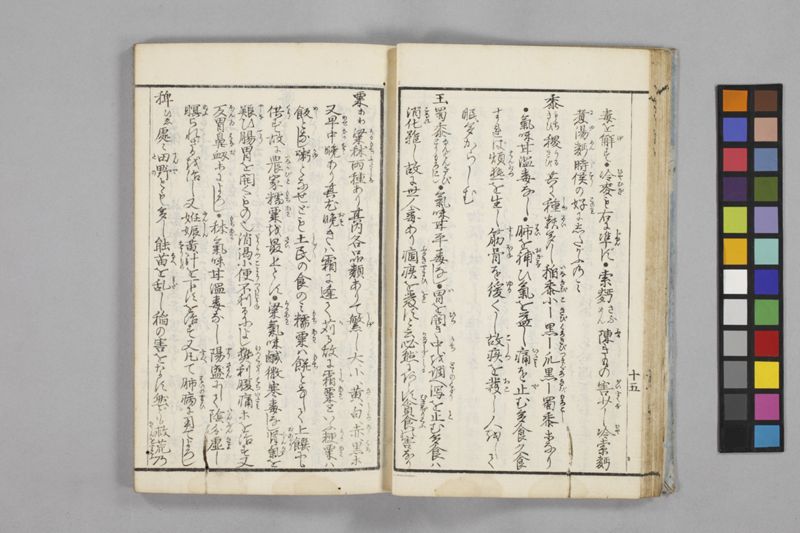
翻刻
【右丁】
毒を解(げ)す●冷麦(ひやむぎ)も右に準(じゆん)ず●索麪《割書:さふ|めん》陳(ふる)きもの害(がい)少(すくな)し冷(ひや)索麪
煮湯麪(にゆめん)時候の好(このみ)にしたがふのみ
黍《割書:もち|きび》稷《割書:うる|きび》共に種類(しゆるい)多し稲黍(いなきび)《振り仮名:小ー|こきび》《振り仮名:黒ー|くろきび》《振り仮名:爪黒ー|つまぐろきび》蜀黍(もろこし)等なり
●気味甘温毒なし●肺(はい)を補(おぎな)ひ気を益し痛(いたみ)を止(や)む多食久食
すれば煩熱(はんねつ)を生し筋骨(すじほね)を緩(ゆる)くし故疾(こしつ)を発(おこ)し人をして
眠多からしむ
玉蜀黍《割書:なんはんきび|とうもろこし》●気味甘平毒なし●胃(い)を開(ひら)き中(うち)を調(とゝの)へ瀉(くだり)を止(と)む多食は
消化(こなれ)難し故に世人毒あり痼疾(ふるきやまひ)を発(をこ)すと云 必(かならず)然(しかる)にあらす貪食(むさぼりくふ)の害なり
【左丁】
粟《割書:あわ》粱(うる)秫(もち)両種(ふたしな)あり其内各品類ありて繁(しげ)し大、小、黄(き)、白(しろ)、赤(あか)、黒(くろ)等
又 早(わせ)中(なか)晩(をく)あり其尤 晩(おそ)きは霜に逢て刈#1る故に霜粟(しもあわ)といふ粳粟(うるあわ)は
飯(めし)となし粥(かゆ)となせども土民(しも〳〵)の食のみ糯粟(もちあわ)は餅(もち)となして《振り仮名:上饌| |おあがり 》にも
供(くう)ず故に農家(いなかびと)糯粟(もちあわ)を最(さい)上とす●粱(うるあわ)気味鹹微寒毒なし腎気(じんき)を
養(やしな)ひ腸(てう)胃を開くもの也 消渇(せうかつ)小便(こよう)不利(つうじかね)るによし熱利(ねつくだり)腹痛(はらいたみ)等を治す又
反胃(ほんゐ)鼻衄(はなぢ)等によろし●秫(もちあわ)気味甘温毒なし陽(やう)盛(さかん)にして陰分(いんぶん)虚(きよ)し
瞑(ねふ)られざるを治し又 妊娠(にんしん)《振り仮名:黄汁| |をりもの 》を下すを治す又 凡(すべ)て肺病(はいのやまひ)に用てよろし
稗《割書:ひゑ》処々 《振り仮名:田野|でんや|たの 》とも多し能 苗(なへ)を乱(みだ)し稲の害をなす然ども《振り仮名:救荒| |きゝんをすくふ 》の
現代語訳
【右丁】
(前ページより続き)…その毒を解消する。●冷麦(ひやむぎ)も右(うどんの項)に準ずる。●索麺(そうめん)は、古いものは害が少ない。冷たい索麺(冷やしそうめん)と煮た温かい麺(にゅうめん)は、その時々の季節の好みに従うのみである。
黍(もちきび)・稷(うるきび)は、ともに種類が多い。稲黍(小きび)・黒きび・爪黒きび・蜀黍(もろこし、とうもろこし)などがある。
●気味は甘・温で毒はない。●肺を補い、気を益し、痛みを止める。多食・久食すると煩熱(胸のほてり)を生じ、筋骨をゆるめ、持病(古くからの病気)を発症させ、人をして眠りがちにさせる。
玉蜀黍(なんばんきび・とうもろこし):●気味は甘・平で毒はない。●胃を開き、体の内を整え、下痢を止める。多食すると消化しにくい。それゆえ世間の人々は「毒があり痼疾(古い病気)を引き起こす」と言うが、必ずしもそうではなく、それは食べ過ぎの害にすぎない。
【左丁】
粟(あわ):粱(うるあわ)と秫(もちあわ)の二種類があり、その中にそれぞれ品種があって複雑である。大・小・黄・白・赤・黒などの種類があり、また早生・中生・晩生がある。その中でも最も遅いものは霜に当たってから刈り取るため「霜粟(しもあわ)」という。粳粟(うるあわ)は飯や粥にするが、庶民(下々の者)の食べ物にすぎない。糯粟(もちあわ)は餅にして、御上りもの(貴人・上位の者へのお供え物や饗応料理)にも供することができる。それゆえ農家の人々は糯粟を最上とする。●粱(うるあわ)の気味は鹹(塩辛い)・微寒で毒はない。腎気を養い、腸・胃を開くものである。消渇(糖尿病に似た病気)・小便不利(小便の通じが悪い)によく、熱利(熱性の下痢)・腹痛などを治す。また反胃(胃の逆流・嘔吐)・鼻衄(鼻血)などにも良い。●秫(もちあわ)の気味は甘・温で毒はない。陽気が盛んで陰分が虚しているために眠れないのを治し、また妊娠中の黄汁(おりもの)が下るのを治す。また、すべての肺の病気に用いてよい。
稗(ひえ):各地の田野(田畑・野原)に多く見られる。よく苗を乱し、稲に害をなす。しかしながら、飢饉を救う(食糧として重要な)……(次ページへ続く)
英語訳
**[Right folio]**
*(Continuing from the previous page)* …effectively counteracts its toxicity. ● **Hiya-mugi** (cold wheat noodles): The same principles as described above (for *udon*) apply. ● **Sōmen** (thin wheat noodles): Aged/dried sōmen has less harm. Whether to eat cold sōmen (chilled) or hot boiled noodles (*nyūmen*) is simply a matter of following one's preference according to the season.
**Mochi-kibi** (glutinous millet / *Panicum miliaceum*) and **Uru-kibi** (non-glutinous millet / *Panicum miliaceum*): Both have many varieties, including *ina-kibi* (small millet), *kuro-kibi* (black millet), *tsuma-guro-kibi* (tip-black millet), and *morokoshi* (sorghum), among others.
● Their flavor and nature are sweet and warm, with no toxicity. ● They supplement the lungs, augment the qi, and stop pain. However, eating them in large quantities or over a prolonged period generates vexation-heat (*hannетsu*), relaxes the muscles and bones, causes old/chronic ailments to flare up, and makes a person prone to excessive sleep.
**Tōmorokoshi / Nanbankibi** (maize / corn): ● Its flavor and nature are sweet and neutral (*hei*), with no toxicity. ● It opens the stomach, regulates the interior of the body, and stops diarrhea. Eating it in excess makes it difficult to digest. For this reason, common people say that it is toxic and causes chronic diseases to recur, but this is not necessarily so — it is merely the harm caused by eating it greedily and to excess.
---
**[Left folio]**
**Awa** (millet / *Setaria italica*): There are two types — *uru-awa* (non-glutinous millet) and *mochi-awa* (glutinous millet) — and within each type there are numerous varieties, making classification complex. There are large, small, yellow, white, red, and black varieties, as well as early-ripening, mid-ripening, and late-ripening types. The latest-ripening of all is harvested after it has been touched by frost, and is therefore called *shimo-awa* ("frost millet"). *Uru-awa* (non-glutinous millet) is made into rice and porridge, but it is food only for the common people (the lower classes). *Mochi-awa* (glutinous millet) can be made into *mochi* (rice cakes) and offered even as refined cuisine (*o-agari*, food served to those of higher rank). For this reason, farming people regard *mochi-awa* as the finest of the two. ● The flavor and nature of *ura-awa* (*ryō* / non-glutinous millet) are salty and slightly cold, with no toxicity. It nourishes the kidney qi and opens the intestines and stomach. It is beneficial for *shōkatsu* (a wasting-thirst disorder resembling diabetes) and difficulty in urination, and treats heat-type diarrhea (*netsukudari*) and abdominal pain. It is also beneficial for *hon'i* (regurgitation / stomach reflux and vomiting) and *hanaji* (nosebleeds). ● The flavor and nature of *mochi-awa* (glutinous millet / *jutsu*) are sweet and warm, with no toxicity. It treats insomnia caused by an excess of yang and deficiency of yin, and also treats the downward discharge of yellow fluid (*orimono* / vaginal discharge) during pregnancy. Furthermore, it is suitable for use in all lung diseases.
**Hie** (barnyard millet / *Echinochloa esculenta*): It grows abundantly in paddy fields and wild areas throughout the country. It is prone to disrupting rice seedlings and causing harm to rice crops. Nevertheless, it is an important food for relieving famine… *(continues on the next page)*