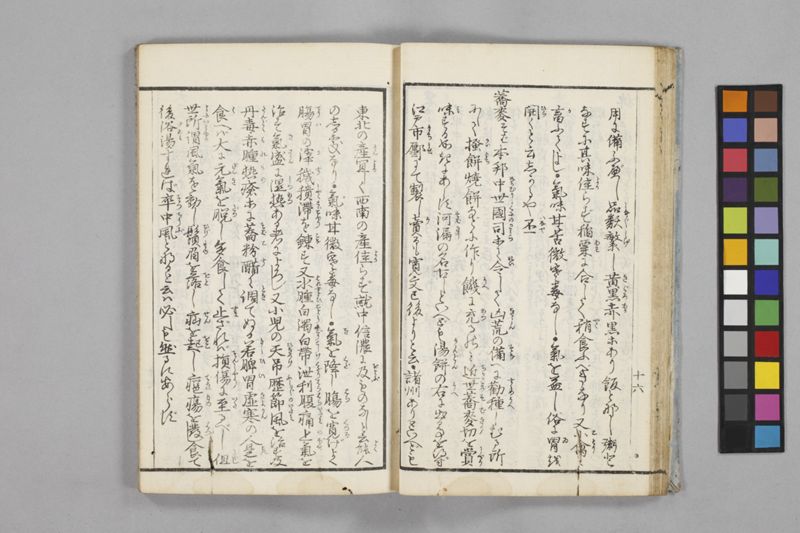
翻刻
【右丁】
用に備ふべし品類(しな〴〵)繁(しげ)し黄黒(きぐろ)赤(あか)黒等あり飯となし粥と
なすに其味 佳(よか)らず稲 粟(あわ)に合して稍(やゝ)食ふべきなり又 小禽(ことり)□
畜(か)ふてよし●気味甘苦微寒毒なし●気を益し俗に胃(ゐ)を
開(ひら)くと云しかるや否(いなや)
蕎麦《割書:そば》本邦 中世(なかむかし)国司(くにのかみ)等(ら)に令(れい)して凶荒(きゝん)の備(そな)へに勧(すゝめ)種(うへ)しむる所
にして掻餅(かいもち)焼餅などに作り饑(うへ)に充(あつ)るのみ近世(ちかころ)蕎麦切(そばきり)を賞(しやう)
味(み)する如きにあらず河漏(そばきり)の名古しといへども湯餅(うんどん)の右(うへ)に出る事を得ず
江戸 市鄽(まちみせ)にて製し売(う)るも寛文已後よりと云●諸州ありといへども
【左丁】
東北の産(さん)宜(よろ)しく西南の産 佳(よか)らず就中信濃に及(およぶ)ものなしと云 能(よく)人
のしる処なり●気味甘微寒毒なし●気(き)を降(くだ)し腸(はら)を寛(くつろ)げよく
腸胃(てうい)の滓穢(かす)積(しやく)滞(とゞこほり)を錬(こな)す又 水腫(はれやまひ)白濁(こようにごり)#1白帯(こしけ)泄利(くだりはら)腹痛(はらいたみ)上気(のぼせ)を
治す気(き)盛(さかん)に湿熱(しつねつ)ある者によろし又小児の天吊(ひきつけ)歴節風(ふし〴〵のいたみ)を治す及
丹毒(たんどく)赤腫熱瘡(はれもの)等に蕎粉(そばこ)醋(す)に調(とき)てぬる若(もし)脾胃(ひい)虚寒(きよかん)の人 是(これ)を
食(く)へば大に元気(げんき)を脱(だつ)し多食して止(やま)ざれば損傷(そんしやう)に至(いた)るべし但(たゞし)
世(よに)所謂(いわゆる)風気を動し鬚(ひげ)眉(まゆ)を落(おと)し疝(せん)を起(をこ)し癰瘍(できもの)を発(はつ)し食て
後 浴湯(ゆあみ)すれば卒(そつ)中風(ちうぶ)となると云は必しも然るにあらず
現代語訳
【右丁】
(前ページより続き)…用いるために備えておくべきである。品種は多く、黄・黒・赤・黒などがある。飯や粥にしても、その味はあまり良くない。稲や粟に混ぜて、少し食べる程度がよい。また、小鳥を飼うのにも良い。●気味は甘・苦・微寒で毒はない。●気を益すと言われ、俗に胃を開くとも言われるが、それが本当かどうかは定かでない。
蕎麦(そば):わが国の中世において、国司などに命じて凶荒(飢饉)の備えとして栽培を奨励させたものであり、かいもち(掻き餅)や焼き餅などに作って、飢えをしのぐためのものにすぎなかった。近世(近ごろ)に蕎麦切りが珍重されるようなことは(昔は)なかった。「河漏(そばきり)」の名は古くからあるといえども、湯餅(うどん)より上位に出ることはできなかった。江戸の市中の店で製造・販売されるようになったのも、寛文(1661~1673年)以降のことだと言われている。●諸国に産するといえども……
【左丁】
……東北の産が良く、西南の産は良くない。とりわけ信濃(信州)の産に及ぶものはないと言われており、これはよく人々の知るところである。●気味は甘・微寒で毒はない。●気を下らせ、腸をくつろげ、腸・胃の滓や穢れ・積滞(つかえ)をよく消化する。また、水腫(浮腫み・むくみの病)・白濁(小便の濁り)・白帯(こしけ、おりもの)・泄利(下り腹)・腹痛・上気(のぼせ)を治す。気が盛んで湿熱のある者に適している。また小児の天吊り(引きつけ・痙攣)・歴節風(関節の痛み)を治す。さらに丹毒・赤腫・熱瘡(腫れ物)などには、蕎麦粉を酢で溶いて塗ればよい。ただし、もし脾胃が虚寒の人がこれを食べると、大いに元気を損ない、多食してやめなければ、体を損傷するに至るだろう。ただし、世間でいわゆる「風気を動かし、鬚や眉を落とし、疝(せん、腹部の痛み)を起こし、癰瘍(できもの)を発し、食後に入浴すると卒中風(中風・脳卒中)になる」というのは、必ずしもそうではない。
英語訳
**[Right folio]**
*(Continuing from the previous page)* …it should be kept in store for use in times of need. It has many varieties, including yellow, black, red, and black types. When made into cooked rice or porridge, the flavor is not particularly good. It is best eaten mixed with regular rice or millet, in modest amounts. It is also good for feeding small birds. ● Its flavor and nature are sweet, bitter, and slightly cold, with no toxicity. ● It is said to augment the qi, and people commonly say it opens the stomach, though whether this is truly the case is uncertain.
**Soba** (buckwheat): In the middle ages of our country, provincial governors (*kokushi*) were ordered to encourage its cultivation as a provision against famine and crop failure. It was made into *kaimochi* (a kind of buckwheat cake) and griddlecakes (*yakimochi*), serving only to stave off hunger. In those earlier times, it was nothing like the prized *sobakiri* (cut buckwheat noodles) enjoyed in more recent times. Although the name *karo* (*sobakiri*) is an old one, buckwheat noodles could not surpass *udon* (*undon* / wheat noodles) in prestige. It is said that manufacturing and selling it in the shops of Edo's marketplace only began after the Kanbun era (1661–1673). ● Although it is produced in various provinces throughout the country…
---
**[Left folio]**
…the produce of the northeast is superior, while that of the southwest is not as good. It is said that nothing can match the produce of Shinano (Shinshū / present-day Nagano Prefecture) in particular — something that is well known among people. ● Its flavor and nature are sweet and slightly cold, with no toxicity. ● It descends the qi, relaxes the intestines, and effectively dissolves and disperses dregs, impurities, and accumulated stagnation in the intestines and stomach. It also treats *suishu* (edema / swelling disease), *hakudaku* (turbid urine), *hakutai* (white vaginal discharge / *koshike*), *setsurei* (diarrhea / loose bowels), abdominal pain, and *jōki* (flushing / heat rising to the head). It is suitable for those whose qi is vigorous with damp-heat. It also treats convulsions (*hikitsuke* / *tentō*) in young children and *rekisetsu-fū* (migratory joint pain / traveling joint wind). Furthermore, for *dantoku* (erysipelas / skin inflammation), red swelling, and hot sores, buckwheat flour mixed with vinegar and applied as a poultice is effective. However, if a person with deficiency-cold (*kyokan*) of the spleen and stomach eats it, they will greatly deplete their vital energy (*genki*), and if they eat too much and do not stop, they will come to suffer serious bodily damage. That said, what the world commonly says — that buckwheat "stirs up wind-qi, causes the beard and eyebrows to fall out, provokes *sen* (abdominal spasms / hernia pain), causes boils and sores (*yōyō*) to erupt, and that bathing after eating it will result in sudden stroke (*sotchūfū* / apoplexy)" — is not necessarily the case.