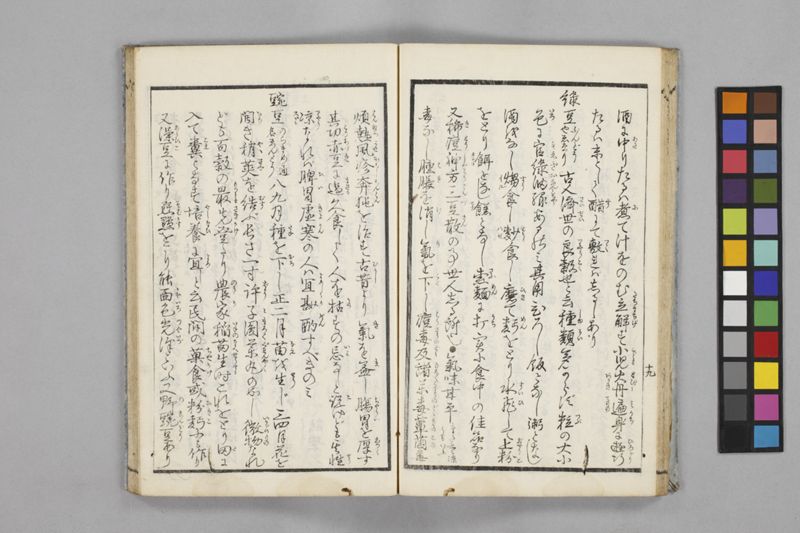
翻刻
【右丁】
酒に中(あた)りたるは煮(に)て汁をのむ立(たちまち)解(げ)す小児(こども)《振り仮名:火丹|とびし【ママ】|あかき 》《振り仮名:遍身|みうち|てもの 》に遊行(ひろがり)
たるは末として醋(す)にて敷(つく)ればしるしあり
緑豆《割書:ぶんどう|やゑなり》古人 済世(さいせい)の良穀(りやうこく)也と云 種類(しゆるい)多からず粒(つぶ)の大小
色(いろ)に宦緑(もゑぎ)納緑(おなんとちや)あるのみ其用ひろし飯となし粥となし
酒をなし《振り仮名:煼|すう|イル 》#1食し《振り仮名:麨|せう|ハゼ 》食し磨(ひき)て麪(めん)をとり水飛(すいひ)して上粉(じやうこ)
をとり《振り仮名:餌| |ダンゴ 》となし《振り仮名:餻| |モチ 》となし索麪(さふめん)#2に打(うち)実に食中の佳品なり
又 稀痘神方三豆散(きとうしんはうさんづさん)の事世人しる所也●気味甘平《割書:また寒涼|ともいふ》
毒なし腫脹(はれ)を消(け)し気(き)を下(くだ)し痘毒(はうさうのどく)及 諸薬毒(もろ〳〵くすりのどく)蕈菌(きのこの)毒
【左丁】
煩熱(はんねつ)風疹(かせほろし)奔㹠(ほんとん)を治す古昔(むかし)より気(き)を益(ま)し腸胃(ちやうい)を厚(あつく)す
其 功(こう)赤豆(あづき)に過(まさる)久食して人を枯(から)すの忌(いみ)なしと説(と)けども其 性(せう)
《振り仮名:凉|りやう|スヾシ 》なれば脾胃(ひい)虚寒(きよかん)の人は宜(よろしく)斟酌(かげん)すべきのみ
豌豆《割書:のらまめ通|名ゑんとう》八九月 種(たね)を下(おろ)し正二月 苗(なえ)を生(せう)じ三四月花を
開(ひら)き稍(やゝ)莢(さや)を結(むす)ぶ長さ一寸 許(ばかり)子 円(まろく)薬丸(ぐわんやく)の如し微物(いかゞのもの)なれ
ども百穀の最(もつとも)先登(さきかけ)たり農家(のうか)稲苗(いねのなへ)生(せうする)時これをとり田(た)に
入て糞(こえ)となす培養(やしなひ)に宜(よろ)しと云民間の茶食(ちやうけ)或 粉麪(ひきこ)にも作り
又 澡豆(あらひこ)に作り䵟(そば)𪒟(かす)を□り能 面色(かほいろ)光沢(つやいづ)といふ又 野豌豆(のゑんどう)あり
現代語訳
【右丁】
(前ページより続き、赤小豆の項)
酒にあたった場合は、煮てその汁を飲めばたちまち解毒できる。子どもの丹毒(赤い皮膚炎)が全身に広がった場合は、粉末にして酢で練り付ければ効果がある。
**緑豆(ぶんどう・やえなり):**
古人は「世を救う良き穀物」と称えた。種類はそれほど多くなく、粒の大小と色(萌葱色・オリーブ茶色)の違いがあるのみである。その用途は広く、飯にし、粥にし、酒を醸し、炒って食べ、焦がして食べ(はぜ食)、挽いて麺をとり、水に晒して上質の粉(澱粉)をとり、団子にし、餅にし、素麺に打つなど、まことに食品中の佳品である。また「稀痘神方三豆散(きとうしんほうさんずさん)」のことは世人の知るところである。
●気味は甘・平(また寒涼とも言う)で毒はない。腫れや張りを消し、気を下らせ、痘瘡(天然痘)の毒および諸々の薬毒・茸の毒、
【左丁】
煩熱(身体の熱くほてる症状)・風疹(発疹を伴う風邪様の症状)・奔豚(気が下腹から胸に突き上げてくる症状)を治す。古来より気を益し、腸胃を丈夫にすると言われており、その効能は赤小豆(あずき)に勝り、長く食しても人を枯らす(やせ衰えさせる)という禁忌もないと説かれている。しかし、その性質が涼(冷やす性質)であるから、脾胃が虚寒(虚弱で冷え性)の人は適宜加減すべきである。
**豌豆(のらまめ・通称えんとう〔えんどう〕):**
八・九月に種を蒔き、正月・二月に苗が育ち、三・四月に花を開き、やがて莢(さや)を結ぶ。莢の長さは一寸(約三センチ)ほどで、実は丸く薬の丸薬のような形をしている。取るに足りないような小さな作物ではあるが、百穀の中で最も早く実る(先駆けとなる)ものである。農家では稲の苗を育てる時期にこれを取り、田に入れて肥料(堆肥)とする。土地の養いに良いと言われている。民間では茶菓子にしたり、挽き粉(粉末)にも作る。また洗い粉(洗顔・洗浄用の粉)として用い、蕎麦殻(そばかす)を□(磨るか、混ぜるか)って、よく顔色に艶が出ると言われている。また野豌豆(野生のえんどう)もある。
英語訳
**[Right folio]**
*(Continued from the previous page, under the entry for adzuki beans)*
For those suffering from alcohol poisoning, boiling the beans and drinking the liquid will provide immediate relief. For children whose *firedew* (*hiyake*; erysipelas/fire-toxin rash) has spread across the entire body, grinding the beans into powder and applying it mixed with vinegar is effective.
---
**Mung beans** (*bundō*; also known as *yaenari*):
The ancients called this "an excellent grain that saves the world." There are not many varieties—differences exist only in the size of the grains and their color (which ranges from bright green to olive-brown). Their uses are wide-ranging: they are made into rice, porridge, and sake; they are eaten parched or roasted; they are milled into noodles; they are water-processed to obtain fine starch powder; they are formed into dumplings (*dango*) and rice cakes (*mochi*); and they are pressed into thin noodles (*sōmen*). They are truly a fine food among all grains. The world is also well acquainted with the *kitōshinpō sandōsan* ("Three-Bean Powder of the Rare Pox Divine Formula"), which includes mung beans as a key ingredient.
● Their flavor and nature are sweet and neutral (also described as cool and cold) with no toxicity. They dissipate swelling and distension, descend *qi* (vital energy), and counteract the toxicity of smallpox, various medicinal poisons, and the toxins of mushrooms,
---
**[Left folio]**
as well as treating febrile irritability (*han'netsu*), wind-rash (*fūshin*; urticaria or rash-type conditions), and *honton* (a surging, rushing sensation of qi rising from the lower abdomen toward the chest). Since ancient times, it has been said to supplement *qi* and strengthen the intestines and stomach, with its efficacy surpassing that of adzuki beans, and without the prohibition of causing physical emaciation even with prolonged consumption. However, since its nature is cooling, those with a deficiency-cold (*kyokan*) spleen and stomach constitution should adjust their intake accordingly.
---
**Garden peas** (*noramame*; commonly called *entō* / *endō*):
Seeds are sown in the eighth and ninth months, seedlings emerge in the first and second months, flowers open in the third and fourth months, and pods gradually form thereafter. The pods are about one *sun* (approximately 3 cm) in length, and the seeds are round, resembling medicinal pills. Though they may seem like a modest crop, they are the very first among the hundred grains to ripen. When farm households raise rice seedlings, they gather these peas and incorporate them into the paddies as fertilizer; it is said to be excellent for soil nourishment. Among ordinary people, they are made into tea-time snacks or ground into flour. They are also made into a washing powder (*araiko*), and when combined with ground buckwheat hulls, they are said to give the complexion a fine luster. There is also the *no-endō* (wild pea variety).