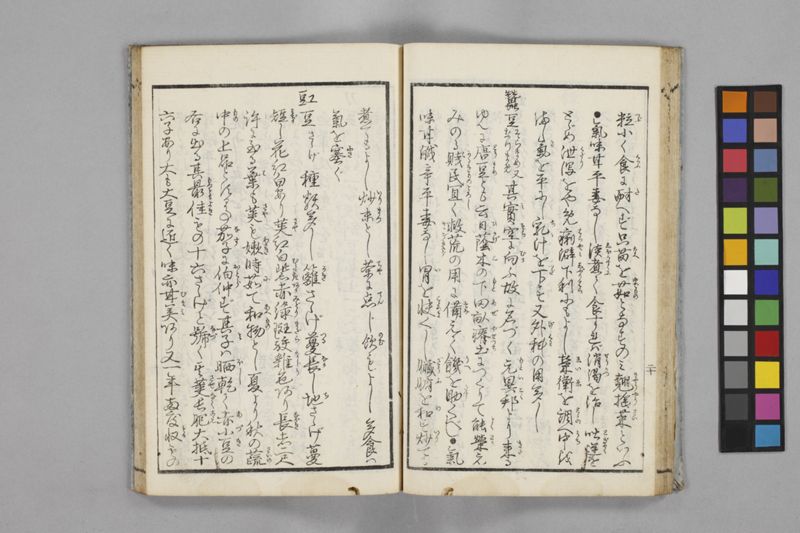
翻刻
【右丁】
粒(つぶ)小く食(くらふ)に耐(た)へず只 苗(なへ)を茹(ゆでもの)となすのみ翹揺菜(きやうやうさい)といふ
●気味甘平毒なし淡煮(しほうすくに)て食すれば消渇(せうかつ)を治し吐逆(とぎやく)を
とゞめ泄瀉(くだり)をやめ痢澼(はらやみ)下利(しぶりはら)にもよし栄衛(ゑいゑ)を調(とゝの)へ中(うち)を
まし気(き)を平にし乳汁(ちゝ)を下(いだ)す又 外科(げくわ)の用多し
蚕豆《割書:そらまめ又|なつまめ》其 実(み)空(そら)に向(むか)ふ故に名づく元(もと)異邦(いこく)より来(きた)る
ゆへに唐豆(とうまめ)とも云 日蔭(ひかげ)木(こ)の下(もと)田畝(あぜ)瘠土(やせつち)につくりて能(よく)栄(さか)え
みのる賤民(かるきもの)宜(よろし)く《振り仮名:救荒| |キヽンノタスケ 》 の用に備(そな)えて饑(うへ)を助(たす)くべし●気
味甘鹹辛平毒なし胃(い)を快(こゝろよ)くし臓腑(ざうふ)を和(わ)す炒(いり)ても
【左丁】
煮てもよし炒末(いりまつ)とし茶(ちや)に点(てん)じ飲(のむ)もよし多食は
気を塞(ふさ)ぐ
豇豆《割書:さゝげ》種類多し籬(かき)さゝげ蔓(つる)長(なか)し地(ち)さゝげ蔓
短(みぢか)し花紅白あり莢(さや)紅白 紫(むらさき)赤(あか)緑(みどり)斑駮(まだら)雑色(まじり)あり長(ながき)者二尺
許に至る葉(は)も莢(さや)も嫩(わかき)時 茹(に)て和物(あへもの)とし夏より秋の蔬(さいの)
中(もの)の上品とする事 茄子(なす)に伯仲(おとら)ず其 子(み)は晒乾(ほし)て赤小豆(あづき)の
右に出る其 最(もつとも)佳(よき)もの十六さゝげと号(なづ)く其 莢(さや)長(ながく)肥(こえ)大抵十
六子あり大も大豆に近く味亦 甘美(むまみ)あり又一年両度 收(とる)もの
現代語訳
【右丁】
(前ページより続き、野豌豆について)
粒が小さく食用には適さない。ただ苗を茹でて食べるのみである。これを「翹揺菜(きょうようさい)」と呼ぶ。
●気味は甘・平で毒はない。薄味で煮て食べると、消渇(糖尿病様の口渇・多飲の症状)を治し、吐き気・嘔逆を止め、下痢を止め、腹痛を伴う下痢・しぶり腹(裏急後重)にも良い。営衛(えいえ;血と気の循環)を整え、中(腹中・消化機能)を益し、気を平らかにし、乳汁を出す。また外科的な用途にも多く使われる。
---
**蚕豆(そらまめ・またなつまめ):**
その実が空(天)に向かって生ることから名付けられた。もとは異国(外国)から渡来したものであるため、唐豆(とうまめ)とも言う。日陰の木の下、田の畦、痩せた土地でもよく育ち実る。身分の低い者(貧しい人々)にとっては飢饉の際の備えとして、飢えを助けるのに用いると良い。
●気味は甘・鹹(塩辛い)・辛・平で毒はない。胃の調子を良くし、臓腑を和らげる。炒っても
【左丁】
煮ても良い。炒って粉末にして茶に点じて飲むのも良い。ただし多食すると気を塞いでしまう(気の流れを滞らせる)。
---
**豇豆(ささげ):**
種類が多い。「籬(かき)ささげ」は蔓が長く、「地(じ)ささげ」は蔓が短い。花は紅・白があり、莢は紅・白・紫・赤・緑・斑(まだら)・雑色(まじり色)などがある。長いものは二尺(約六十センチ)ほどにも達する。葉も莢も若い時に茹でて和え物にし、夏から秋の野菜の中で上品(最上のもの)とすることは、茄子に劣らない。その実(豆)は晒して乾燥させると赤小豆(あずき)より優れている。その中で最も良いものを「十六ささげ」と称する。その莢は長く太く、おおよそ十六粒の実がある。粒の大きさも大豆に近く、味もまた甘くて美味しい。また一年に二度収穫できるものも
英語訳
**[Right folio]**
*(Continued from the previous page, on the wild pea)*
The grains are small and not suitable for eating. Only the seedlings are boiled and consumed as a vegetable. This plant is called *kyōyōsai* ("翹揺菜").
● Its flavor and nature are sweet and neutral, with no toxicity. When cooked plainly with little salt, it treats *shōkatsu* (消渇; a wasting-thirst condition similar to diabetes, characterized by excessive thirst and urination), arrests nausea and upward counterflow of stomach qi (*tōgyaku*), stops diarrhea, and is beneficial for abdominal pain with loose stools and tenesmus (*shiburi-bara*; dysentery-like straining). It regulates the *ei* and *e* (營衛; the nutritive and defensive aspects of qi circulation), strengthens the middle (digestive function), calms the qi, and promotes the flow of breast milk. It also has many applications in surgery (external medicine).
---
**Broad beans** (*soramame*; also called *natsumame*):
They are so named because their pods face upward toward the sky (*sora*). Since they originally came from foreign lands, they are also called *tōmame* ("Tang/Chinese beans"). They thrive and bear fruit well in shaded spots beneath trees, along field embankments, and in poor, lean soils. They are a worthy provision for people of humble means, and should be cultivated as a reserve against famine to help relieve hunger.
● Their flavor and nature are sweet, salty, pungent, and neutral, with no toxicity. They promote comfort in the stomach and harmonize the viscera and bowels. Whether roasted or
---
**[Left folio]**
boiled, both are good. Roasting them into a powder and whisking it into tea to drink is also beneficial. However, eating too many will obstruct and stagnate the flow of qi.
---
**Cowpeas / Long beans** (*sasage*):
There are many varieties. The "fence sasage" (*kaki-sasage*) has long vines, while the "ground sasage" (*ji-sasage*) has short vines. Flowers come in red and white; pods come in red, white, purple, red, green, dappled (*madara*), and mixed colors. The longest pods can reach up to two *shaku* (approximately 60 cm). Both the leaves and pods, when young, are boiled and dressed as seasoned salads (*aemono*), and as a summer-through-autumn vegetable they rank among the finest—not inferior to the eggplant. The seeds (beans), when sun-dried, surpass even adzuki beans. The finest among them is called the "*jūroku-sasage*" ("sixteen-pod bean"). Its pods are long and plump, typically containing sixteen seeds. The individual seeds are close in size to soybeans, and the flavor is also sweet and delicious. There is also a variety that can be harvested twice a year,