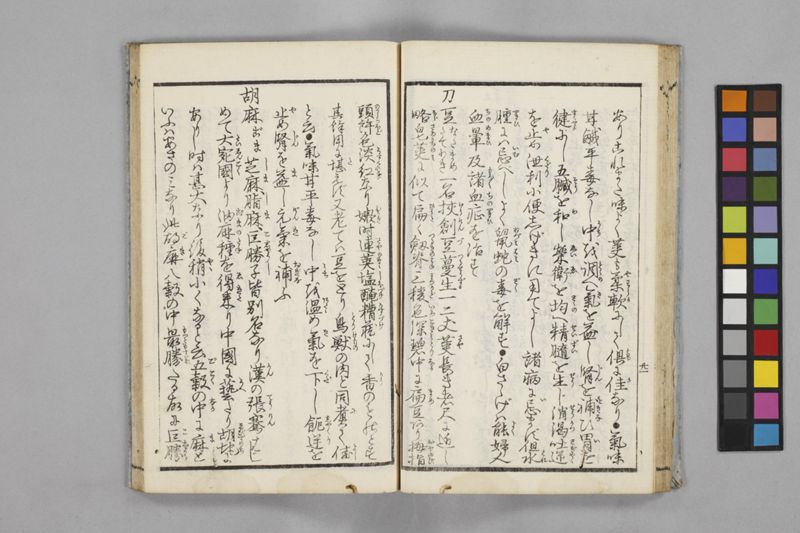
翻刻
【右丁】
ありこれまた味よく莢も柔軟(やわらか)にして倶(とも)に佳(か)なり●気味
甘鹹平毒なし中(うち)を調(とゝの)へ気(き)を益し腎(じん)を補(をきな)ひ胃(い)を
健(すくやか)にし五 臓(そう)を和(わ)し栄衛(ゑいゑ)を均(とゝの)へ精膸(せいずい)を生(せう)じ消渇(せうかつ)吐逆(とぎやく)
を止(や)め 泄利(くだり)小便しげきに用てよし諸病に忌(い)まず但 水(はれ)
腫(やまひ)には忌(いむ)べしよく鼠(ねづみ)蛇(はみ)の毒(どく)を解す●白さゝげは能(よく)婦人
血暈(ちのめまひ)及 諸(もろ〳〵)血症(ちのやまひ)を治す
刀豆《割書:なたまめ|たてわき》一名 挟剣豆(けうけんづ)蔓(つる)生(せうずる)一二丈 莢(さや)長き者尺に近し
略(ほゞ)皂莢(さいかちのみ)に似て扁(ひらた)く剣背(つるきのみね)三稜(みつかど)色(いろ)深碧(こきみとり)中(なか)に扁豆(まめ)あり拇指(おやゆび)
【左丁】
頭(のかしら)許(ほど)色 淡紅(うすくれない)なり嫩(わかき)時 連莢(さやのまゝ)塩醃(しほづけ)糟蔵(かすづけ)にして香(かう)のものとす
其余用に堪(た)えず又老ては豆をとり鳥獣(とりけもの)の肉と同 煑(に)て佳(よし)
と云●気味甘平毒なし中(うち)を温(あたゝ)め気(き)を下(くだ)し𩚚(しやく)逆(り)を
止(や)め腎(じん)を益(ま)し元気(げんき)を補(おぎな)ふ
胡麻《割書:ごま)》芝麻(しま)、脂麻(しま)、巨勝子(こしやうし)皆別名なり漢(かん)の張騫(てうけん)はじ
めて大宛国(たいゑんこく)より油麻種(ごまのたね)を得(ゑ)来(きた)り中国に芸(うへ)たり胡地(ゑびすのち)に
ありし時は甚大なり後 稍(やゝ)小くなると云 五穀(ごこく)の中(なか)に麻(ま)と
いふはあさのみなり此 胡麻(ごま)八穀の中 最(もつとも)勝(すぐれ)たる故に巨勝(こしよう)
現代語訳
【右丁】
(前ページからの続き:豇豆/ささげについて)
これもまた味よく、莢も柔らかで、どちらも優れている。
・気味は甘・鹹(かん)・平にして毒なし。体の内を調え、気を益し、腎を補い、胃を健やかにし、五臓を和らげ、営衛を均等に整え、精髄を生じ、消渇・嘔吐・逆上せを止め、下痢・頻尿にもよい。諸病においても忌むことがない。ただし、水腫(むくみの病)には忌むべきである。また、ねずみや蛇の毒をよく解する。
・白ささげは、婦人の血暈(血の道による目まい)および諸々の血の病に効果がある。
---
**刀豆(なた豆・たてわき)** 一名を挟剣豆(きょうけんず)ともいう。蔓性で、一丈から二丈にも伸びる。莢は長いもので一尺近くになる。ほぼ皂莢(さいかちの実)に似て扁平で、剣の背(みね)のような三稜があり、色は深い碧緑色である。中に豆があり、親指の
---
【左丁】
頭(先端)ほどの大きさで、色は淡い紅色である。若いうちは莢のまま塩漬けや粕漬けにして香の物(漬物)とする。その他の用途には向かない。また、老熟したときは豆を取り出し、鳥や獣の肉と一緒に煮るとよいという。
・気味は甘・平にして毒なし。体の内を温め、気を下し、しゃっくりや逆上せを止め、腎を益し、元気を補う。
---
**胡麻(ごま)** 芝麻(しま)・脂麻(しま)・巨勝子(こしょうし)はいずれも別名である。漢の張騫(ちょうけん)が最初に大宛国(たいえんこく)から胡麻の種を得て帰り、中国で植えたのが始まりとされる。胡地(えびすの地、すなわち西域)にあったころは粒が甚だ大きかったが、後にやや小さくなったと伝えられる。五穀の中に「麻(ま)」というのは、あさ(大麻)の実のことである。この胡麻は八穀の中でも最も優れているゆえに「巨勝(こしょう)」
英語訳
**[Right Page]**
*(Continuing from the previous page: Cowpea / Long Bean — Sasage / 豇豆)*
This variety, too, is flavorful, and the pods are tender and soft — both the pod and the bean are excellent.
· Its flavor and nature are sweet, salty (*kan*), and neutral (*hei*), with no toxicity. It regulates the interior of the body, replenishes the *qi*, tonifies the kidneys, invigorates the stomach, harmonizes the five viscera (*go-zō*), balances the nutritive and defensive *qi* (*ei-e*), generates vital essence and marrow (*seizui*), stops wasting-thirst (*shōkatsu*), vomiting, and nausea, and is beneficial for diarrhea and frequent urination. It is not contraindicated in most illnesses. However, it should be avoided in cases of water-swelling (*fushu*, edema). It is also highly effective at neutralizing the poison of rats and snakes.
· White *sasage* (white cowpea) is particularly effective in treating blood-dizziness (*chi no memai*) in women and various blood-related ailments.
---
**Sword Bean (*Nata-mame* / 刀豆; also called *Tatewaki*)** — Its alternative name is *Kyōkenzu* (挟剣豆, "sword-gripping bean"). It is a climbing vine that can grow one to two *jō* (approx. 3–6 meters) in height. The pods, when long, can approach one *shaku* (approx. 30 cm) in length. They resemble the pods of the honey locust (*saika-chi*) — flat and broad, with three ridges like the back of a sword blade. The color is a deep, dark green. Inside the pod are beans approximately the size of the tip of a thumb,
---
**[Left Page]**
and pale reddish in color. When young, the pods are preserved whole — either pickled in salt or in sake lees — and used as *kōnomono* (fragrant pickled vegetables). They are not well-suited for many other uses. Once the pods are mature and aged, the beans are extracted and simmered together with the meat of birds or beasts, which is said to be excellent.
· Its flavor and nature are sweet and neutral (*hei*), with no toxicity. It warms the interior of the body, descends the *qi*, stops hiccups and adverse rising of *qi* (*shakuri* and *gyaku*), nourishes the kidneys, and replenishes the *genki* (original vital energy).
---
**Sesame (*Goma* / 胡麻)** — *Shima* (芝麻), *Shima* (脂麻), and *Koshōshi* (巨勝子) are all alternative names. It is said that Zhang Qian (張騫) of the Han dynasty was the first to bring sesame seeds from the kingdom of Dayuan (大宛国, in present-day Central Asia) back to China and cultivate them there. When it grew in the land of the *Ebisu* (胡地, the western frontier regions), the seeds were said to be exceedingly large, but they reportedly became somewhat smaller over time after introduction. Among the five grains (*gokoku*), the one referred to as "*ma*" (麻) is the seed of hemp (*asa*, i.e., cannabis). This sesame, however, surpasses all others among the eight grains (*hakkoku*), and it is for this reason that it is called *Koshō* (巨勝, "the greatest victor") —