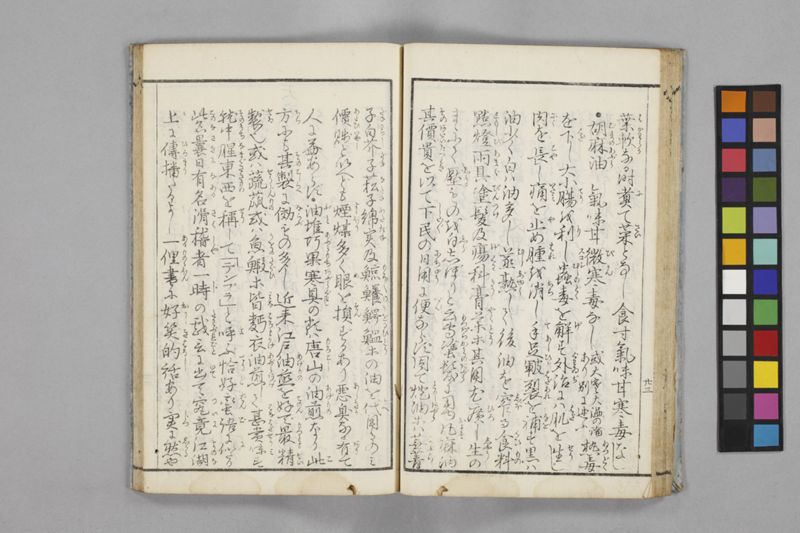
翻刻
【右丁】
葉(は)軟(やわらか)なる時 煑(に)て菜(さい)となし食す気味甘寒毒なし
●胡麻油(ごまのあぶら) 気味甘《振り仮名:微|び|スコシ 》寒(かん)毒なし《割書:或大寒大温の論|あり別に述ふ》熱毒(ねつどく)
を下(くだ)し大小 腸(てう)を利(り)し虫毒(むしのどく)を解(げ)す外治(ぐわいぢ)には肌(はだ)を生(せう)じ
肉(にく)を長(こや)し痛(いたみ)を止(や)め腫(はれ)を消(ちら)し手足(てあし)皸(ひゞ)裂(はだあれ)を補(なを)す黒は
油少く白は油多し蒸(むし)熟(じゆく)して後油を搾(しぼ)る食料(くひもの)
点灯(ともしび)雨具(あまぐ)塗髪(びんつけ)及 瘍科(げくわ)膏薬(かうやく)等其用尤 広(ひろ)し生(しやう)の
まゝにて圧(しぼる)ものを白(しら)しぼりと云 専(もつぱら)塗髪(かみのあぶら)に用ゆ凡(およそ)麻油
其(その)価(あたい)貴(たつとき)を以て下民(した〴〵)の日用(にちやう)に便(べん)ならず因て灯油(ともしあぶら)等は蕪菁(かぶら)
【左丁】
子(だね)白芥子(からしだね)菘子(なたね)綿実(わただね)及 鯨鱶鰐鰮(もろ〳〵のうをるひ)等(とう)の油を代(かへ)用るのみ
価(あたひ)賤(いやし)といへども煙煤(すゝぼり)多く眼(め)を損(そん)ずるあり悪臭(あしきか)なる有(あり)て
人に益あらず●油堆功果寒具(ぶとあぶらもちあぶらぐわし)の類は唐山(もろこし)の油煎(あげもの)なり此(こ)
方(ちら)にも其(その)製(こしらへ)に傚(ならぶ)もの多し近来江戸 油煎(あげもの)を好(このん)で最(もつとも)精(せい)
製(せゐ)也或は蔬蓏(せうじんもの)或は魚鰕(うをのたぐひ)等 皆(みな)麪衣(ころもかけ)油煎(あぶらあげ)して甚(はなはだ)賞味(せうみ)す
就中(そのうち)腥東西(なまぐさきもの)を称(せう)して「テンプラ」と呼(よ)ぶ恰好(てうど)蛮語(ばんご)に似(に)たり
此名(このな)曩日(さきに)有名(なある)滑稽者(さくしや)一 時(じ)の戯言(たわぶれごと)に出(いて)て究竟(ついに)江湖(よのな)
上(か)に伝播(ひろまり)たるよし一俚書(あるものゝほん)に好笑的話(おかしきはなし)あり実(じつ)に然(しかる)や
現代語訳
【右丁】
(前ページからの続き:胡麻の苗について)
葉が柔らかい時に煮て菜(おかず)として食べる。気味は甘・寒にして毒なし。
●胡麻油(ごま油) 気味は甘・微寒にして毒なし(大寒・大温の二説あり、別に述べる)。熱毒を下し、大腸・小腸の働きを助け、虫毒を解する。外用(外科的治療)としては、肌を再生させ、肉を育て、痛みを止め、腫れを散らし、手足のひび・肌荒れを治す。黒ごまは油が少なく、白ごまは油が多い。蒸して熟した後に油を搾る。食用・灯火・雨具・髪油(びんつけ油)および外科の膏薬など、その用途はことに広い。生のまま搾ったものを「白搾り」と呼び、もっぱら髪油に用いる。およそ麻油(ごま油)はその値が高いため、下々の民の日常の用には不便である。そのため、灯油などにはかぶら(蕪菁)の
【左丁】
種・白芥子(からし菜の種)・菘子(菜種)・綿実(綿の実)および鯨・鱶・鰐・鰮(いわし)などの魚類の油をかわりに用いるだけのことである。値が安いとはいえ、煤煙(すすぼり)が多く目を損なうものがあり、また悪臭のあるものもあって、人の体には益がない。
●油堆・功果・寒具(ぶと・あぶらもち・あぶら菓子)の類は、唐(中国)の揚げ物である。こちら(日本)でもその作り方を真似たものが多い。近頃、江戸では揚げ物を好んで、たいそう精巧に作られている。あるものは精進物(野菜・果物の類)、あるものは魚や海老の類など、みなに衣をかけて油で揚げて、たいそう賞味される。そのうち、生臭いもの(魚介類)の揚げ物のことをとくに「テンプラ」と呼ぶ。ちょうど南蛮語(外国語)に似た響きである。この名は、かつてある有名な滑稽者(戯作者・洒落者)が一時の戯れ言から生み出し、ついには世の中に広まったとのこと。ある通俗の書(里書)に面白い話として載っており、果たして本当のことであるのか(定かではない)。
英語訳
**[Right Page]**
*(Continuing from the previous page: Sesame Sprouts)*
When the leaves are still tender, they are boiled and eaten as a vegetable side dish. Their flavor and nature are sweet and cold (*kan* / 寒), with no toxicity.
● **Sesame Oil (*Goma no abura* / 胡麻油)** — Its flavor and nature are sweet and slightly cold (*bi-kan* / 微寒), with no toxicity. *(There are differing theories — that it is greatly cold or greatly warm — which will be discussed separately.)* It purges heat-toxins (*netsudoku* / 熱毒), promotes the function of the large and small intestines, and neutralizes insect-venom toxicity (*mushino doku* / 虫毒). For external treatment (*gaichi* / 外治), it regenerates skin, nourishes flesh, relieves pain, disperses swellings, and heals cracked and chapped hands and feet. Black sesame yields less oil, while white sesame yields more. The oil is pressed after steaming and cooking the seeds. Its uses are exceedingly broad: as food, for lamps, for rain gear, as hair oil (*binsuke* / 塗髪), and in surgical plasters (*kōyaku* / 膏薬) used in the surgical arts (*gekka* / 瘍科). Oil pressed from the raw, unsteamed seeds is called *shira-shibori* ("white-pressed") and is used exclusively as a hair oil. Since sesame oil (*mayu* / 麻油) commands a high price, it is not convenient for daily use among common people. Therefore, for lamp oil and similar purposes, oil pressed from turnip seeds (*kabura* / 蕪菁),
**[Left Page]**
white mustard seeds (*shiro-karashidane* / 白芥子), rapeseed (*natane* / 菘子), cottonseed (*watadane* / 綿実), and the oils of various fish and marine creatures — whale, shark, ray (*wani* / 鰐), and sardine (*iwashi* / 鰮) — are substituted. Though inexpensive, some of these produce excessive soot and smoke that harms the eyes, while others have foul odors (*ashiki ka* / 悪臭), and they are of no benefit to people.
● Items of the category of ***yudai*, *kōka*, and *kango*** (油堆・功果・寒具 — types of fried confections known in Japan as *buto*, *aburamochi*, and *abura-gashi*) are fried foods (*agemo-no* / 油煎) of China. Here in Japan too, there are many things made in imitation of those methods. In recent times in Edo, fried foods have become very popular and are prepared with great refinement. Various things — whether vegetarian ingredients (vegetables and fruits) or fish and shrimp — are all coated in batter and deep-fried, and are greatly enjoyed and savored.
Among these, fried dishes made with raw animal ingredients (fish and shellfish) are particularly called "**Tenpura**" (テンプラ). The word happens to sound rather like a word from a southern barbarian language (*bango* / 蛮語 — i.e., a European language). It is said that this name originated as a playful jest from a certain well-known comic writer (*kokkei-sha* / 滑稽者) of earlier days and eventually spread throughout the world at large. One popular book (*risho* / 俚書) contains an amusing anecdote about it — though whether it is actually true is uncertain.