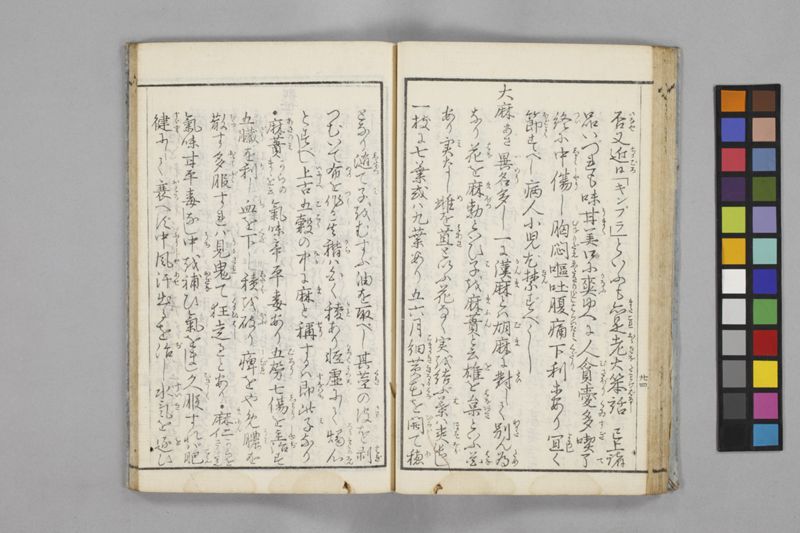
翻刻
【右丁】
否(いなや)又 近日(ちかごろ)「キンプラ」といふも亦(また)是(これ)老大笨話(おゝきなたわけばなし) 已上諸
品いづれも味 甘美(うまく)口に爽(かなふ)ゆへに人 貪愛(むさぼり)多喫了(くゐすぎて)
終(つい)に中傷(しよくしやう)し胸(むね)悶(もだえ)嘔吐(ゑたきもどし)腹痛(はらいたみ)下利(くだり)等あり宜(よろし)く
節(ほどよく)すべし病人小児尤 禁(きん)ずべし
大麻《割書:あさ》異名(いめう)多し一に漢麻(かんま)とは胡麻(ごま)に対(たい)して別(わかた)ん為(ため)
なり花(はな)を麻勃(まぼつ)といひ子(み)を麻蕡(まふん)と云雄(を)を枲(はなあさ)といふ花(はな)
あり実(み)なし雌(め)を苴(みあさ)といふ花なく実を結ぶ葉(は)は夾長(ほそなが)し
一枝に七葉或は九葉あり五六月 細(こまかき)黄花(きなるはな)を開(ひらい)て穂(ほ)
【左丁】
となり随(したがつ)て子(み)をむすぶ油を取べし其 茎(くき)の皮(かわ)を剥(はぎ)
つむいて布(ぬの)を作(つく)る其 稭(から)は白く稜(かど)あり軽(かろく)虚(うつろ)にて燭心(ろうそくのしん)
とすべし上古(いにしへ)五穀(ごこく)の中(なか)に麻(ま)と称(せう)するは即(すなはち)此 子(み)なり
●麻蕡(あさのみ)《割書:からの|まゝを云》気味辛平毒あり五労(ごろう)七 傷(しよう)を主治(しゆぢ)す
五 臓(ざう)を利(り)し血(ち)を下(くだ)し積(しやく)を破(やぶ)り痺(しびれ)をやめ膿(うみ)を
散(ちら)す多服(おゝくぶく)すれば見鬼(うかされ)て狂(くるひ)走(はし)ることあり●麻仁(まにん)《割書:からを|さりたる也》
気味甘平毒なし中(うち)を補(おぎな)ひ気をまし久(ひさしく)服すれば肥(こえ)
健(すぐやか)にして衰(おとろ)へず中風(ぶうじや)汗(あせ)出るを治(ぢ)し水気(すいき)を逐(を)ひ
現代語訳
【右丁】
(前ページからの続き)
…本当のことかどうか。また近頃「キンプラ」というものも出てきたが、これもまた大きなたわけた話である。
以上に挙げた諸品(揚げ物の類)はいずれも味が甘美で口に合うため、人が欲張って食べすぎてしまい、ついには食傷(消化不良)を起こし、胸のもだえ・嘔吐・腹痛・下痢などが生じる。程よく節制すべきである。病人・小児はとくに禁ずべきものである。
---
**大麻(あさ)**
異名が多い。一に「漢麻(かんま)」とも呼ぶが、これは胡麻(ごま)と区別するためである。花を「麻勃(まぼつ)」といい、実を「麻蕡(まふん)」という。雄株を「枲(はなあさ)」といい、花はあるが実を結ばない。雌株を「苴(みあさ)」といい、花はなく実を結ぶ。葉は細長く、一枝に七葉または九葉がある。五月・六月頃に細かい黄色い花を開いて穂と
【左丁】
なり、それに従って実を結ぶ。油を採ることができる。その茎の皮を剥いで紡いで布を作る。その茎の芯は白く、角(かど)があり、軽くて中が空洞であるから、ろうそくの芯として使うことができる。上古(いにしえ)の五穀の中で「麻」と称したのは、すなわちこの実(み)のことである。
●**麻蕡(あさのみ)**〔からのままのもの(殻ごとのもの)をいう〕 気味は辛・平にして毒あり。五労・七傷を主治する。五臓の働きを助け、血を下し、積(しゃく)を破り、しびれを止め、膿を散らす。多量に服用すると、うかされて(幻覚を起こして)狂い走ることがある。
●**麻仁(まにん)**〔殻を取り除いたもの〕 気味は甘・平にして毒なし。内(体の内部)を補い、気を増し、長く服用すれば肥え健やかになって衰えない。中風(卒中)に汗が出るのを治し、水気(むくみ)を追い出し、
英語訳
**[Right Page]**
*(Continuing from the previous page)*
…whether it is actually true or not. And recently, something called "*Kinpura*" (キンプラ) has also appeared — this too is nothing more than a great piece of nonsense.
All of the aforementioned foods (fried things of various kinds) have a delicious, sweet flavor that pleases the palate, and so people tend to crave them and overeat, ultimately suffering from food injury (*shokushō* / 食傷 — indigestion or dietary overindulgence), leading to chest distress, nausea and vomiting, abdominal pain, diarrhea, and similar complaints. One should consume them in proper moderation. They are especially to be forbidden for the sick and for young children.
---
**Hemp (*Asa* / 大麻)**
It has many alternative names. One name, "*Kanma*" (漢麻 / Chinese hemp), is used to distinguish it from sesame (*goma* / 胡麻). Its flowers are called "*mabotsu*" (麻勃), and its seeds are called "*mafun*" (麻蕡). The male plant is called "*hana-asa*" (枲), which produces flowers but no fruit. The female plant is called "*mi-asa*" (苴), which produces no flowers but bears fruit. The leaves are narrow and long; each branch bears seven or nine leaves. In the fifth and sixth months, small yellow flowers bloom and form spikes,
**[Left Page]**
which subsequently bear seeds. Oil can be extracted from these seeds. The bark of the stem is peeled off and spun to make cloth. The stalk's core is white, angular, lightweight, and hollow, making it suitable for use as candle wicks. In ancient times (*jōko* / 上古), the "hemp" (*ma* / 麻) referred to among the Five Grains (*gokoku* / 五穀) was precisely these seeds.
● ***Mafun* (麻蕡 / hemp seeds in the husk)** *(referring to the seeds with the husk still on)* — Its flavor and nature are acrid (*shin* / 辛) and balanced (*hei* / 平), with toxicity. It is the primary treatment for the Five Fatigues (*gorō* / 五労) and Seven Injuries (*shichishō* / 七傷). It promotes the function of the five viscera (*gozō* / 五臓), moves blood downward, breaks up accumulations (*shaku* / 積), relieves numbness, and disperses pus. If taken in large quantities, it may cause one to become delirious (experiencing hallucinations) and run about in a frenzied state.
● ***Manin* (麻仁 / hemp seed kernels)** *(referring to the seeds with the husk removed)* — Its flavor and nature are sweet (*kan* / 甘) and balanced (*hei* / 平), with no toxicity. It nourishes the interior of the body, increases vital energy (*ki* / 気), and if taken over a long period, one becomes well-nourished and vigorous without decline. It treats excessive sweating associated with *chūfū* (中風 / stroke or wind-stroke), expels water-*ki* (*suiki* / 水気 — edema or pathological dampness),