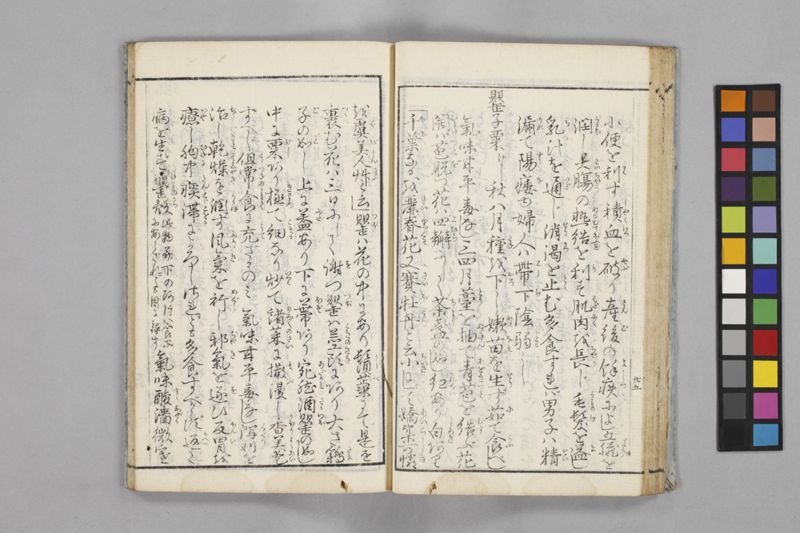
翻刻
【ここに注記を書きます】
小便を利(り)す積(しやく)血(けつ)を破(やぶ)り産後(さんご)の余疾(よしつ)によし五 臓(ざう)を
潤(うるほ)し大腸(たいちやう)の熱(ねつ)結(むすぼふれ)を利(り)す肌肉(はだにく)を長(ちやう)じ毛髪(かみのけ)を益(ま)し
乳汁(ちゝ)を通(いだ)じ【ママ】消渇(せうかつ)を止(とゝ)む多食すれば男子は精(せい)
漏(もれ)て陽(やう)痿(な)ゆ婦人は帯下(こしけ)陰 弱(よわ)し
罌子粟《割書:けし》秋八月 種(たね)を下(おろ)し嫩苗(わかなえ)を生(せう)ず茹(に)て食(くふ)べし
気味甘平毒なし三四月 薹(とう)を抽(ぬきん)で青苞(あをきつと)を結(むす)ぶ花
開(ひらけ)ば苞(つと)脱(を)つ花は四弁(よひら)にして茶盞(ちよく)の如し紅(くれない)あり白(しろき)あり
「千葉(や☐)#1なるを麗春花(れいしゆんくわ)又 賽牡丹(さいぼたん)と云 小(ちいさ)にして嬌柔可憐(あいらしき)
【左丁】
を虞美人草(ぐびじんさふ)と云」罌(つぼ)は花の中にあり鬚蘂(しべ)#2にて是を
裹(つゝ)む花は三日にして謝(を)つ罌(つぼ)は茎頭(くきのさき)にあり大さ鶏(たま)
子(ご)の如(ごと)し上に葢(ふた)あり下に蒂(ほぞ)あり宛然(あだかも)酒罌(さかつほ)の如し
中に粟(けし)あり極(きわめ)て細(こまか)なり炒(いり)て諸菜(もろ〳〵のさい)に撒漫(まぶ)し香美(かほりよく)愛(あい)
すべし但(たゞ)常食(つねのしょく)に充(みて)ざるのみ 気味甘平毒なし瀉利(くだり)を
治(ぢ)し乾燥(かわきはしやぎ)を潤(うるほ)す風気(ふうき)を行(めぐら)し邪気(ぢやき)を逐(を)ひ反胃(ほんい)を
療(いや)し胸中(むねに)痰(たん)滞(とゞこをる)によろしされども多食すべからず返(かへつ)て
病を生ず●罌殻(けしのから)《割書:此物幷下のあ行は食品|にあらざれども因に録す》気味 酸(すく)濇(しぶく)微寒
現代語訳
**(前ページからの続き:麻仁)**
小便の出をよくし、積(しゃく)・血(けつ)を破り、産後の余病によく、五臓を潤し、大腸の熱による閉結(便秘)を通じ、肌肉を育て、毛髪を増やし、乳汁の出をよくし、消渇(口の渇き・糖尿病様の病)を止める。ただし多食すれば、男子は精が漏れて陽痿(勃起不全)となり、婦人は帯下(こしけ)が生じ、陰部が弱くなる。
---
**芥子(けし)**〔罌子粟〕
秋の八月に種を播き、若い苗を育てる。これを茹でて食べるとよい。気味は甘・平にして毒なし。三月・四月頃に薹(とう)が立ち、青い苞(つぼみ)を結ぶ。花が開くと苞は落ちる。花は四弁で、茶碗(ちょく)のような形をしている。紅いものもあれば白いものもある。花びらが多く重なるものを「麗春花(れいしゅんか)」または「賽牡丹(さいぼたん)」といい、小さくて愛らしいものを
【左丁】
「虞美人草(ぐびじんそう)」という。壺(罌)は花の中にあり、しべによって包まれている。花は三日で散る。壺(実)は茎の先端にあり、大きさは鶏卵ほどである。上に蓋があり、下に蒂(へた)があり、まるで酒壺のような形をしている。中に芥子(けし)の粒があり、極めて細かい。炒って様々な料理に振りかけると、香りよく美味しく、愛すべき食材である。ただし主食の代わりになるものではない。気味は甘・平にして毒なし。下痢を治し、乾燥(渇き・はしゃぎ)を潤す。風気を巡らせ、邪気を追い出し、反胃(嘔吐・逆流)を癒し、胸に痰が滞るのによい。しかしながら多食してはならず、かえって病を生じる。
●**罌殻(けしのから)**〔この品ならびに以下の「あ行」の項目は食品ではないが、参考のために記録する〕 気味は酸(すっぱく)・渋く・微寒にして
英語訳
***(Continuing from the previous page: Manin / hemp seed kernels)***
It promotes urination, breaks up accumulations (*shaku* / 積) and blood stagnation (*ketsu* / 血), and is beneficial for residual ailments after childbirth. It moistens the five viscera, relieves heat-induced binding in the large intestine (constipation), promotes the growth of skin and flesh, increases hair growth, promotes the flow of breast milk, and stops *shōkatsu* (消渇 / intense thirst and wasting — akin to diabetes). However, if eaten in excess, men may suffer from seminal leakage and impotence (*yōi* / 陽痿), while women may develop vaginal discharge (*koshike* / 帯下) and weakness of the female reproductive organs.
---
**Poppy (*Keshi* / 罌子粟)**
Seeds are sown in the eighth month of autumn, and young seedlings are grown. These may be boiled and eaten. Their flavor and nature are sweet (*kan* / 甘) and balanced (*hei* / 平), with no toxicity. In the third and fourth months, a flowering stalk (*tō* / 薹) shoots up and forms green buds. When the flower opens, the bud casing falls away. The flower has four petals and resembles a tea cup (*choku* / 茶盞). Some are crimson and some are white. Those with many layers of petals are called "*Reishunka*" (麗春花 / Beautiful Spring Flower) or "*Saibotan*" (賽牡丹 / Pseudo-Peony), and the small, delicate, and charming varieties are called
**[Left Page]**
"*Gubijinsō*" (虞美人草 / The Grass of Lady Yu — the Oriental poppy). The seed pod (*tsubo* / 罌) is found within the flower, enveloped by the stamens and pistils. The flower falls after three days. The pod sits atop the stem and is roughly the size of a hen's egg. It has a lid on top and a calyx base at the bottom, resembling in every way a sake jar (*sakatsubo* / 酒罌). Inside are poppy seeds, which are extremely fine. When toasted and sprinkled over various dishes, they are fragrant, delicious, and altogether pleasing. However, they cannot serve as a staple food. Their flavor and nature are sweet (*kan* / 甘) and balanced (*hei* / 平), with no toxicity. They treat diarrhea, moisten dryness and parching, circulate *fūki* (風気 / wind-*ki*), expel pathogenic *jaki* (邪気 / evil *ki*), cure *hon'i* (反胃 / retching, acid reflux, or counterflow of stomach *ki*), and are good for phlegm stagnation in the chest. Nevertheless, one must not eat them in excess, as doing so will on the contrary give rise to illness.
● ***Keishino Kara* (罌殻 / poppy seed shells/husks)** *(This item, along with the entries under the "a" syllabary section below, are not food products per se, but are recorded here for reference.)* — Their flavor and nature are sour (*suku* / 酸), astringent (*shibu* / 渋), and slightly cold (*bikan* / 微寒)…