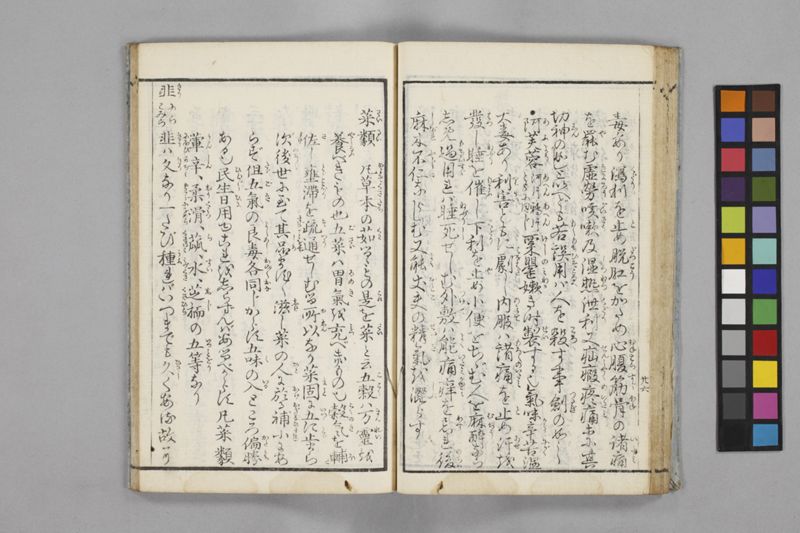
翻刻
【右丁】
毒あり瀉利(くだり)を止(と)め脱肛(だつこう)をかため心(むね)腹(はら)筋(すじ)骨(ほね)の諸痛(いたみ)
を罷(や)む虚労(きよろう)咳嗽(がいさう)及 湿熱(しつねつ)泄利(くだり)又 疝瘕(せんしやくの)疼痛(いたみ)等に其
功 神(しん)の如しといへども若(もし)誤用(もちひそこなへ)ば人を殺(ころ)す事 剣(つるぎ)の如し
●阿芙蓉(あふよう)《割書:阿片(あへん)鴉片(あへん)|ともに同じ》粟罌(けしのみ)嫩(わか)き時 製(せい)する也気味 辛(からく)苦(にがく)温
大毒あり利害(りがい)ともに劇(はなはだ)し内服(のみて)は諸痛(もろ〳〵のいたみ)を止(と)め汗(あせ)を
発(はつ)し睡(ねぶり)を催(もよふ)し下利(くだり)を止(や)め小便をちゞむ人を麻酔(むちう)なら
しめ過用(もちひすぐ)れば睡死(ねぶりし)せしむ外敷(つけて)は能(よく)痛(いたみ)痒(かゆみ)を忘(わす)れ後(のちは)
麻木(しびれ)不仁(ふじ▢)#1ならしむ又 能(よく)丈夫(おとこ)の精気(せいき)を澀(しぶ)らす
【左丁】
菜類(さいるい) 凡(およそ)草本(くさたち)の茹(くわ)るもの是(これ)を菜(さい)と云 五穀(ここく)は万霊(まんれい)を
養(やしなふ)べきもの也 五菜(ごさい)は胃気(ゐのき)を充(みつ)べきもの也 穀気(こくき)を《振り仮名:輔|ほ| た》
《振り仮名:佐|さ|すけ 》し壅滞(とゞこほり)を《振り仮名:疎通|そつう|すじとをす》せしむる所以(ゆゑん)なり菜 固(まこと)に五(いつゝ)に止(とゞ)まら
ず後(のち〳〵)世に至て其 品(しな)ます〳〵滋(しけ)し菜の人(ひと)に於(おけ)る補(おぎなひ)小(すこし)にあ
らず但(たゞ)五気(ごき)の良毒(よしあし)各(おの〳〵)同(おな)じからす五 味(み)の入(いる)ところ偏勝(かたかち)
ある也 民生(ひと〴〵)日(ひに)用ゆこれをしらずんばあるべからす凡菜類
《振り仮名:葷辛|くんしん|にほひ からみ 》、《振り仮名:柔滑|じうくわつ|やわらになめら 》、《振り仮名:蓏|ら|くさのみ 》、《振り仮名:水|すい|みづくさ 》、《振り仮名:芝栭|しじ|くさひら》の五等(いつとをり)なり
韭(きう)《割書:にら|こみら》韭(きう)は久(きう)なり一たび種(うふ)ればいつまでも久(ひさし)くある故に
現代語訳
**(前ページからの続き:罌殻/けしのから)**
毒あり。下痢を止め、脱肛を引き締め、胸・腹・筋・骨のさまざまな痛みを癒す。虚労(体の消耗による疲弊)・咳嗽(せき)、および湿熱による下痢、また疝瘕(せんしゃく)の疼痛などに対しては、その効き目は神のようだといえども、もし誤って用いれば、人を殺すこと剣のごとし。
●**阿芙蓉(あふよう)**〔阿片(あへん)・鴉片(あへん)ともに同じ〕 芥子(けし)の実が若い時に製する。気味は辛(からく)・苦(にがく)・温にして大毒あり。利害ともに甚だしい。内服すれば諸々の痛みを止め、汗を発し、眠りを催し、下痢を止め、小便を縮める。人を麻酔(意識朦朧)の状態にし、過用すれば眠ったまま死に至らしめる。外に塗れば、よく痛みや痒みを忘れさせるが、その後は麻木(しびれ)・不仁(感覚麻痺)の状態にする。また、男性の精気を渋らせる(抑制する)。
---
**菜類(さいるい)**
およそ草本(くさたち)にして茹でて食べられるものを「菜(さい)」という。五穀は万物の霊(人)を養うべきものであり、五菜は胃気を充たすべきものである。穀気を補い助け、滞りを疏通(すじとおし)させるゆえんである。菜は実に五種に止まらず、後世に至って、その品はますます多くなった。菜が人に対してもたらす補益は、決して小さくない。ただし、五気の良し悪しはそれぞれ同じではなく、五味の入るところには偏りがある。人々が日々用いるものとして、これを知らなければならない。およそ菜類は、葷辛(にほひ・からみ)、柔滑(やわら・なめら)、蓏(くさのみ)、水(みづくさ)、芝栭(くさひら)の五等(いつとおり)に分けられる。
---
**韭(きう)**〔にら・こみら〕
「韭(きう)」は「久(きう)」なり。一度種を播けば、いつまでも久しくあり続けることから、
英語訳
***(Continuing from the previous page: Keshi no Kara / Poppy Seed Shells)***
It is toxic. It stops diarrhea, tightens prolapsed rectum (*dakkō* / 脱肛), and alleviates various pains in the chest, abdomen, muscles, and bones. For conditions such as *kyorō* (虚労 / consumptive exhaustion), coughing, diarrhea due to damp-heat, and the pains of *senshaku* (疝瘕 / hernial and abdominal masses with pain), its efficacy is said to be godlike — and yet, if misused, it can kill a person as surely as a sword.
● ***Afuyō* (阿芙蓉 / Opium)** *(the terms "Ahen" [阿片] and "Ahen" [鴉片] refer to the same thing)* — This is prepared from the poppy (*keshi*) plant while the fruit is still young. Its flavor and nature are acrid (*kara* / 辛), bitter (*niga* / 苦), and warm (*on* / 温), with great toxicity. Both its benefits and its harms are extreme. Taken internally, it stops all manner of pain, induces sweating, brings on sleep, stops diarrhea, and reduces urination. It renders a person insensible (anaesthetized), and if used excessively, causes one to die in one's sleep. Applied externally, it effectively causes one to forget pain and itching, but thereafter induces numbness (*maboku* / 麻木) and loss of sensation (*fujin* / 不仁). It also suppresses and restrains the vital essence (*seiki* / 精気) of men.
---
**Vegetables (*Sairui* / 菜類)**
All herbaceous plants that can be cooked and eaten are called *sai* (菜 / vegetables). The five grains (*gokoku* / 五穀) are that which nourishes all living beings, while the five vegetables (*gosai* / 五菜) are that which replenishes the stomach *ki* (*i no ki* / 胃気). This is the reason they supplement and assist the *ki* of grains, and promote the free flow through any stagnation and obstruction. Vegetables are certainly not limited to five kinds; as the ages have progressed, their varieties have grown ever more numerous. The nourishing benefit that vegetables offer to people is by no means small. However, the quality — whether beneficial or harmful — of the five *ki* (五気) is not the same for each, and where the five flavors (五味) enter the body, there are imbalances and predominances. As things that people use daily, one must not remain ignorant of this. Vegetables in general are divided into five categories: *kunshinn* (葷辛 / pungent and acrid), *jūkatsu* (柔滑 / soft and smooth), *ra* (蓏 / fruits of herbaceous plants), *sui* (水 / aquatic plants), and *shiji* (芝栭 / mushrooms and fungi).
---
***Kiu* (韭) — Garlic Chives (*nira* / にら; also called *komira* / こみら)**
The character 韭 (*kiu*) carries the meaning of 久 (*kiu* / "long-lasting"). Since once the seeds are sown, the plant continues to grow for a very long time, it is called…
*(Entry continues on the next page.)*