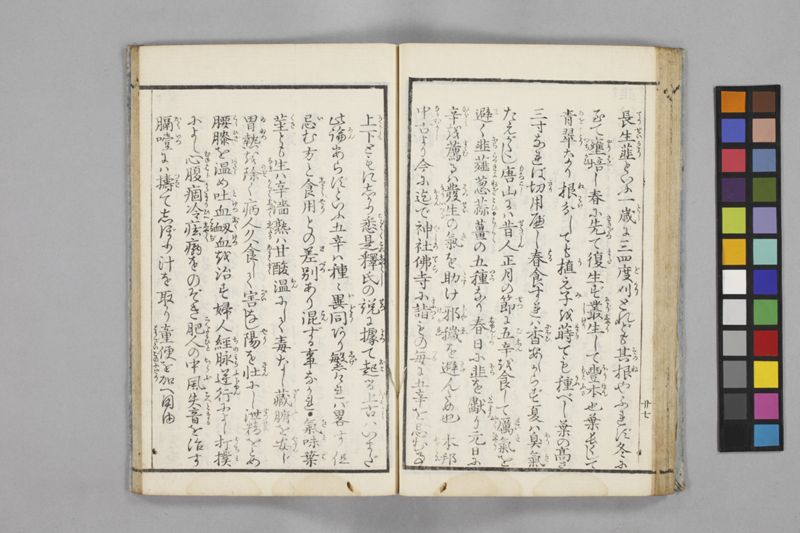
翻刻
【右丁】
長生韭(てうせいきう)といふ一 歳(とし)に三四 度(ど)刈(かり)とれども其根(そのね)やふれず冬に
至て《振り仮名:壅培|やうばい|つちかひ 》し春に先(さきだつ)て復(また)生ず《振り仮名:叢生|そうしやう|しけり 》して《振り仮名:豊本|ほうはん|もとふさ 》也葉長くして
青翠(あをみどり)なり根分(ねわけ)しても植(う)え子(み)を蒔(まき)ても種(うふ)べし葉の高さ
三寸なれば切(きり)用べし春(はる)食すれは香(にほひ)あしからず夏は臭気(しうき)
たえがたし唐山(もろこし)には昔人(せきしん)正月の節(せつ)に五辛(ごしん)を食して《振り仮名:厲気|れいき|やくひやう 》を
避(さ)く韭(にら)薤(らつきよ)葱(ねぎ)蒜(こひる)薑(はじかみ)の五 種(いろ)なり春日(じゆんじつ)に韭(にら)を献(たてまつ)り元日に
辛(からみ)を薦(すゝむ)るは《振り仮名:発生|はつせい|なりいつる 》 の気(き)を助(たす)け《振り仮名:邪穢|じやゑ|けがれ 》を避(さけ)んため也 《振り仮名:本邦| |わがくに 》
中古(なかむかし)より今に迄(およん)で神社(やしろ)仏寺(てら)に詣(まふつる)もの毎(つね)に五辛を忌む事
【左丁】
上下(かみしも)ともにしかり悉(こと〳〵く)是(これ)釈氏(しやくし)の説(せつ)に拠(よつ)て起(おこ)る上古(おゝむかし)はいまだ
此 論(ろん)あらずといふ五辛は種々 異同(いどう)あり繁(しげ)ければ略す但
忌(い)む方と食用(しよくやう)との差別(さべつ)あり混(こん)ずる事なかれ●気味(きみ)葉(は)
茎(くき)とも《振り仮名:生| |なま 》は《振り仮名:辛| |からく 》《振り仮名:濇| |しぶく 》《振り仮名:熟| |にへたる 》は《振り仮名:甘| |あまく 》《振り仮名:酸| |すく 》温(おん)にして毒なし蔵腑(ざうふ)を安(やすん)じ
胃熱(ゐねつ)を除(のぞ)く病人久食して害(がい)なし陽(やう)を壮(さかん)にし泄精(せつせい)をとめ
腰(こし)膝(ひざ)を温(あたゝ)め吐血(とけつ)《振り仮名:衄血|じくけつ|はなぢ 》を治す婦人 経脈(ちのみち)逆行(ふじゆん)によし打撲(うちみ)
によし心(むね)腹(はら)痼(かたまり)冷(ひへ)痃(しやく)癖をのぞき肥人(こへたるひと)の中風(ちうぶ)失音(こへとまる)を治す
膈噎(かくいつ)には擣(つき)てしぼり汁を取り《振り仮名:童 便| |とうざいごの小やう 》を加へ用ゆ
現代語訳
**(前ページからの続き:韭/にら)**
「長生韭(ちょうせいきゅう)」という。一年に三・四度刈り取っても、その根は傷まず、冬になると土を培って養い、春に先立ってまた芽を出す。株が茂って、根元がふさふさと豊かである。葉は長くして青々としている。株分けして植えることもでき、種を蒔いて育てることもできる。葉の高さが三寸(約9cm)ほどになれば切って使うとよい。春に食べれば香りも悪くないが、夏は臭気に耐えがたい。
中国では昔、正月の節に五辛(ごしん)を食して疫病(やくびょう)を避けたという。韭(にら)・薤(らっきょう)・葱(ねぎ)・蒜(こひる/ひとえびる)・薑(はじかみ/しょうが)の五種である。春の日に韭を捧げ、元日に辛みのものを勧めるのは、発生の気を助け、邪穢(けがれ)を避けるためである。
わが国では中古(平安時代中頃)以来今に至るまで、神社・仏寺に参詣する者は常に五辛を忌む。
**(左丁)**
これは上下(身分の貴賤)を問わずすべてそうであり、いずれも釈氏(仏教)の説に拠って起こったことである。上古(大昔)にはまだこの論はなかったという。五辛については種々の異同(説の違い)があり、煩雑なので略す。ただし、忌む場合と食用にする場合とには区別があり、混同してはならない。
●**気味(性質・味)** 葉も茎もともに、生では辛(から)く渋(しぶ)く、熟(煮え)たものは甘(あま)く酸(す)く、温にして毒なし。臓腑を安定させ、胃熱(胃の熱邪)を除く。病人が長く食しても害がない。陽気を盛んにし、精の漏れ(泄精)を止め、腰・膝を温め、吐血・鼻血(衄血)を治す。婦人の経脈(月経)が逆行する(月経不順・逆上)に良く、打撲傷にも良い。胸・腹の痼(かたまり)・冷え・痃癖(しゃくへき)を除き、肥えた人の中風(ちゅうぶ)・失音(声がとまる)を治す。
膈噎(かくいつ/食べ物が喉や食道につかえる症状)には、にらを搗いて絞り汁を取り、童便(わらべの小水)を加えて用いる。
英語訳
***(Continuing from the previous page: Kiu / Garlic Chives [韭 / にら])***
It is called *chōsei-kiu* (長生韭 / "long-living chives"). Even if cut three or four times a year, the roots remain undamaged; when winter comes, they are nurtured with earthing-up, and the plant sprouts again ahead of spring. The clumps grow thickly, and the bases are lush and full. The leaves are long and a vivid green. The plant can be propagated by dividing the clumps or by sowing seed. When the leaves have grown to about three *sun* (approximately 9 cm) in height, they may be cut and used. Eaten in spring, the fragrance is quite pleasant, but in summer the smell becomes difficult to bear.
In China, it was the custom since ancient times to eat the *goshin* (五辛 / Five Pungents) at the New Year's festival in order to ward off epidemic disease (*yakubyō*). The five kinds are: garlic chives (*nira* / 韭), Chinese shallots (*rakkyo* / 薤), green onion (*negi* / 葱), small garlic (*kohiru* / 蒜), and ginger (*hajikamu* / 薑). Offering garlic chives on the first spring day and presenting pungent foods on New Year's Day was done in order to assist the *ki* of generation and new growth, and to ward off impurity and evil (*jae* / 邪穢).
In our country, from the middle ages (roughly the mid-Heian period) down to the present day, those who visit Shinto shrines and Buddhist temples have always abstained from the Five Pungents.
***(Left page)***
This practice holds true across all social ranks without exception, and all of it arose based on the teachings of the Buddha (*Shakushi* / 釈氏 / the Śākya). It is said that in the most ancient times, there was not yet this doctrine. There are various differences of opinion regarding what constitutes the Five Pungents, and as it is a complex matter, we shall omit a full discussion here. However, one must be aware that there is a distinction between abstaining from these for ritual purposes and using them as food, and the two must not be confused.
● **Flavor and Nature (*kimi* / 気味):** Whether leaf or stem, when raw, the taste is acrid (*kara* / 辛) and astringent (*shibu* / 濇); when cooked, it becomes sweet (*ama* / 甘) and sour (*su* / 酸). It is warm in nature and non-toxic. It settles the viscera (*zōfu* / 蔵腑), and removes heat from the stomach (*i no netsu* / 胃熱). Even if consumed over a long period by sick persons, it causes no harm. It invigorates the *yō* (陽 / yang) energy, arrests seminal leakage (*setsusei* / 泄精), warms the lower back and knees, and treats spitting of blood (*toketsu* / 吐血) and nosebleeds (*jikuketsu* / 衄血). It is beneficial for women whose menstrual flow runs contrary (*gyakkō* / 逆行 / irregular or counterflowing), and is also good for contusions and bruises. It removes hardened accumulations (*kata* / 痼), cold (*hie* / 冷), and *shaku-heki* (痃癖 / flank masses and abdominal obstruction) in the chest and abdomen, and treats stroke (*chūbu* / 中風) with loss of voice (*shitsuon* / 失音) in obese persons.
For *kakuitsu* (膈噎 / obstruction of the esophagus or diaphragm; difficulty in swallowing), pound the chives and extract the juice, then add *dōben* (童便 / urine of a young boy) and administer.